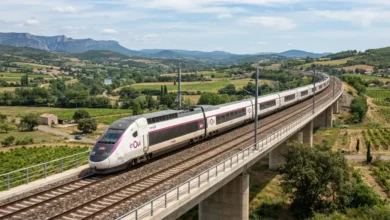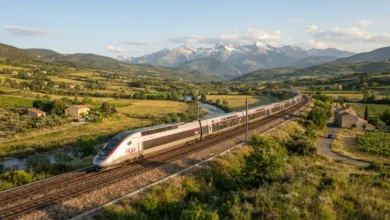
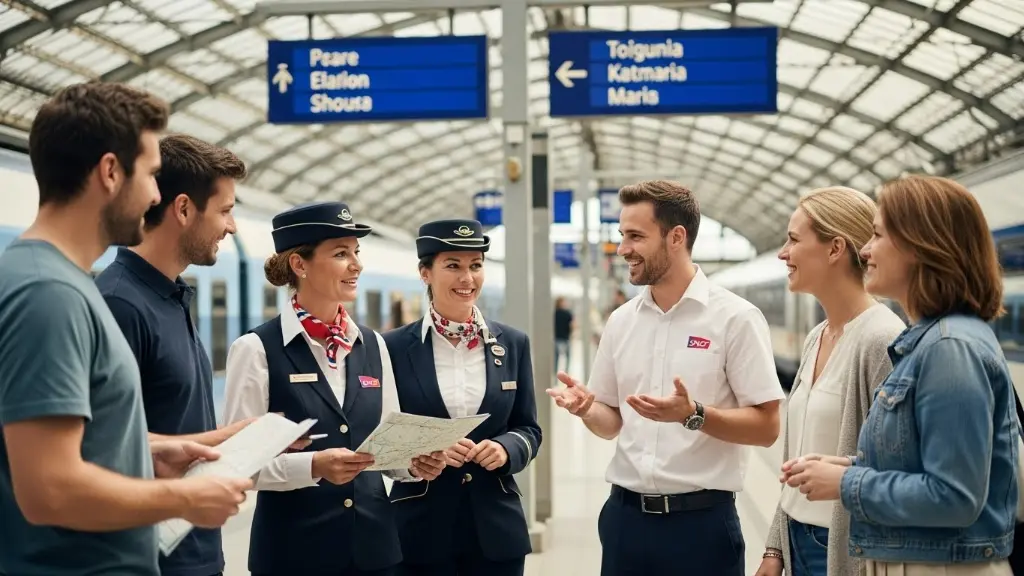
You are sitting on a train in rural France. The scenery is beautiful, but your heart starts beating a little faster. You hear the door slide open. The conductor is coming down the aisle, checking tickets.
He stops at your seat and says something rapid-fire in French. You freeze.
Is he asking for your ticket? Is he telling you you’re in the wrong seat? Is the train about to explode?
The language barrier is one of the biggest sources of anxiety for American travelers in Europe. We often feel embarrassed that we only speak one language, while Europeans seem to speak five.
So, the big question: Can you get by with just English on European trains?
The answer is yes, but the experience changes drastically depending on which country you are visiting. Here is the geography of language on the rails.
Zone 1: The “No Problem” Countries
(Germany, Austria, The Netherlands, Scandinavia, Switzerland)
If you are traveling through Northern or Central Europe, you can breathe easy. The level of English proficiency here is staggering.
- The Situation: In countries like the Netherlands, Sweden, or Germany, almost every train conductor speaks fluent English. In fact, their English is often better than some native speakers!
- The Experience: If you have a question about a connection or a delay, you can ask freely. Announcements on major long-distance trains (like the German ICE or Austrian Railjet) are almost always repeated in English after the local language.
Zone 2: The “So-So” Countries
(France, Italy, Spain, Portugal)
In Southern Europe, things get a little more mixed. While English is the international language of tourism, it isn’t guaranteed that every railway employee speaks it fluently.
- The Situation: Younger staff usually speak decent English. Older conductors, who have been working the rails for 30 years, might only speak the local language.
- The Experience:
- In France (SNCF): The French have a reputation for being strict about their language, but they are generally helpful to tourists if you are polite. Start with a “Bonjour” before switching to English.
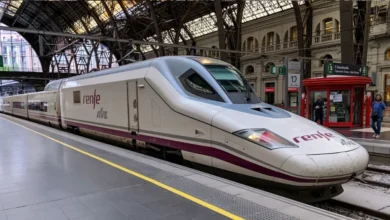
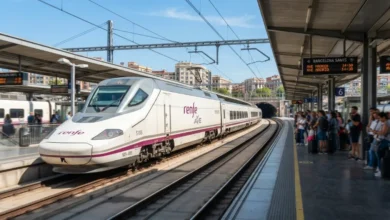
- In Italy (Trenitalia) & Spain (Renfe): Major high-speed lines (between Rome/Milan or Madrid/Barcelona) usually have English-speaking crews. On slower, regional trains in the countryside, you might need to rely on hand gestures.
Zone 3: Eastern Europe
(Poland, Czech Republic, Hungary, Romania)
This is a transitional area. In capital cities and on international trains, English is common. However, on older domestic trains, the older staff might speak German or Russian as a second language, rather than English. Don’t worry—they are used to confused tourists and are usually patient.
Your Survival Kit: 4 Words You Must Learn
Even if you don’t speak the language, learning just four words related to train travel can save you from a panic attack.
You don’t need to learn how to order a 3-course meal. You just need to recognize these words when you see them on a sign or hear them over the loudspeaker.
1. Platform
- French: Quai
- German: Gleis
- Italian: Binario
- Spanish: Vía
2. Seat
- French: Place
- German: Sitzplatz
- Italian: Posto
- Spanish: Asiento
3. Carriage / Car
- French: Voiture
- German: Wagen
- Italian: Carrozza
- Spanish: Coche
4. Delay (The most important one!)
- French: Retard
- German: Verspätung
- Italian: Ritardo
- Spanish: Retraso
If you hear the word “Retard” or “Ritardo” over the loudspeaker followed by a number (like “10” or “20”), you know the train is running late. You don’t need to understand the rest of the sentence to get the gist!
The Ultimate Cheat Code: Google Translate
If you get into a complicated situation—like a cancelled train or a dispute about a seat reservation—technology is your best friend.
Download the Google Translate App before you leave the US.
Crucial Tip: Download the “Offline Language Pack” for the countries you are visiting. Cell service can be spotty in tunnels or rural areas.
How to use it:
- Conversation Mode: You can speak into your phone in English, and it will speak out loud in Italian (or French/German) to the conductor. They can speak back, and it translates for you. It feels like science fiction, but it works.
- Camera Mode: Point your camera at a confusing sign or a paper ticket, and the app will translate the text in real-time on your screen.
The “Universal Language” of Tickets
Here is the best news: The QR Code is universal.
These days, 90% of ticket checks involve you showing a QR code on your phone and the conductor scanning it silently. No conversation is required.
If there is a problem, a smile, a shrug, and showing your destination on your map app usually solves everything. European conductors see thousands of tourists a year; they are experts at non-verbal communication.
Summary
Don’t let the language barrier stop you from exploring. In the North, you’ll chat in English. In the South, you’ll get by with a smile, a “Bonjour,” and your Google Translate app.
The train tracks speak the same language everywhere! 🗣️🚆