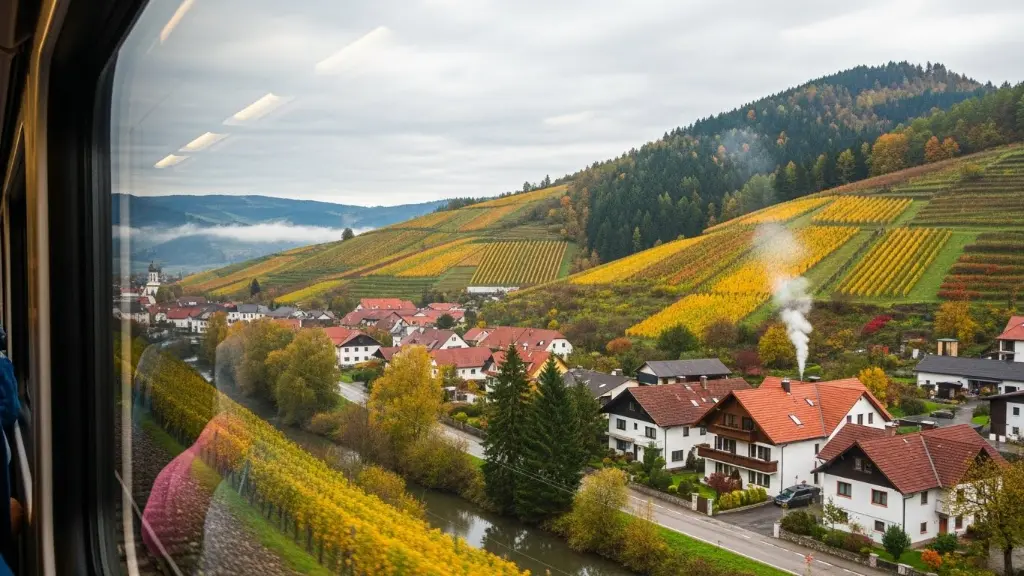
It was declared impossible. Then one man built it anyway.
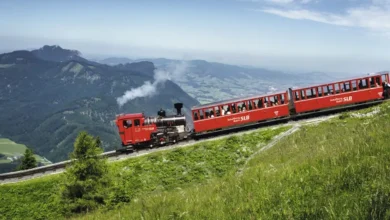
The Semmering Railway (Semmeringbahn) was the world’s first mountain railway built for standard-gauge trains. Completed in 1854, it climbs over the Semmering Pass through the Austrian Alps using 16 viaducts, 15 tunnels, and over 100 curved stone bridges — all without a single cogwheel.
In 1998, UNESCO recognized the Semmeringbahn as a World Heritage Site. Not for its scenery alone, but for changing what humanity believed was possible.
And the best part? You can ride it today on a regular Austrian train for under €30.
Here is the story of the railway that made mountains conquerable.
The History: “It Cannot Be Done”
In the 1840s, the Austrian Empire needed a railway connecting Vienna to Trieste — its only seaport. But one massive obstacle stood in the way: the Alps.
The Semmering Pass rises to 985 meters. Engineers said a railway over it was impossible. Locomotives of the era were too weak. Gradients too steep. Curves too tight.
Enter Carl Ritter von Ghega — a Venetian-born engineer with a radical vision.
Instead of fighting the mountain, Ghega designed a railway that danced with it. He used:
- Tight curves that wrapped around hillsides
- Massive viaducts that leaped across valleys
- Tunnels that punched through rock when curves were not enough
- A maximum gradient of 2.5% — steep, but manageable for steam locomotives
Over 20,000 workers — many of them Italian stonemasons — labored for six years. Working conditions were brutal. Hundreds died from accidents, disease, and avalanches.
On July 17, 1854, the Semmering Railway opened. It was an instant sensation — proof that railways could go anywhere.
Ghega became a national hero. His face appeared on the Austrian 20 Schilling banknote for decades. And his railway still runs today, virtually unchanged, 170 years later.
The Journey: Riding Through History
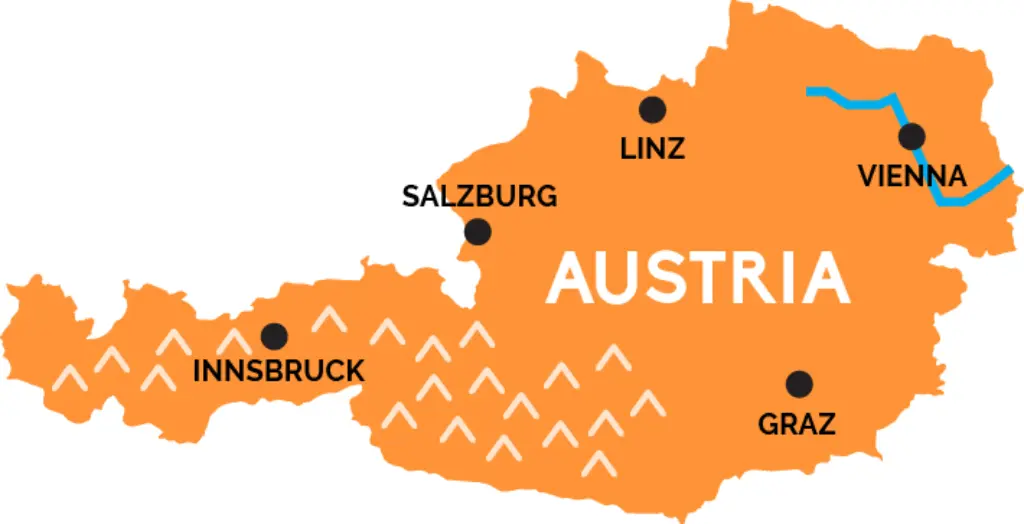
The historic Semmering section runs from Gloggnitz to Mürzzuschlag — 41 kilometers of continuous engineering brilliance.
However, most travelers experience it as part of the longer Vienna to Graz route, which includes the Semmering crossing.
Vienna → Gloggnitz
- Duration: About 1 hour
- What You See: The train leaves Vienna and heads south through the flat Wiener Becken (Vienna Basin). Vineyards, small towns, and the foothills of the Alps begin to appear.
- The Vibe: Pleasant but ordinary. Save your camera battery — the spectacle is coming.
Gloggnitz → Semmering Summit
- Duration: About 30 minutes
- What You See: This is where the magic begins.
- The Climb: The train immediately starts ascending, twisting along the mountainside.
- Viaducts: You cross the famous stone viaducts, including the iconic Schwarza Viaduct and the Kalte Rinne Viaduct — a double-decker two-story bridge that is one of the most photographed railway structures in the world.
- Tunnels: The train ducks in and out of short tunnels, each one revealing a new perspective on the valley below.
- Highlight: The Polleroswand Curve — a dramatic horseshoe turn carved into the cliff face. You can see the track you just traveled on below you.
- Pro Tip: Sit on the LEFT side of the train when traveling south (Vienna → Graz) for the best viaduct and valley views.
Semmering Station (Summit)
- Elevation: 896 meters
- What You See: The elegant Semmering station, surrounded by grand 19th-century hotels. This was once the summer retreat of Viennese aristocracy.
- Highlight: The station building itself — a beautiful piece of railway architecture.
- Optional Stop: Get off here to explore the historic resort village and hike the Semmering Railway Trail (more on this below).
Semmering → Mürzzuschlag
- Duration: About 15 minutes
- What You See: The train descends into Styria, passing through the final tunnels and viaducts.
- Highlight: The descent is just as dramatic as the climb. Watch for the Weinzettelwand Tunnel and the views back toward the Semmering peaks.
- Arrival: Mürzzuschlag marks the end of the UNESCO-listed section.
Mürzzuschlag → Graz
- Duration: About 1.5 hours
- What You See: The Mürz Valley — green, wide, and industrial. The scenery calms down after the Semmering drama.
- Highlight: The approach to Graz, with views of Schlossberg (the castle hill) as you arrive.
The Viaducts: Stars of the Show
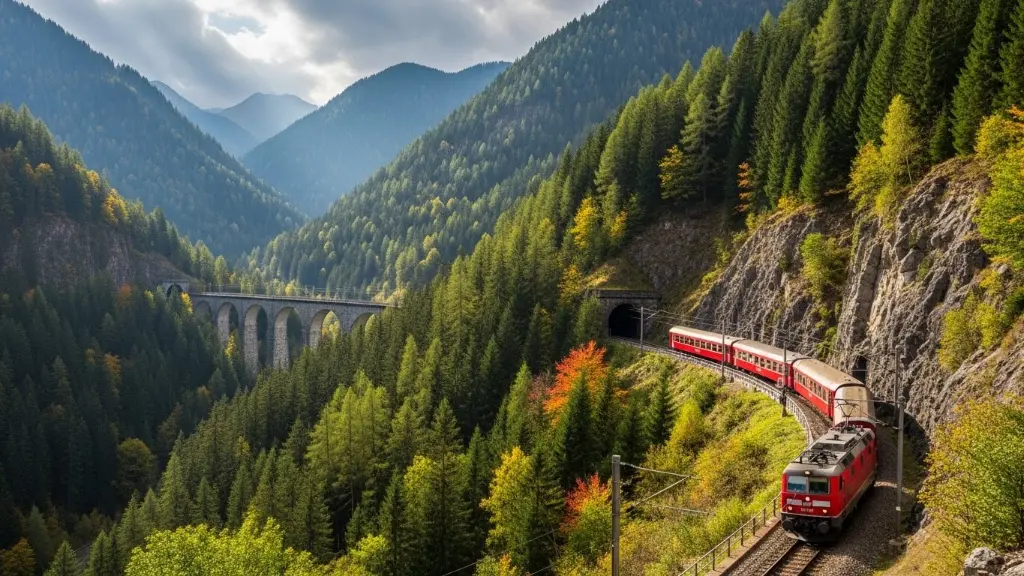
The viaducts of the Semmering Railway are not just engineering — they are art.
| Viaduct | Length | Height | Special Feature |
|---|---|---|---|
| Schwarza Viaduct | 228m | 25m | The first major viaduct; elegant stone arches |
| Kalte Rinne Viaduct | 184m | 46m | Two-story double viaduct — the most famous |
| Krausel-Klause Viaduct | 95m | 36m | Curved stone arches over a deep gorge |
| Gamperl Viaduct | 111m | 38m | Hidden gem, often overlooked |
| Payerbach Viaduct | 60m | 20m | Visible from the valley floor |
These structures are over 170 years old and still carry modern trains at full speed. Ghega built them to last.
What Makes It Special?
| Feature | Details |
|---|---|
| UNESCO World Heritage | The first railway to receive this honor (1998) |
| Engineering Pioneer | The world’s first standard-gauge mountain railway |
| No Cogwheel | Climbs 460 meters using only adhesion (friction) |
| 16 Viaducts | Massive stone bridges spanning Alpine valleys |
| 15 Tunnels | Carved through solid rock with 1850s technology |
| Over 100 Bridges | Smaller structures and curved stone arches |
| Still in Service | Part of the regular Austrian rail network — not a museum |
| Virtually Unchanged | The original 1854 route is still used today |
The Price (Absurdly Good Value)
You are riding a UNESCO World Heritage Site — and it costs less than a fancy coffee in Vienna.
Vienna → Graz (Full Route)
| Class | Advance Price | On-the-Day Price |
|---|---|---|
| Second Class | €15 – €30 | €40 – €55 |
| First Class | €25 – €50 | €65 – €90 |
Vienna → Semmering (If Stopping at the Summit)
| Class | Approximate Price |
|---|---|
| Second Class | €18 – €25 |
| First Class | €30 – €40 |
Rail Pass Discounts
| Pass | What You Get |
|---|---|
| Eurail / Interrail Global Pass | Fully included. No reservation required for regional trains. Railjet reservation optional (€3). |
| ÖBB Vorteilscard | 50% off all Austrian train tickets. Costs €66/year — pays for itself quickly. |
| ÖBB Sparschiene | Advance discount tickets. Book 2-3 weeks ahead for the best prices. |
Pro Tip: Book on the ÖBB website for the cheapest fares. Select “Sparschiene” tickets when available.
Is It Worth It?
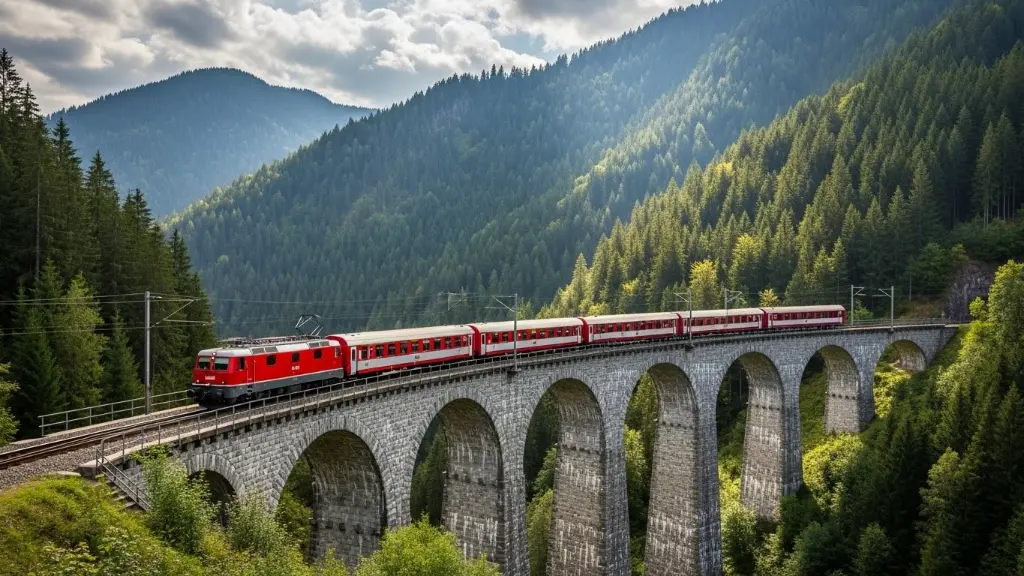
ABSOLUTELY YES, if:
- You love railway history. This is where mountain railways began.
- You appreciate engineering. The viaducts are as impressive today as they were in 1854.
- You are traveling between Vienna and Graz anyway. This is the standard route — you will cross the Semmering automatically.
- You want a UNESCO experience without crowds. This is not a tourist train — just regular Austrian rail service.
- You enjoy hiking. The Semmering Railway Trail offers incredible views of the line from outside.
MAYBE NOT, if:
- You expect Swiss-style panoramic windows. These are regular Austrian trains with normal (but large) windows.
- You want high-altitude drama. The summit is under 1,000 meters — no glaciers or eternal snow.
- You dislike tunnels. You will pass through 15 of them — some travelers find the constant light changes annoying.
- The weather is terrible. Fog and rain hide the views and the viaducts.
The Best Seat Strategy
| Direction | Best Side | Why |
|---|---|---|
| Vienna → Graz (southbound) | LEFT | Best views of the major viaducts and the valley below |
| Graz → Vienna (northbound) | RIGHT | Same views in reverse |
Pro Tip: On Railjet trains, first class offers 2+1 seating (more space, better window access). In second class, try to grab a window seat in a less crowded car.
Important: The windows on modern Railjet trains are large but can have a slight tint. For photography, older regional trains (REX) have windows that open — but they are slower.
Train Options: Railjet vs. Regional
Two types of trains cross the Semmering:
| Train Type | Duration (Vienna-Graz) | Pros | Cons |
|---|---|---|---|
| Railjet | 2.5 hours | Fast, modern, comfortable, dining car | Windows do not open, slight tint |
| REX (Regional Express) | 3+ hours | Windows open, more stops, cheaper | Slower, less comfortable |
My Recommendation: Take the Railjet for comfort. If you are a photographer, consider the REX on the Gloggnitz → Mürzzuschlag section for better photos.
Best Time to Ride
| Season | Experience |
|---|---|
| Spring (April-May) | Green hillsides, blooming meadows, waterfalls at full flow |
| Summer (June-August) | Best weather, longest days, ideal for hiking the trail |
| Autumn (September-October) | Golden forests, misty valleys, dramatic lighting |
| Winter (November-March) | Snow-covered viaducts — magical but check weather conditions |
Pro Tip: Autumn mornings often bring mist that settles in the valleys while the viaducts rise above — incredibly photogenic.
What to Do at Each End
In Vienna
- Schönbrunn Palace: The Habsburg summer residence — one of Europe’s grandest palaces.
- St. Stephen’s Cathedral: Gothic masterpiece in the heart of the city.
- Coffee House Culture: Café Central, Café Sacher — experience the Viennese tradition.
- Belvedere Palace: Home to Klimt’s “The Kiss” and stunning Baroque gardens.
- The Naschmarkt: Vienna’s famous food market — perfect for lunch before your train.
In Graz
- Schlossberg: The castle hill with panoramic views. Take the funicular or climb the 260 steps.
- Kunsthaus Graz: The “Friendly Alien” — a futuristic blue blob of a museum.
- Altstadt (Old Town): UNESCO-listed. Red rooftops, Renaissance courtyards, Baroque facades.
- Murinsel: A floating steel island in the Mur River — café, amphitheater, and urban art.
- Eggenberg Palace: Baroque palace with peacocks roaming the gardens.
In Semmering (If You Stop)
- Historic Grand Hotels: The Panhans and Südbahnhotel are legendary 19th-century resorts (the Südbahnhotel is currently being restored).
- Semmering Railway Trail: Hike alongside the tracks and photograph the viaducts from below (see below).
- Mountain Hiking: Trails lead to surrounding peaks like the Hirschenkogel (1,340m) with panoramic views.
- Semmering Ski Resort: In winter, a small but charming ski area operates near the summit.
The Semmering Railway Hiking Trail (Bahnwanderweg)
For the ultimate Semmering experience, get off the train and walk alongside it.
The Bahnwanderweg Semmering is a 21-kilometer hiking trail that follows the railway from Semmering station to Payerbach-Reichenau. It offers views you cannot get from inside the train:
- Standing beneath the Kalte Rinne Viaduct as a train passes overhead
- Photographing the curved viaducts from the valley floor
- Exploring abandoned tunnels and railway workers’ huts
- Seeing the engineering up close — the stonework, the drainage systems, the retaining walls
| Trail Details | Information |
|---|---|
| Length | 21 km |
| Duration | 6-8 hours (full trail) |
| Difficulty | Moderate (mostly downhill if starting from Semmering) |
| Best Direction | Semmering → Payerbach (downhill) |
| Train Connection | Return by train from Payerbach to Vienna or back to Semmering |
Pro Tip: You can do shorter sections. The Semmering → Breitenstein segment (about 2 hours) includes the most famous viaducts.
Combine It With…
The Semmering Railway is perfectly positioned for longer Austrian adventures.
Vienna → Semmering → Graz Day Trip
- Morning Railjet from Vienna to Semmering (1.5 hours)
- Hike the Bahnwanderweg or explore the resort village (3-4 hours)
- Afternoon train to Graz (1 hour)
- Evening in Graz — dinner, Schlossberg views, stay overnight or return to Vienna
The Southern Railway Classic (Südbahn)
Follow the original 1854 route from Vienna toward the Adriatic:
- Vienna → Semmering → Graz (Semmering Railway)
- Graz → Maribor, Slovenia (1 hour)
- Maribor → Ljubljana (1.5 hours)
- Ljubljana → Trieste, Italy (direct bus or train via Divača)
This was the route that built empires — now yours for a few train tickets.
Vienna → Graz → Zagreb
- Vienna → Graz (Semmering Railway, 2.5 hours)
- Graz → Zagreb, Croatia (3.5 hours)
A perfect two-country Central European loop.
The Austrian Alps Loop
- Vienna → Semmering → Graz (Semmering Railway)
- Graz → Bruck an der Mur → Salzburg (through the Alps)
- Salzburg → Vienna (fast Railjet via Linz)
Experience two very different Alpine railway routes in one trip.
Practical Tips
Which Trains Cross the Semmering?
- Railjet: Vienna → Graz (every 1-2 hours). Modern, fast, comfortable.
- Railjet: Vienna → Villach / Klagenfurt (some services). Also crosses the Semmering.
- REX (Regional Express): Slower, more stops, but windows open.
Seat Reservations
- Not Required: For most Railjet trains, reservations are optional.
- Recommended: On busy travel days (Friday evenings, Sunday evenings, holidays).
- Cost: €3 for a reserved seat if booking through ÖBB.
Best Departure Time for Light
- Southbound (Vienna → Graz): Morning light (before noon) illuminates the viaducts beautifully.
- Northbound (Graz → Vienna): Late afternoon light creates dramatic shadows.
Food on Board
- Railjet: Dining car with coffee, snacks, meals, and Austrian beer/wine.
- REX: No dining car. Bring your own provisions.
Photography Tips
- The train moves quickly — use a fast shutter speed.
- Sit close to the window to minimize reflections.
- The Kalte Rinne Viaduct is on the LEFT side going south — be ready.
- Burst mode helps capture fleeting views.
The Future: The Semmering Base Tunnel
A new Semmering Base Tunnel (27.3 km) is currently under construction. Expected to open around 2030, it will allow high-speed trains to pass under the mountain rather than over it.
What does this mean for the Semmering Railway?
- The historic line will remain open for regional traffic and tourism.
- High-speed trains will bypass the scenic route.
- If you want to experience the classic Semmering crossing, ride it now — or specifically choose a regional train in the future.
The UNESCO-protected viaducts are not going anywhere. But the experience of crossing the Semmering on an intercity train may become rarer.
Alternative: The Mariazellerbahn
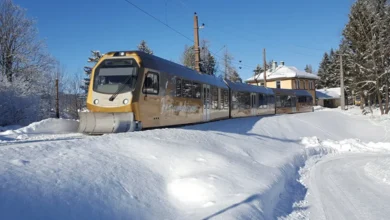
If you love historic Austrian mountain railways, consider the Mariazellerbahn — a narrow-gauge railway from St. Pölten to Mariazell.
- Length: 84 km
- Special Feature: Narrow gauge, climbs into the Alps, panoramic “Himmelstreppe” (Sky Staircase) trains available
- Highlight: The pilgrimage town of Mariazell
The Mariazellerbahn is more touristy (with dedicated panoramic cars), while the Semmering is a working mainline railway. Both are worth experiencing.
Summary
The Semmering Railway is more than a train ride. It is a journey through the history of human ambition.
When Carl Ritter von Ghega looked at the Austrian Alps in the 1840s, everyone said a railway across them was impossible. He built it anyway — with stone, iron, and the labor of 20,000 workers.
170 years later, you can sit in a comfortable seat, sip Austrian coffee, and watch those same viaducts pass by your window. The trains are modern, but the route is unchanged. The stone arches that seemed miraculous in 1854 still carry passengers over the Alps today.
For under €30, you ride a UNESCO World Heritage Site. No special tickets. No reservations required. Just show up at Vienna Central Station and get on.
That is the real miracle of the Semmering Railway — it is not a museum piece. It is still alive.
Ready to ride? Book your tickets on the ÖBB website or buy them at the station. Railjet trains run every 1-2 hours from Vienna Hauptbahnhof to Graz. No reservation needed — just hop on and watch history roll by.