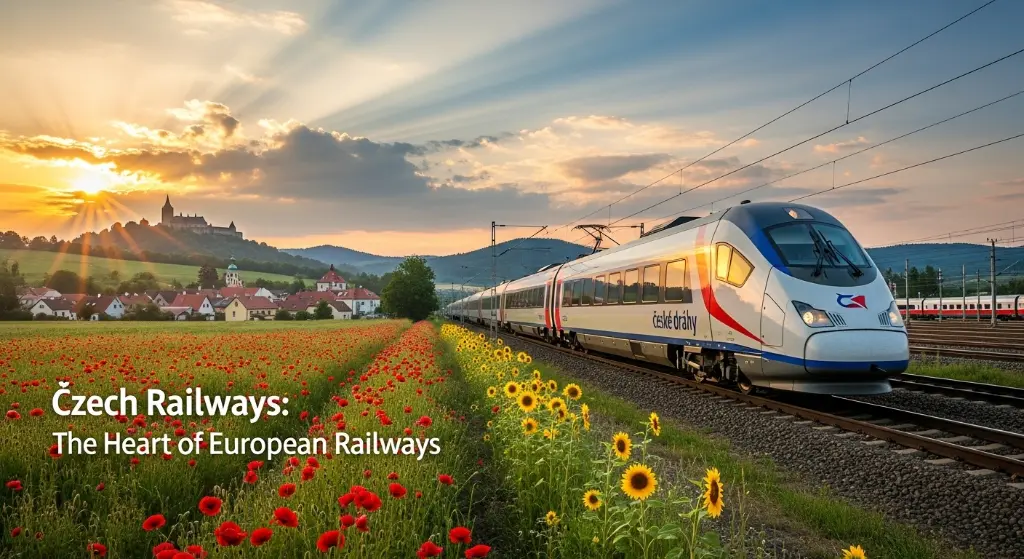
It is the country with the densest railway network in the world — where every village seems to have a station and the beer in the dining car is cheaper than water at the airport.
The Czech Republic (Czechia) is a rail traveler’s paradise. While it may not have 300 km/h bullet trains like France, it offers a frequency and reliability of service that is the envy of larger nations. From the gothic majesty of Prague to the industrial soul of Ostrava and the vineyards of Moravia, the train is the undisputed king of Czech transport.
With three major competing operators driving prices down and quality up, and a landscape dotted with historic branch lines, Czechia offers a unique blend of modern comfort and nostalgic charm.
Czech Republic by Train: The Overview
| Fact | Details |
|---|---|
| Total Network | ~9,500 km (One of the densest in the world) |
| Main Operator | České dráhy (ČD) — State-owned |
| Major Private Competitors | RegioJet, Leo Express |
| Maximum Speed | 160 km/h (High-speed lines up to 320 km/h planned) |
| International Connections | Germany, Austria, Slovakia, Poland, Hungary |
| Eurail/Interrail | Valid on ČD, RegioJet, and Leo Express (check specific routes) |
The History: An Imperial Legacy
The Czech rail story began under the Austro-Hungarian Empire. The first locomotive-powered line opened in 1839, connecting Vienna to Brno. Because Prague was the industrial heart of the Empire, the rail network was built with intensity, creating a “hub-and-spoke” system centered on the capital.
After the fall of the Iron Curtain, the state railway (České dráhy) underwent a massive modernization. In 2011, the country became a pioneer in European rail by allowing private operators to compete on the main Prague-Ostrava line. This “competition experiment” was so successful it led to some of the lowest rail fares in Europe and a significant jump in onboard service quality.
The Operators: Competition at Its Best
1. České dráhy (ČD) — The National Carrier
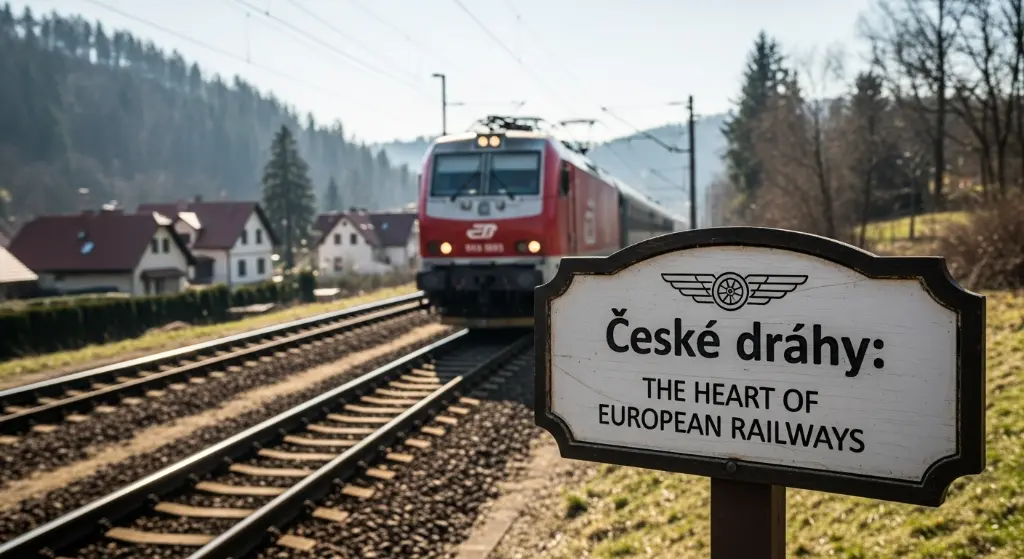
The blue-and-white trains of ČD go everywhere. They operate everything from the premium Pendolino to tiny “wooden” railbuses on rural branch lines.
- Best for: Reaching small towns, regional exploration, and using rail passes.
2. RegioJet — The Yellow Disruptor
RegioJet turned the market upside down with its bright yellow trains and “airline-style” service. They focus on major corridors (Prague to Ostrava, Brno, Vienna, and Budapest).
- Best for: Low prices, free coffee/steward service, and high-speed international links.
3. Leo Express — The Sleek Modernist
Operating black, modern Stadler Flirt trainsets, Leo Express offers a high-tech vibe with great Wi-Fi and premium “Gold” class seats.
- Best for: Business travelers and modern comfort on the Prague-Ostrava-Kraków route.
Train Types: From Pendolino to Local
| Train Category | Name | Description |
|---|---|---|
| SC | SuperCity | The Pendolino. The fastest trains in the country (Prague to Ostrava). Required reservation. |
| rj / EC / IC | Railjet / EuroCity | High-standard international trains. Fast, air-conditioned, with excellent dining cars. |
| Ex / Rx | Express | Fast long-distance trains stopping only in major cities. |
| R | Rychlík | “Fast” trains that serve as the backbone of the inter-regional network. Older but reliable. |
| Sp / Os | Spěšný / Osobní | Regional and local stopping trains. The “Os” stops at every single village. |
The Price: Affordable and Flexible
Czech rail prices are among the lowest in the EU. Unlike many Western countries, “walk-up” prices are still very reasonable.
- Action Prices (Akční jízdenka): Buying 1–2 weeks in advance can save you 50% on long-distance routes.
- Group Discounts: If two or more people travel together, the second and subsequent passengers get a significant discount automatically.
- First Class: On many Czech routes, upgrading to 1st class costs only a few Euros more than 2nd class.
Rail Passes: Are They Worth It?
Eurail and Interrail are fully accepted by ČD. Since 2020, they are also widely accepted by RegioJet and Leo Express on most routes, though you may still need a small seat reservation fee (€1–€5).
Is it worth it?
If you are only traveling within Czechia, point-to-point tickets are often cheaper than the daily cost of a pass. However, if you are using Prague as a base to visit Vienna, Berlin, or Budapest, a pass provides excellent value and flexibility.
Scenic Routes: Hidden Gems
1. The Posázavský Pacifik
A legendary route near Prague that winds through the Sázava River valley. It was built for hikers and campers in the 1920s and offers stunning views of cliffs and deep forests.
2. The Šumava Lines
Narrow-gauge and regional lines through the Šumava National Park (the “Green Heart of Europe”). Expect dense pines, peat bogs, and total silence.
3. The Moldau Valley (Prague to Dresden)
The stretch of track between Ústí nad Labem and the German border follows the Elbe (Labe) river through “Bohemian Switzerland.” The sandstone rock formations are world-famous.
Regional Guide: Major Hubs
- Prague (Praha hl.n.): The grand central hub. An architectural masterpiece with a mix of historical domes and modern terminals.
- Brno (Brno hl.n.): The gateway to Moravian wine country and the fast link to Vienna.
- Ostrava (Ostrava-Svinov / hl.n.): The industrial gateway to Poland and the fastest domestic destination from Prague.
- Břeclav: A tiny town that is a massive international junction where trains from Prague, Warsaw, Berlin, Vienna, and Budapest all meet.
International Connections: The Central European Crossroads
Czechia is perfectly positioned for “rail-tripping” to neighboring capitals:
- To Vienna: Railjets run every hour from Prague (4h) and Brno (1.5h).
- To Budapest: Direct EuroCity “Metropolitan” trains run every 2 hours (approx. 7h).
- To Berlin: The EuroCity “Berliner” connects Prague to Berlin in just over 4 hours.
- To Kraków: Direct Leo Express and RegioJet services connect the two cities (approx. 6h).
Night Trains: Wake Up in a New Capital
The Czech Republic maintains a strong “NightJet” and EuroNight network through ČD’s “Vltava” and “Canopus” services.
- Routes: Prague to Zurich, Prague to Warsaw, and Prague to Budapest.
- Experience: You can choose from seats, 4-6 person couchettes, or private sleeper cabins with showers.
Practical Tips
- Validate? No. Unlike Italy, you do not need to stamp Czech tickets. Just show the QR code to the conductor.
- Dining Cars: Czech dining cars (operated by JLV) are legendary. Look for the “Happy Hour” prices on domestic routes—a draft beer and a hot schnitzel for roughly €10.
- App: Download “Můj vlak” (My Train) by ČD. It is one of the best rail apps in Europe for real-time tracking and easy ticket buying.
- Stations: “Hlavní nádraží” (abbreviated as hl.n.) means Main Station.
Common Mistakes
- Buying from the wrong operator: If you buy a ticket for a ČD train, it is not valid on a yellow RegioJet train. Check the logo on the side of the carriage!
- Not reserving on Fridays/Sundays: Trains between Prague and the rest of the country are packed on weekends. A seat reservation is usually only €1—buy it.
- Assuming English everywhere: While younger staff speak great English, conductors on rural regional trains may only speak Czech. Have your ticket ready on your phone screen.
Summary
The Czech Republic is proof that you don’t need high-speed tracks to have a world-class railway. It is affordable, incredibly frequent, and offers a level of onboard hospitality (especially in the dining cars and private trains) that puts most European airlines to shame.
Ready to explore? Grab a ticket to Brno, order a Budvar in the dining car, and watch the Bohemian castles roll by.