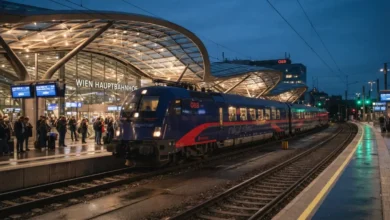
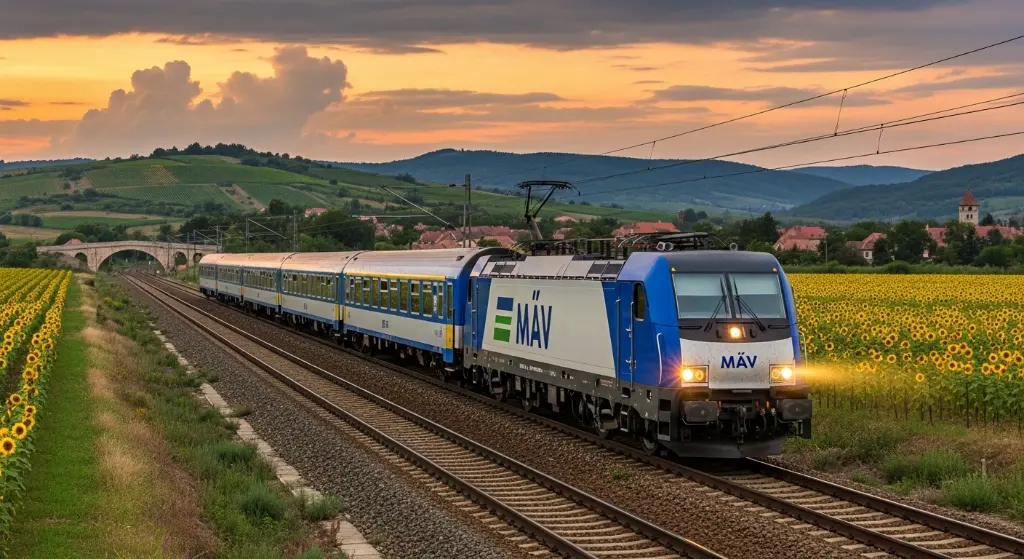
It is the land where the railway stations look like palaces and the trains connect two halves of a fallen empire.
Hungary is the undisputed railway crossroads of Central and Eastern Europe. Its capital, Budapest, serves as the great turntable where the sleek Railjets of the West meet the night trains heading for the Balkans and the Carpathians.
Here, the legacy of the Austro-Hungarian Empire is written in steel. The network is dense, the architecture is grand, and the prices are incredibly low compared to Western Europe. From the shores of Lake Balaton—the “Hungarian Sea”—to the vineyards of Tokaj and the bustling platforms of Budapest Keleti, Hungary offers a rail experience that is steeped in history, occasionally gritty, but always fascinating.
This is your complete guide to exploring Hungary by train.
Hungary by Train: The Overview
| Fact | Details |
|---|---|
| Total Network | ~7,700 km of railway lines |
| Main Operator | MÁV-START (State-owned) |
| Regional Operator | GYSEV / Raaberbahn (Austro-Hungarian joint venture) |
| Private Competitors | RegioJet (International routes) |
| Maximum Speed | 160 km/h (Upgrades ongoing) |
| International Connections | Austria, Slovakia, Ukraine, Romania, Serbia, Croatia, Slovenia |
| Eurail/Interrail | Valid on MÁV and GYSEV |
| Currency | Hungarian Forint (HUF) — NOT the Euro |
Why Train Travel Works in Hungary
- The Hub of Budapest: Almost all main lines radiate from Budapest. If you want to go from one side of the country to the other, you usually pass through the capital, making it an ideal base.
- Affordability: Train travel here is exceptionally cheap. A cross-country ticket often costs less than a lunch in Vienna.
- Architectural Grandeur: Budapest’s stations (Keleti and Nyugati) are architectural masterpieces from the 19th century.
- The “Retor” Charm: While modernization is happening, you can still find classic, locomotive-hauled trains with compartments that feel like traveling back in time.
- Dining Car Culture: MÁV operates one of the last classic dining car services (Utasellátó) where you can get a hot goulash soup and a draft beer for very little money.
The History: The Steam Engine of the Empire
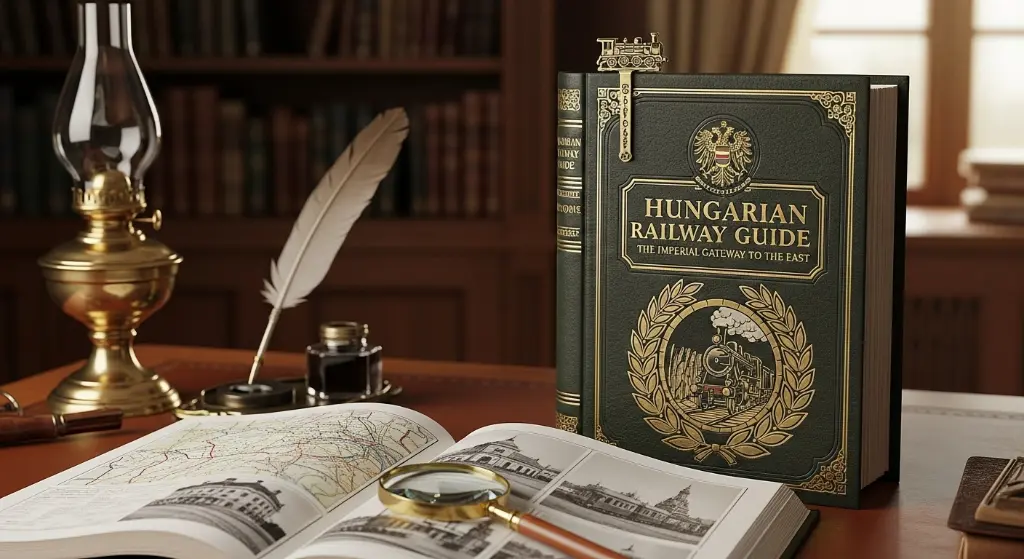
Hungary’s railway history is momentous. The first steam train line opened in 1846 between Pest and Vác. Following the Austro-Hungarian Compromise of 1867, the railway network exploded in size to connect the agricultural Hungarian plains with the industrial markets of Vienna and Bohemia.
Fun Fact: Budapest is home to the Millennium Underground Railway (Metro Line 1). Opened in 1896, it was the first electric subway on the European continent (second in the world only to London). Riding it today feels like stepping into a 19th-century time capsule.
After World War I and the Treaty of Trianon, Hungary lost two-thirds of its territory, leaving its railway network cut in odd places. Today, the network is focused on reintegrating with Western Europe while maintaining its vital role as the transit corridor to the Balkans.
The Operators: Who Runs the Trains?
1. MÁV-START (Magyar Államvasutak)
The state railway company. You will see their signature blue engines and blue-grey carriages everywhere. They run everything from suburban commuter trains to international EuroCity services.
- Reputation: Variable. International and InterCity trains are generally good; regional trains can be old and sometimes delayed.
2. GYSEV / Raaberbahn
This is a unique historical anomaly—a cross-border railway company owned jointly by the Hungarian state, the Austrian state, and a construction company. They operate in Western Hungary (Sopron area) and connect to Austria.
- Reputation: Excellent. Their green-and-yellow trains are modern, clean, and punctual.
3. RegioJet
The Czech private operator runs trains through Hungary on the Prague-Vienna-Budapest route.
- Reputation: Very popular for low fares and high service levels (free coffee, sushi on the menu).
Train Types: A Complete Guide
Hungary has a specific hierarchy of trains. Knowing the difference matters for your comfort and wallet.
International & Premium
Railjet (rjx)
Operated by ÖBB (Austria) and MÁV. These are high-speed (up to 230 km/h in Austria, 160 km/h in Hungary) modern trains connecting Budapest-Vienna-Munich-Zurich.
- Amenities: Wi-Fi, bistro, Business Class.
- Reservation: Optional but highly recommended.
EuroCity (EC)
The standard international train. Locomotive-hauled with open-plan or compartment carriages.
- Key Route: The “Metropolitan” to Prague and Berlin.
Domestic Long-Distance
InterCity (IC)
The backbone of domestic travel. These trains usually connect Budapest with cities like Szeged, Debrecen, Pécs, and Miskolc.
- Composition: Often a mix of very modern “IC+” coaches and older, non-air-conditioned carriages.
- Reservation: Mandatory. You must have a seat reservation to board.
Sebesvonat (Fast Train) & Gyorsvonat (Rapid Train)
Faster than regional trains but slower than ICs. They stop at major towns.
- Quality: Often older rolling stock. Great for budget travelers, less good for those needing AC in summer.
Regional
Személyvonat (Passenger Train)
Stops at every single station. Slow, cheap, and reaches the smallest villages.
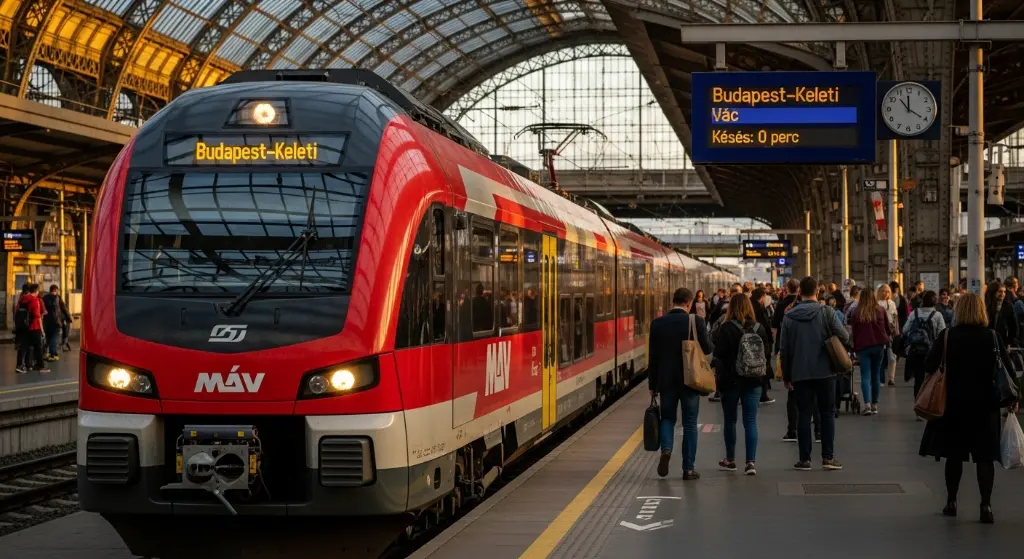
- Modernization: Around Budapest (the “Elővárosi” lines), these are often sleek, red Stadler FLIRT trains (very comfortable). In the countryside, they might be older electric or diesel units.
The Price: Incredible Value
Hungary is one of the cheapest places in Europe to ride trains.
Domestic Pricing
Fares are distance-based.
- Example: A 2.5-hour ride from Budapest to Eger costs roughly 4,000 HUF (~€10).
- Supplements: You pay a small surcharge for InterCity trains (seat reservation).
International Pricing (START Europa)
MÁV offers a discount system called “START Europa” for international trips booked online or via the app.
- Budapest to Vienna: From €13.
- Budapest to Prague: From €20.
Discounts
- Youth (under 26): 33% discount on weekends (Fri 10:00 to Sun 23:59).
- Children: Under 6 travel free; 6–14 travel at 50%.
- Seniors (EU Citizens 65+): Travel FREE on domestic lines (you only pay the rapid train/IC seat reservation supplements). Yes, free.
Rail Passes: Are They Worth It?
Eurail / Interrail Hungary Pass
- Price: ~€60-80 for 3 days.
- Verdict: Rarely worth it for domestic travel because normal tickets are so cheap. You would need to take multiple long InterCity trips a day to break even.
- Global Pass: Good if you are transiting Hungary on a larger European trip, but remember to pay for seat reservations on IC/EC trains.
Scenic Routes: Plains, Lakes, and Hills
Hungary is mostly flat (the Great Hungarian Plain), but there are beautiful exceptions.
1. The Danube Bend (Budapest – Esztergom)
The S72 train line runs from Budapest Nyugati to the historic city of Esztergom. It follows the Danube River as it curves between the Pilis and Börzsöny mountains. The arrival in Esztergom, dominated by its massive basilica, is spectacular.
2. Lake Balaton (The North Shore)
The train line along the northern shore of Lake Balaton (Budapest-Balatonfüred-Tapolca) offers lovely views of the lake and the volcanic Badacsony hills. In summer, vintage diesel locomotives often run on this route for nostalgia.
3. The Children’s Railway (Gyermekvasút)
Unique in the world. Located in the Buda Hills overlooking the capital. It is a real narrow-gauge railway operated almost entirely by children (aged 10-14), under adult supervision. They check tickets, signal trains, and announce departures. It is a serious vocational training program and a charming tourist attraction.
Regional Guide: The Budapest Stations
Budapest does not have one central station; it has three main terminals (fejpályaudvar), forming a triangle.
1. Budapest Keleti (Eastern Station)
- The Grand Dame. Built in 1884, its facade is an eclectic masterpiece with a massive central arch.
- Serves: Most international trains (Vienna, Munich, Zurich, Bucharest, Belgrade) and domestic ICs to the East.
- Vibe: Majestic but chaotic. The surrounding area is gritty.
2. Budapest Nyugati (Western Station)
- The Engineering Marvel. Designed by the Eiffel Company (yes, the Eiffel Tower people). It features a stunning iron-and-glass train shed.
- Serves: Trains to the Danube Bend, Debrecen, Szeged, and Prague/Berlin (via the Metropolitan EC).
- Vibe: Bustling. Connected to a major shopping mall (WestEnd).
3. Budapest Déli (Southern Station)
- The Modernist. A concrete brutalist structure from the 1970s.
- Serves: Trains to Lake Balaton and the southwest (Pécs, Croatia, Slovenia).
- Vibe: Functional and slightly retro.
International Connections: The “Golden Triangle”
Budapest forms one point of the “Imperial Triangle” with Vienna and Prague.
To Austria (Vienna)
- Frequency: Hourly (Railjet and EC).
- Time: 2 hours 40 minutes.
- Note: This is one of the busiest and most reliable routes in Central Europe.
To Slovakia (Bratislava)
- Frequency: Every 2 hours.
- Time: 2 hours 25 minutes.
- Note: Trains usually continue to Prague.
To Romania (Bucharest/Transylvania)
- Routes: Multiple night and day trains connecting Budapest to Arad, Cluj-Napoca, and Bucharest.
- Scenery: The journey through the Carpathian Mountains is stunning.
To Ukraine
- Routes: Direct trains to Mukachevo and Kyiv exist, but check current geopolitical conditions and visa requirements.
Night Trains: The Retro Comfort
MÁV operates a dedicated night train service called Utasellátó. They are known for reviving the classic dining car experience.
- EuroNight “Kálmán Imre”: Budapest to Munich/Zurich.
- EuroNight “Metropol”: Budapest to Berlin/Prague.
- “Adria” InterCity: A seasonal (summer only) night train from Budapest to Split (Croatia). It is often voted one of the best night trains in Europe due to its modern sleeping cars and excellent dining car.
Practical Tips for Travelers
- The MÁV App: Download it. It is called MÁV. You can check schedules, buy tickets, and store them on your phone. It offers a discount compared to buying at the counter.
- Seat Reservations: On InterCity (IC) trains, reservations are mandatory. If you have a rail pass, you must buy a reservation (approx €3) at the station or online.
- Taxis: Never hail a taxi directly outside Keleti or Nyugati stations. You will likely be overcharged. Use an app like Bolt or Főtaxi.
- Validate: On regional trains without seat numbers, you don’t need to validate online tickets. However, if you buy a paper ticket for the Metro or Tram in Budapest (BKK), you MUST validate it in the orange machines.
- Names: Learn the Hungarian names for key cities:
- Vienna = Bécs
- Bratislava = Pozsony
- Prague = Prága
Common Mistakes
- Confusing the stations: Check your ticket carefully! Is it Keleti, Nyugati, or Déli? They are far apart (though connected by Metro).
- Thinking “Gyorsvonat” means fast: It translates to “Rapid Train,” but these are often the older, slower trains without AC. Choose “InterCity” for comfort.
- Throwing away the ticket: Keep it until you exit the station. Some stations have ticket barriers at the exit.
Summary
Hungary offers a railway experience that balances imperial nostalgia with modern efficiency. It is the perfect bridge between the polished networks of the West and the adventurous routes of the Balkans.
Whether you are admiring the ironwork at Nyugati station, eating schnitzel in a dining car speeding across the Great Plain, or taking the slow train to a wine cellar in Tokaj, Hungary offers one of the best price-to-experience ratios in European rail travel.
Ready for the journey? Start at the magnificent Keleti station, look up at the statues of James Watt and George Stephenson on the facade, and board a train into the heart of Europe.