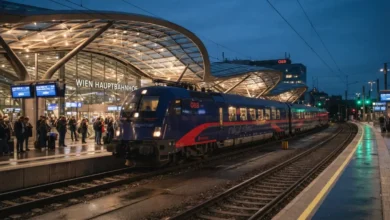
It is the country where the railway hugs the ocean so closely you can almost feel the salt spray on the windows.
Portugal offers one of Europe’s most visually stunning rail experiences. While not as extensive as the networks of France or Germany, the Portuguese system (Comboios de Portugal, or CP) excels where it matters most: connecting the vibrant cities of the coast with speed, style, and scenery.
From the historic Douro Valley line, often voted the most beautiful in the world, to the sleek Alfa Pendular tilting trains racing between Lisbon and Porto, Portugal proves that rail travel doesn’t have to be complicated to be unforgettable.
This is your complete guide to exploring Portugal by train.
Portugal by Train: The Overview
| Fact | Details |
|---|---|
| Total Network | ~2,500 km of railway lines |
| Main Operator | Comboios de Portugal (CP) — State-owned |
| Infrastructure | Infraestruturas de Portugal (IP) |
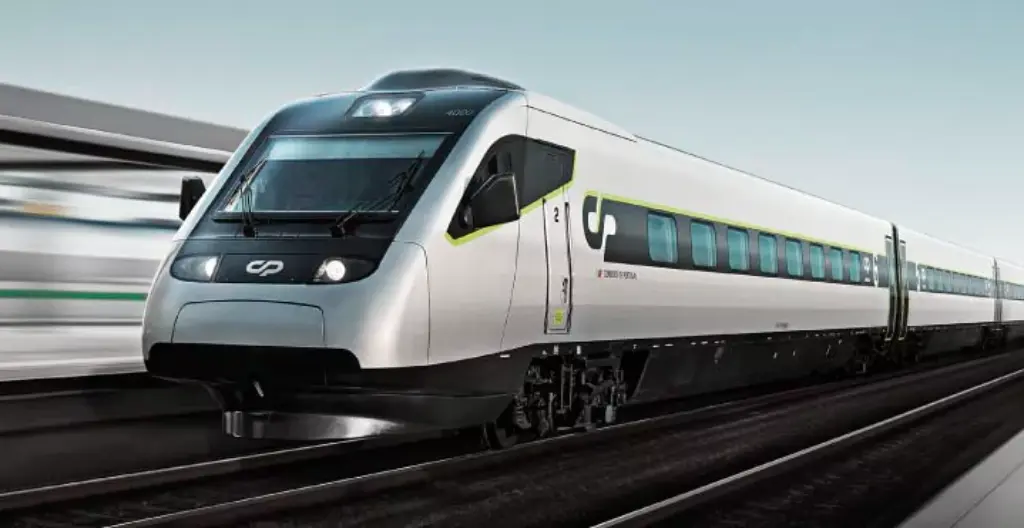
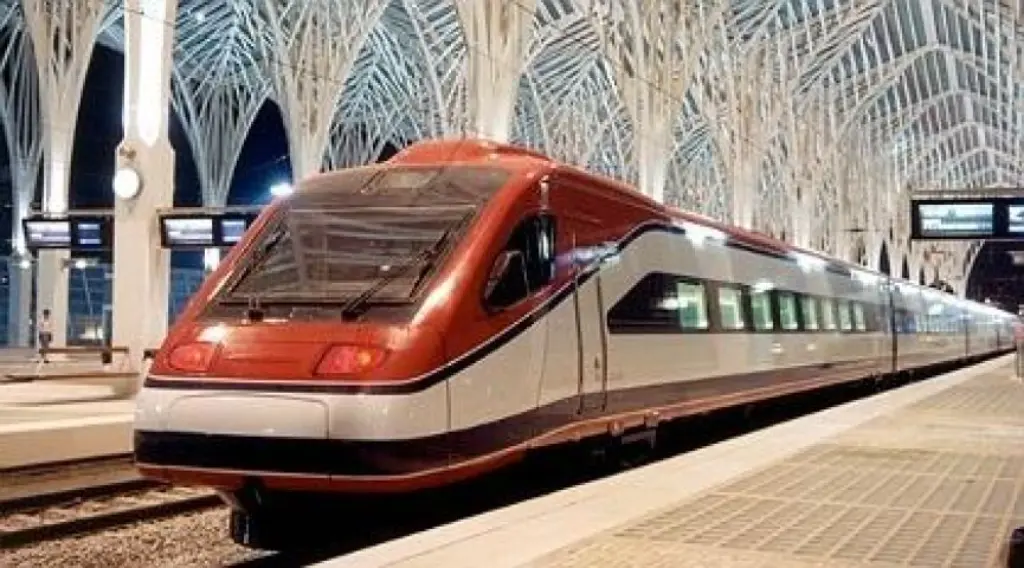
| High-Speed Service | Alfa Pendular (AP) — Tilting trains |
| Maximum Speed | 220 km/h (Alfa Pendular) |
| Private Operator | Fertagus (Lisbon commuter) |
| International Connections | Spain (Vigo, Badajoz) — Limited direct options |
| Eurail/Interrail | Fully valid on CP trains |
| Currency | Euro (€) |
Why Train Travel Works in Portugal
- The North-South Spine: The main line connects nearly every major destination: Braga, Porto, Aveiro, Coimbra, Lisbon, and Faro. It is a simple, linear network perfect for touring.
- Coastal Beauty: Unlike many countries where tracks are inland, Portuguese lines often run right along the beach or riverbanks.
- Historic Stations: São Bento in Porto is famous for its 20,000 azulejo tiles depicting Portuguese history. It is a destination in itself.
- Affordability: Tickets are reasonably priced, and advance discounts are generous.
- The Douro Line: A bucket-list journey for any rail enthusiast or wine lover.
The History: From Royal Trains to High Speed
Portugal’s first railway line opened in 1856, connecting Lisbon to Carregado. King Pedro V inaugurated it, seeing rail as the engine of modernization. The network expanded rapidly, conquering the difficult terrain of the Douro and the mountains of the interior.
In the late 20th century, while many rural lines were sadly closed, Portugal invested heavily in its main corridor. The introduction of the Alfa Pendular in 1999 brought high-speed tilting technology (similar to Italy’s Pendolino) to the winding tracks of the Atlantic coast, slashing travel times without building entirely new lines.
Today, the focus is on modernization and better integration with Spain’s high-speed network, with the “Ferrovia 2020” investment plan aiming to electrify more lines and improve freight capacity.
The Operators: Simplicity Itself
Unlike countries with fractured markets, Portugal keeps it simple.
1. Comboios de Portugal (CP)
The state-owned national operator runs almost everything, from suburban trains to the premium Alfa Pendular.
- Website: cp.pt
- Reputation: Generally reliable, clean, and friendly. Strikes can occasionally disrupt services, so check news before travel.
2. Fertagus
A private operator running the double-decker commuter trains across the massive 25 de Abril Bridge in Lisbon, connecting the capital to Setúbal.
- Website: fertagus.pt
- Best for: Commuting from the south bank or reaching the beaches of Costa da Caparica (via bus connection from Pragal).
3. Metropolitano de Lisboa / Metro do Porto
While not “heavy rail,” the metro systems in Lisbon and Porto are essential for reaching main train stations.
- Lisbon Metro: metrolisboa.pt
- Porto Metro: metrodoporto.pt (Includes light rail to the airport)
Train Types: From Tilting Tech to Regional Charm
Portugal has a clear hierarchy of trains. Choosing the right one can save you hours.
Premium & Long-Distance
Alfa Pendular (AP)
The flagship. These sleek, tilting trains connect the major cities (Braga-Porto-Lisbon-Faro) at speeds up to 220 km/h. Because they tilt, they can take curves faster than regular trains.
- Amenities: Free Wi-Fi, bar car/cafeteria, audio/video channels, power sockets (in 1st class and some 2nd).
- Classes: Conforto (1st Class – spacious 1+2 seating) and Turística (2nd Class – 2+2 seating).
- Reservation: Mandatory.
Intercidades (IC)
The “Intercity” trains. They stop more frequently than the AP and use traditional locomotive-hauled carriages.
- Speed: Up to 200 km/h.
- Vibe: Comfortable, slightly cheaper than AP, great for mid-sized towns like Aveiro or Guimarães. Air-conditioned with a bar service (often vending machines or trolley).
- Reservation: Mandatory.
Regional & Urban
Regional (R) & InterRegional (IR)
The slow trains connecting smaller towns and villages.
- Speed: Slower, more stops.
- Vibe: Basic but functional. No seat reservations—just hop on.
- Key Route: The spectacular Douro Line trains are often Regional or InterRegional services.
Urbano (Urban)
High-frequency commuter networks in Lisbon (Urbano de Lisboa) and Porto (Urbano do Porto).
- Key Route: The famous Cascais Line (Lisbon to Cascais) and the Sintra Line.
- Tickets: Use zone-based tickets (like the Viva Viagem card in Lisbon) or CP passes.
The Price: Book Early, Save Big
Portuguese trains offer excellent value, especially if you plan ahead.
Promo Fares
CP offers “Promo Ticket” discounts if you book 5 or more days in advance (up to 60 days).
- Lisbon to Porto: Can drop to €9.50 (regular price ~€25-32).
- Lisbon to Faro: Can drop to €11 (regular price ~€23-25).
- Availability: Limited seats per train, non-refundable, exchangeable with fees.
Standard Pricing Table (Approximate)
| Route | Train Type | Duration | 2nd Class (Full Price) | 1st Class (Full Price) |
|---|---|---|---|---|
| Lisbon – Porto | Alfa Pendular | 2h 50m | €31.90 | €44.60 |
| Lisbon – Porto | Intercidades | 3h 15m | €25.25 | €37.40 |
| Lisbon – Faro | Alfa Pendular | 3h 00m | €23.70 | €31.70 |
| Lisbon – Sintra | Urban | 40m | €2.40 | N/A |
| Porto – Régua | InterRegional | 2h 10m | €10.85 | N/A |
Discounts
- Youth (under 25): 25% off on all un-discounted tickets. Just show ID.
- Seniors (65+): 50% off. Yes, half price on almost everything. A massive benefit.
- Children: Under 4 free (no seat); 4–12 years 50% off.
- Round Trip: Small discount (~10%) if buying a return ticket.
Rail Passes: Are They Worth It?
Eurail / Interrail Portugal Pass
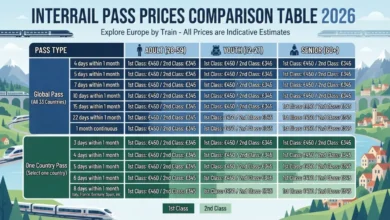
- Price: ~€90-120 for 3-4 days within a month.
- Verdict: Usually NOT worth it for short domestic trips because point-to-point tickets (especially Promo fares) are so cheap.
- Global Pass: Excellent if you are arriving from Spain or touring multiple countries, as cross-border tickets can be expensive or tricky to book.
- Reservations: Mandatory for AP and IC trains. Cost is small (~€5). You generally must make these reservations at ticket counters in Portugal (they are hard to book online from abroad).
Scenic Routes: The Best in Europe?
Portugal’s geography forces trains into spectacular places.
1. The Douro Line (Linha do Douro)
The Champion. Running from Porto (São Bento or Campanhã) to Pocinho, this line hugs the Douro River as it winds through UNESCO-listed vineyard terraces. It is an engineering marvel.
- The Best Part: The section from Régua to Pocinho is pure magic—the train is practically skimming the water, far from any roads.
- Tip: Sit on the right side leaving Porto for the best river views.
2. The Cascais Line (Linha de Cascais)
A commuter line that feels like a holiday. It runs from Lisbon (Cais do Sodré) to the resort town of Cascais, paralleling the wide Tagus estuary and the Atlantic Ocean.
- Stops: Belém (for the tower and pastries) and Estoril (famous for its casino and beaches).
3. The Algarve Line (Linha do Algarve)
A slow, rattling regional train that spans the entire southern coast from Lagos to Vila Real de Santo António (border with Spain). It doesn’t run on the beach, but it connects all the major Algarve towns.
- Vibe: Relaxed, sunny, and filled with surfers and backpackers.
- Connectivity: Connects with the high-speed line at Tunes or Faro.
4. The Beira Baixa Line (Linha da Beira Baixa)
A lesser-known gem running through the interior along the Tejo River.
- Highlight: Views of the Portas de Ródão (giant rock formations narrowing the river).
Regional Guide: Major Hubs
Lisbon (Lisboa)
The capital has a dispersed station system. Know where you are going!
| Station | Serves | Location |
|---|---|---|
| Santa Apolónia | Main terminus for North (Porto) & International. | Edge of Alfama district (Blue Metro). |
| Oriente | Modern hub (Expo ’98). All AP/IC trains stop here. | Near Airport (Red Metro). |
| Rossio | Commuter trains to Sintra. | Historic center (Green Metro). |
| Cais do Sodré | Commuter trains to Cascais. | Riverfront (Green Metro). |
| Entroncamento | Major railway junction (The “Railway City”). | Central Portugal. |
Porto
- Campanhã: The main through-station for fast trains (AP/IC) coming from Lisbon. It is on the edge of town.
- São Bento: The city-center terminus. You must visit this station. Its main hall is covered in 20,000 blue-and-white tiles telling the story of Portugal.
- Note: Most fast trains stop at Campanhã. Your long-distance ticket usually includes a free transfer on a commuter train between Campanhã and São Bento.
International Connections: The Spanish Puzzle
Rail connections between Portugal and Spain are historically poor (“The Iberian Gauge Problem”), but options exist.
The “Celta” (Porto to Vigo)
A comfortable, twice-daily train connecting Porto (Campanhã) with Vigo in Galicia (Spain).
- Time: ~2 hours 20 minutes.
- Booking: Can be booked on cp.pt or Renfe.
- Tip: From Vigo, you can connect to Spain’s high-speed network to Madrid.
Lisbon to Madrid
Currently, there is no direct day train.
- The Route: You must take a Portuguese train to Entroncamento or Badajoz, switch to a Spanish regional train across the border, and then catch a Spanish high-speed train to Madrid. It is an adventure, not a commute.
- Future: High-speed links (Évora-Badajoz line) are under construction to speed this up.
The Sud Express (Lisbon to Hendaye/Paris)
Status: Suspended since the pandemic. Currently, there is no direct night train out of Portugal.
Practical Tips for Travelers
- The CP App: Download it. It allows you to buy tickets (including Promo fares), check schedules, and show e-tickets. It is user-friendly and reliable.
- Link: CP App on Google Play / Apple Store
- Seat Direction: On the Alfa Pendular, you cannot always choose seat direction during booking. If you get motion sickness, be aware that tilting trains can feel unusual if facing backward.
- Validate?
- Long-Distance (AP/IC): No. You have a specific seat reservation. Just show the conductor your ticket.
- Urban/Regional: Yes. If using reusable cards (like the “Viva Viagem” in Lisbon), always tap in at the barriers or yellow validators before boarding.
- Café Cars: The bar cars on AP and IC trains serve decent espresso (café) and snacks (tosta mista – ham and cheese toastie) for very fair prices compared to other European trains.
Common Mistakes
- Confusing Lisbon stations: Check if your train leaves from Santa Apolónia or Oriente. They are 10 minutes apart by train/metro, but missing your station is stressful.
- Missing the Douro: Visiting Porto and not taking the train at least to Pinhão or Régua is a travel crime.
- Thinking you can train to the beach in the Algarve: The Algarve line is often 1-2 km inland from the actual beaches. You usually need a short Uber or bus ride from the station to the sand (except in places like Lagos or Faro).
- Buying international tickets too late: The “Celta” to Vigo can sell out in summer.
Summary
Portugal offers a rail experience that is less about conquering distances and more about enjoying the view. It connects the historic grandeur of Porto and Lisbon with the relaxed vibes of the Algarve and the stunning landscapes of the Douro Valley.
It is affordable, accessible, and—when the sun is setting over the Atlantic as your train glides into Lisbon—utterly magical.
Ready to ride? Start at Porto São Bento, admire the tiles, and board a train along the river of gold.
Useful Links:
- CP Official Website: www.cp.pt
- Infraestruturas de Portugal (Map): www.infraestruturasdeportugal.pt
- Lisbon Metro: www.metrolisboa.pt