For years, flying was considered the fastest way to travel between European cities. But high-speed rail has changed the game. When you compare total journey time — including airport transfers, security checks, and boarding — trains often come out ahead.
Here’s a real-world, route-by-route comparison of train vs plane travel times across Europe.
Paris – Lyon
By Train (TGV): ~2 hours city center to city center
By Plane: 1 hour flight + 1–1.5 hours airport procedures + 30–60 minutes transfers
Winner: Train. Faster overall and significantly less stressful.
Madrid – Barcelona
By Train (AVE): 2.5 hours city center to city center
By Plane: 1 hour 15 min flight + airport time and transfers
Winner: Train. Consistent punctuality and no airport commute.
Rome – Milan
By Train (Frecciarossa): ~3 hours
By Plane: 1 hour 10 min flight + airport logistics
Winner: Train. Comparable flight time, but dramatically faster door-to-door.
Berlin – Munich
By Train (ICE): ~4 hours
By Plane: 1 hour flight + airport procedures
Winner: Train for convenience. Plane may win slightly on pure flight time, but total journey often favors rail.
Amsterdam – Paris
By Train (Thalys/Eurostar): ~3 hours 20 minutes
By Plane: 1 hour 15 min flight + airport transfers
Winner: Train. Central stations eliminate hidden travel time.
London – Paris
By Train (Eurostar): 2 hours 20 minutes
By Plane: 1 hour 15 min flight + airport time
Winner: Train. High-speed rail dominates this corridor.
The Hidden Time Costs of Flying
Flight duration is only part of the equation. Travelers must account for:
- Arrival at airport 1–2 hours before departure
- Security screening
- Baggage claim delays
- Airport-to-city transfers
High-speed trains depart from central stations, allow quick boarding, and often require minimal waiting time.
When Flying Still Makes Sense
Flights remain competitive for distances over 1,000 km or when rail infrastructure is limited. Cross-continental routes and island connections still favor aviation.
Environmental Impact Comparison
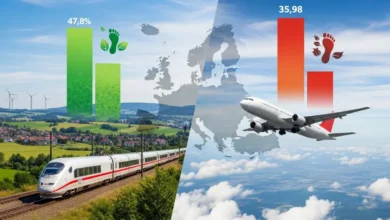
Beyond time savings, trains produce significantly lower carbon emissions than short-haul flights. Choosing rail supports Sustainable Travel in Europe and aligns with Europe’s climate goals.
So What Really Saves Time?
On routes under 800–1,000 km with high-speed infrastructure, trains typically save time door-to-door. On longer routes, planes may still win — but the gap is shrinking as rail networks expand.
Explore how Europe’s fastest rail lines compare in our guide to High-Speed Trains in Europe – The Complete Guide.
The next time you book a trip, don’t just compare ticket prices — compare total journey time.