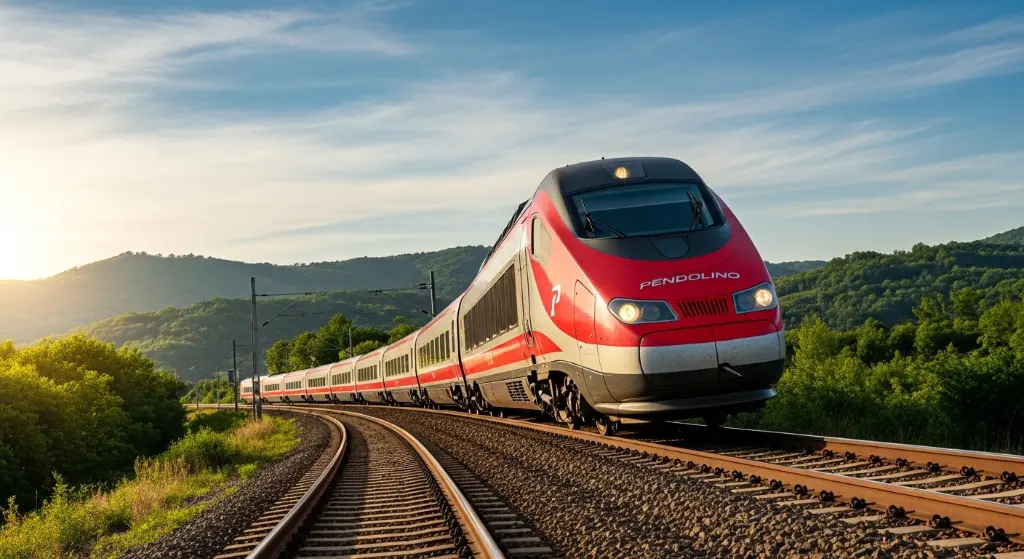
It is the train that taught the world how to lean into a turn.
The Pendolino isn’t just a specific model; it’s a revolutionary technology that saved railways billions of dollars. Instead of building expensive new straight tracks for high-speed trains (like the French TGV or Japanese Shinkansen), engineers asked a simpler question: Why can’t the train just lean like a motorcycle?
By tilting into curves, the Pendolino can travel 20-30% faster on old, twisting tracks without spilling a drop of coffee. From Italy to the UK, from Finland to China, the Pendolino has extended the life of 19th-century railways into the 21st century.
This is the story of the tilting train that conquered the world.
What is a Pendolino?
The name comes from the Italian word pendolo (pendulum). It refers to a family of tilting trains developed originally by Fiat Ferroviaria (now owned by Alstom) in Italy.
The Problem
When a train goes around a curve fast, centrifugal force pushes passengers to the outside. It’s uncomfortable, coffee spills, and luggage falls. To fix this, you have to slow down.
The Solution
The Pendolino uses hydraulic cylinders to physically tilt the carriage body by up to 8 degrees. This counteracts the centrifugal force.
- Result: Passengers feel like they are upright, even though the train is leaning.
- Benefit: The train can take curves much faster than conventional trains.
The Models: A Global Family
The Pendolino family has evolved over decades. Here are the most famous versions you might ride today.
1. The Pioneer: ETR 450 (Italy)
- Launch: 1988
- Status: Retired.
- Legacy: The first active tilting train. It cut the Rome-Milan journey from 5 hours to under 4 hours, proving the technology worked.
2. The Icon: ETR 470 / Class 390 (Italy, Switzerland, UK)
This is the classic “Fiat” look.
- United Kingdom (Avanti West Coast): The Class 390 Pendolino is the backbone of the West Coast Main Line (London to Manchester/Glasgow). It revolutionized UK rail travel, slashing journey times on a very curvy Victorian track.
- Italy/Switzerland (Cisalpino): Used for years to cross the winding Alpine routes.
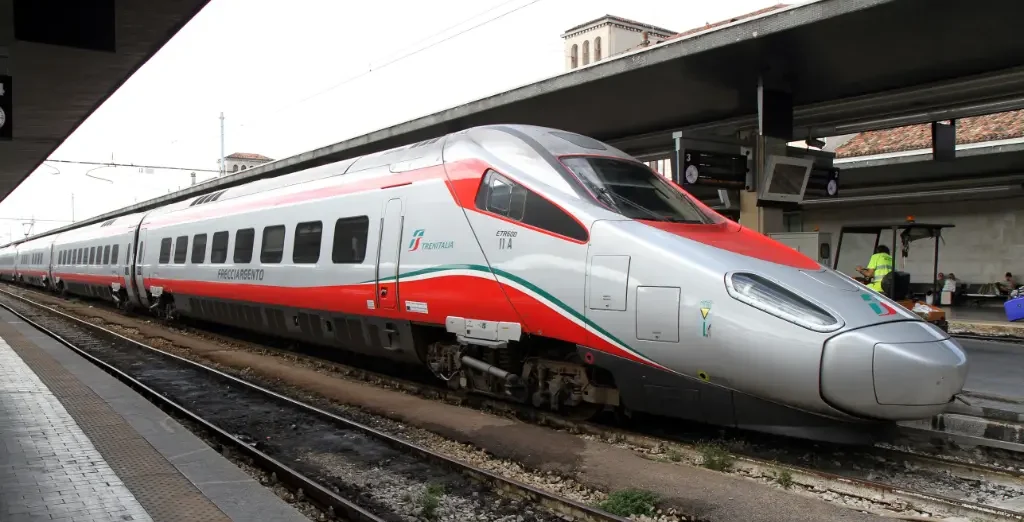
3. The New Generation: ETR 600 / 610 (New Pendolino)
A more modern, aerodynamic nose and improved tilting tech.
- Italy (Frecciargento): Used by Trenitalia on routes that mix high-speed lines with older tracks (e.g., Rome to Venice).
- Switzerland (SBB Astoro): Crosses the Alps (Gotthard and Simplon routes).
- China (CRH5): A version adapted for Chinese railways.
- Poland (ED250): The non-tilting version! Poland bought the Pendolino body for aerodynamics but didn’t pay for the tilting mechanism. It runs as the EIP (Express InterCity Premium).
4. The Avelia Pendolino
Alstom’s latest iteration.
- USA (Acela II): The new Avelia Liberty trains for Amtrak’s Northeast Corridor are based on Pendolino tech to handle the tight curves of the American East Coast.
Where Can You Ride One?
The Pendolino is truly global. Here is where it runs:
| Country | Operator | Name | Route |
|---|---|---|---|
| Italy | Trenitalia | Frecciargento / ETR 600 | Rome-Venice, Rome-Lecce |
| UK | Avanti West Coast | Class 390 | London-Glasgow, London-Manchester |
| Switzerland | SBB | Astoro (ETR 610) | Zurich-Milan, Geneva-Milan |
| Poland | PKP Intercity | EIP (ED250) | Warsaw-Krakow/Gdansk (Non-tilting) |
| Finland | VR | Sm3 | Helsinki-St. Petersburg (suspended), domestic |
| Czech Rep. | ČD | SuperCity (Class 680) | Prague-Ostrava |
| Portugal | CP | Alfa Pendular | Lisbon-Porto-Faro |
| Spain | Renfe | Alvia (S-104/114) | Madrid-North/South |
The Experience: What It’s Like Onboard
The Tilt
You might not even notice it at first. The transition is smooth. However, if you look out the window, you’ll see the horizon dip at a strange angle.
- Motion Sickness: Some sensitive passengers (“Pendolino sickness”) feel a bit queasy because their eyes see a tilt but their inner ear doesn’t feel the force (it’s cancelled out).
- Tip: If you get motion sick, book a forward-facing seat and look at the horizon.
Speed
Pendolinos usually run at max speeds of 250 km/h (155 mph). While slower than the 300+ km/h TGV, their average speed is high because they don’t have to slow down as much for corners.
Interior
Because the carriage has to be narrower at the top to fit through tunnels while tilting (tapered shape), the overhead luggage racks can be smaller than on regular trains. The windows are often slightly smaller and curved.
Why Is It Controversial?
Cost vs. Benefit:
Tilting technology is expensive to maintain. The hydraulic systems are complex.
- Germany abandoned tilting trains (ICE-T) on many routes due to technical glitches.
- Poland bought the trains without the tilt to save money, arguing that track upgrades were a better investment.
The “Vomit Comet”:
Early versions were notorious for making passengers sick. Modern sensors have largely fixed this by making the tilt smoother and more predictive.
Summary
The Pendolino is the unsung hero of high-speed rail. It didn’t need new maps or new lands; it took the old, winding paths of history and made them fast again.
It is Italian design engineering at its best: elegant, clever, and moving with a style that makes straight lines seem boring.
Ready to lean? Book a ticket on the West Coast Main Line in the UK or the Frecciargento in Italy, grab a window seat, and feel the world tilt.