226 Fully automated trains from Siemens and Stadler will transform Danish urban rail by 2032
DSB, Denmark’s national railway operator, has awarded a landmark contract to Siemens Mobility and Stadler Rail for at least 226 fully automated S-tog trains. This transformative order will make Copenhagen’s S-tog network one of the largest fully automated urban rail systems in the world.
Set to enter service from 2032, the new trains will bring greener operations, improved reliability, and higher frequency to the Danish capital’s essential commuter railway — a system that carries over 400,000 passengers daily.
The Deal at a Glance
| Detail | Information |
|---|---|
| Customer | DSB (Danske Statsbaner) |
| Manufacturers | Siemens Mobility and Stadler Rail (consortium) |
| Train Type | Fully automated S-tog (Grade of Automation 4) |
| Quantity | At least 226 trains (options for more) |
| Entry into Service | 2032 onwards |
| Network | Copenhagen S-tog (S-train) system |
| Key Feature | Fully driverless operation |
What Is the Copenhagen S-tog?
The S-tog (short for “Bybanen S-tog” or simply “S-train”) is Copenhagen’s urban rail network — the backbone of public transport in the Danish capital region.
S-tog Network Overview
| Fact | Details |
|---|---|
| Lines | 7 lines (A, B, Bx, C, E, F, H) |
| Stations | 85 stations |
| Route Length | 170 km |
| Daily Passengers | ~400,000 |
| Annual Passengers | ~115 million |
| Coverage | Copenhagen city center to suburbs in all directions |
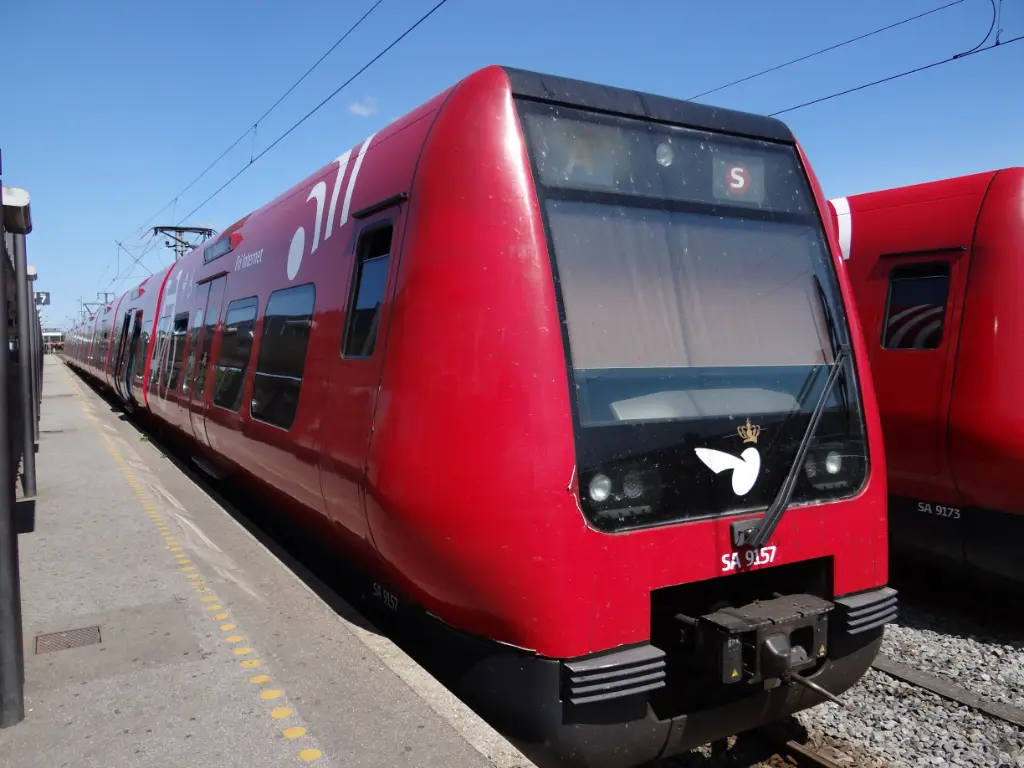
| Current Fleet | 136 fourth-generation SA trains (introduced 1996-2006) |
| Operator | DSB |
| Gauge | Standard gauge (1,435 mm) |
| Power | 1,650 V DC third rail |
The S-tog’s Role
The S-tog is not a metro — it is a suburban railway that serves a different function:
| S-tog | Copenhagen Metro |
|---|---|
| Suburban reach (up to 40 km from center) | City center focus |
| 85 stations across the region | 39 stations (and growing) |
| Surface and elevated running | Mostly underground |
| Longer station spacing in suburbs | Consistent short spacing |
| Higher capacity per train | Smaller, more frequent trains |
| DSB operated | Metro Service (separate company) |
Together, the S-tog and Metro form Copenhagen’s rapid transit backbone, but the S-tog carries more passengers and serves a larger geographic area.
Why Automation? The Case for Driverless Trains
The decision to convert the entire S-tog network to fully automated operation represents one of Europe’s most ambitious urban rail modernization projects.
The Problem with the Current System
| Challenge | Impact |
|---|---|
| Aging Fleet | Current trains (1996-2006) approaching end of life |
| Capacity Limits | Peak hour crowding on key routes |
| Frequency Constraints | Driver availability limits service frequency |
| Operational Costs | Labor-intensive operation |
| Reliability Issues | Older equipment requires more maintenance |
| Inflexibility | Fixed schedules cannot easily adapt to demand |
What Automation Solves
| Benefit | Explanation |
|---|---|
| Higher Frequency | Trains every 2-3 minutes possible (vs. current 5-10 min) |
| Faster Response | System can add trains during demand surges |
| Improved Reliability | Consistent performance without human variability |
| Lower Operating Costs | Reduced labor costs over system lifetime |
| Better Energy Efficiency | Optimized driving patterns reduce power consumption |
| Extended Service Hours | Easier to run late-night/early-morning services |
| Enhanced Safety | Automated systems eliminate human error |
Grades of Automation
Railway automation is classified by the International Association of Public Transport (UITP):
| Grade | Name | Description | Driver Role |
|---|---|---|---|
| GoA 0 | Manual | Driver controls everything | Full control |
| GoA 1 | Non-automated | Driver with automatic train protection | Primary operator |
| GoA 2 | Semi-automated | Automatic acceleration/braking, driver monitors | Supervises, handles doors/emergencies |
| GoA 3 | Driverless | Automated operation, attendant on board | Attendant for emergencies only |
| GoA 4 | Unattended | Fully automated, no staff on train | None required |
The new Copenhagen S-tog will operate at GoA 4 — fully unattended operation with no driver or attendant required on board. This places it among the most advanced urban rail systems in the world.
The Manufacturers: Siemens Mobility and Stadler Rail
The contract brings together two of Europe’s leading train manufacturers in a consortium arrangement.
Siemens Mobility
| Aspect | Details |
|---|---|
| Headquarters | Munich, Germany |
| Expertise | Rolling stock, signaling, automation systems |
| Automated Train Experience | Paris Metro, Nuremberg U-Bahn, numerous others |
| Role in Contract | Train automation systems, signaling, integration |
Siemens brings extensive experience in automated train operation, having delivered driverless systems for:
- Paris Metro Line 14 (extended)
- Nuremberg U-Bahn (first automated conversion of existing metro)
- Barcelona Metro Line 9/10
- Various automated people movers worldwide
Stadler Rail
| Aspect | Details |
|---|---|
| Headquarters | Bussnang, Switzerland |
| Expertise | Rolling stock manufacturing, particularly regional trains |
| Notable Products | FLIRT, KISS, METRO, WINK, SMILE |
| Role in Contract | Train design and manufacturing |
Stadler has become one of Europe’s most successful train builders, with a strong presence in:
- Swiss railways (SBB and private operators)
- German regional rail
- UK rail (Greater Anglia, Merseyrail)
- Scandinavian networks (existing Danish contracts)
Why a Consortium?
Major automated train projects often involve multiple suppliers because they require:
- Vehicle design and manufacturing (Stadler’s strength)
- Signaling and train control (Siemens’ strength)
- Automation systems integration (Siemens’ strength)
- Testing and commissioning (both)
The consortium approach brings together complementary expertise for a project of this complexity.
Technical Specifications: The New S-tog
While complete specifications are still being finalized, key parameters are emerging:
Expected Design Features
| Feature | Expected Specification |
|---|---|
| Automation Level | GoA 4 (fully unattended) |
| Configuration | Multi-car EMUs (likely 4-8 cars) |
| Capacity | Higher than current fleet |
| Doors | Wide doors for rapid boarding |
| Accessibility | Full step-free access |
| Power | 1,650 V DC (compatible with existing infrastructure) |
| Speed | Up to 120 km/h |
| Climate Control | Full air conditioning and heating |
Automation Systems
| System | Function |
|---|---|
| CBTC | Communications-Based Train Control — enables precise positioning and close headways |
| ATO | Automatic Train Operation — controls acceleration, braking, door operation |
| ATP | Automatic Train Protection — prevents unsafe movements |
| Platform Screen Doors | Physical barriers between platform and track (new installations) |
| Remote Monitoring | Control center oversight of all trains |
| Passenger Communication | Direct link to control center from every car |
Safety Features
Automated trains require comprehensive safety systems:
| Feature | Purpose |
|---|---|
| Platform Screen Doors | Prevent falls onto tracks, enable safe driverless operation |
| CCTV Throughout | Full video coverage of every car |
| Emergency Intercoms | Direct communication with control center |
| Intrusion Detection | Sensors to detect objects/people on tracks |
| Automatic Emergency Braking | Immediate response to hazards |
| Fire Detection | Early warning systems throughout |
| Evacuation Lighting | Battery-powered emergency lighting |
The Transformation Timeline
Converting an existing railway to fully automated operation is a massive undertaking spanning nearly a decade.
Project Phases
| Phase | Period | Activities |
|---|---|---|
| Contract Award | 2024 | Consortium selected, detailed planning begins |
| Design and Development | 2024-2027 | Train design finalized, systems development |
| Infrastructure Preparation | 2025-2030 | Signaling upgrades, platform screen doors installation |
| Manufacturing | 2027-2035 | Train production (226+ units) |
| Testing and Commissioning | 2030-2032 | Trial operations, safety certification |
| Service Introduction | 2032 | First automated trains enter passenger service |
| Full Conversion | 2032-2035 | Progressive replacement of entire fleet |
Key Milestones
| Year | Milestone |
|---|---|
| 2024 | Contract signed, detailed design begins |
| 2026 | Prototype trains under construction |
| 2028 | First prototype delivered for testing |
| 2030 | Infrastructure largely complete, test operations begin |
| 2032 | First automated trains in passenger service |
| 2035 | Full fleet operational, complete automation achieved |
The Challenge of Conversion
Unlike building a new automated metro from scratch, Copenhagen must convert an operating railway while maintaining service for 400,000 daily passengers. This requires:
- Phased infrastructure upgrades — installing new systems while the old ones operate
- Parallel operations — running new and old trains simultaneously during transition
- Weekend/night closures — intensive work during service gaps
- Fallback plans — contingencies if problems arise
- Public communication — keeping passengers informed throughout
Impact on Passengers
What Will Change
| Before (Current) | After (2032+) |
|---|---|
| Trains every 5-10 minutes | Trains every 2-4 minutes possible |
| Fixed timetable | Demand-responsive frequency |
| Driver at front of train | No driver (control center supervision) |
| Open platform edges | Platform screen doors |
| 1996-2006 train design | Modern 2030s interiors |
| Limited late-night service | Potential 24/7 operation |
Passenger Benefits
| Benefit | Details |
|---|---|
| Shorter Waits | Much higher frequency means less waiting |
| Better Reliability | Automated systems are more consistent |
| Increased Capacity | More trains, more seats |
| Improved Safety | Platform doors prevent accidents |
| Modern Comfort | New trains with contemporary amenities |
| Real-Time Information | Enhanced passenger information systems |
| Accessibility | Full step-free access throughout |
Passenger Concerns and Responses
| Concern | Response |
|---|---|
| “Is it safe without a driver?” | Automated systems have excellent safety records; control center monitors all trains; multiple redundant safety systems |
| “What if something goes wrong?” | Emergency intercoms connect directly to control center; staff can be dispatched; trains can be controlled remotely |
| “Will there be staff at stations?” | Station staff will remain for assistance and security |
| “What about my job?” | Long transition period allows natural attrition; drivers retrained for other roles |
Environmental Benefits
Automation brings significant sustainability improvements:
Energy Efficiency
| Factor | Impact |
|---|---|
| Optimized Driving | Automated systems use ideal acceleration/braking profiles |
| Regenerative Braking | Energy recovered and fed back to grid |
| Reduced Empty Running | Better matching of supply to demand |
| New Train Efficiency | Modern trains use less energy than 1990s designs |
Carbon Reduction
| Aspect | Benefit |
|---|---|
| Modal Shift | Better service attracts passengers from cars |
| Fleet Efficiency | 15-20% energy savings estimated vs. current fleet |
| Renewable Integration | Denmark’s grid increasingly renewable |
| Lifecycle Emissions | New trains designed for sustainability |
Denmark’s Climate Goals
Denmark has committed to reducing greenhouse gas emissions by 70% by 2030 compared to 1990 levels. Transport is a key sector, and improved public transport is essential to getting people out of cars.
The new S-tog system supports this by:
- Making rail more attractive through frequency and reliability
- Reducing per-passenger energy consumption
- Enabling future capacity growth without infrastructure expansion
The Bigger Picture: Automated Metros Worldwide
Copenhagen is joining a growing list of cities with fully automated urban rail.
Existing GoA 4 Systems
| City | Line | Opened | Notes |
|---|---|---|---|
| Lille, France | VAL | 1983 | World’s first automated metro |
| Paris, France | Line 14 | 1998 | High-capacity automated metro |
| Copenhagen, Denmark | Metro | 2002 | Copenhagen’s existing automated metro |
| Dubai, UAE | Red/Green Lines | 2009 | World’s longest automated metro at opening |
| Nuremberg, Germany | U2/U3 | 2008/2010 | First conversion of existing metro |
| Barcelona, Spain | L9/L10 | 2009 | Longest automated metro in Europe |
| Singapore | Various | Various | Extensive automated network |
| Doha, Qatar | All lines | 2019 | Built for World Cup |
What Makes Copenhagen Different
The S-tog automation is notable for several reasons:
| Factor | Significance |
|---|---|
| Scale | 226 trains — one of the largest automated fleets ordered |
| Suburban Railway | Not a metro — longer distances, higher speeds |
| Conversion | Transforming an existing system, not building new |
| Complexity | 85 stations, 170 km of route, 7 lines |
| Integration | Must work with existing Metro and regional rail |
Copenhagen’s Automation Experience
Copenhagen already operates an automated metro (opened 2002), giving the city valuable experience:
| Copenhagen Metro | Lessons for S-tog |
|---|---|
| Fully automated since opening | Proven technology works in Danish conditions |
| Excellent reliability record | Public acceptance of driverless trains |
| High passenger satisfaction | Modern design attracts riders |
| Operational since 2002 | Over 20 years of local expertise |
This existing experience makes Copenhagen well-positioned to extend automation to the S-tog network.
Challenges and Risks
A project of this scale faces significant challenges:
Technical Challenges
| Challenge | Mitigation |
|---|---|
| System Integration | Experienced consortium, proven technology |
| Infrastructure Age | Comprehensive upgrades included in project |
| Weather Conditions | Danish winters require robust design |
| Legacy Systems | Careful transition planning |
| Cybersecurity | State-of-the-art security protocols |
Operational Challenges
| Challenge | Mitigation |
|---|---|
| Maintaining Service During Conversion | Phased approach, night/weekend work |
| Staff Transition | Long timeline allows retraining, redeployment |
| Public Acceptance | Communication campaign, existing Metro experience |
| Emergency Procedures | New protocols, extensive training |
Project Risks
| Risk | Status |
|---|---|
| Delays | Common in major rail projects; timeline includes buffer |
| Cost Overruns | Fixed-price elements; contingency budgeted |
| Technical Problems | Proven technology reduces risk |
| Supply Chain | Consortium has manufacturing capacity |
Learning from Other Projects
Major automated train projects have faced challenges elsewhere:
| Project | Issue | Lesson |
|---|---|---|
| Berlin Brandenburg Airport | Years of delays | Careful testing before opening |
| Crossrail (London) | Software integration problems | Allow time for system integration |
| California High-Speed Rail | Cost escalation | Realistic budgeting essential |
Copenhagen’s advantage is working with experienced suppliers on proven technology, reducing (but not eliminating) risk.
Economic Impact
Investment Scale
While exact contract values have not been fully disclosed, the project represents billions of euros in investment:
| Component | Estimated Scope |
|---|---|
| 226+ Trains | Major manufacturing contract |
| Signaling Systems | Complete network CBTC installation |
| Platform Screen Doors | 85 stations to be equipped |
| Control Systems | New operations control center |
| Infrastructure Upgrades | Track, power, communications |
| Testing and Commissioning | Multi-year program |
Economic Benefits
| Benefit | Impact |
|---|---|
| Construction Jobs | Manufacturing, installation, civil works |
| Operating Savings | Lower per-passenger costs long-term |
| Productivity Gains | Better transport enables economic activity |
| Property Values | Improved transit supports development |
| Carbon Credits | Emissions reductions have economic value |
Danish Industry Participation
While the main manufacturers are German (Siemens) and Swiss (Stadler), Danish companies will participate in:
- Civil engineering works
- Infrastructure installation
- Component supply
- Operations and maintenance (long-term)
What This Means for European Rail
The Copenhagen S-tog automation is significant beyond Denmark:
Precedent for Conversion Projects
Most automated systems worldwide were built as new lines. Converting existing railways to automation is more challenging but opens huge potential:
| System | Status |
|---|---|
| Nuremberg (Germany) | Converted Lines U2/U3 to GoA 4 (completed) |
| Paris (France) | Converting Line 4 to GoA 4 (in progress) |
| Copenhagen (Denmark) | S-tog conversion announced |
| Many others | Watching Copenhagen with interest |
If Copenhagen succeeds, other cities with aging suburban rail fleets may follow.
Siemens and Stadler Positioning
This contract strengthens both manufacturers’ positions in the automated train market:
| Company | Strategic Benefit |
|---|---|
| Siemens | Reinforces leadership in automated systems |
| Stadler | Entry into major automation project |
| Both | Reference for future global bids |
Supply Chain Development
Major orders drive innovation and capability:
- New automation technologies developed
- Manufacturing processes refined
- Expertise built for future projects
- European rail industry strengthened
The Current S-tog Fleet: What’s Being Replaced
The 226 new trains will replace the current fourth-generation S-tog fleet:
Current Fleet (SA Trains)
| Specification | Details |
|---|---|
| Built | 1996-2006 |
| Manufacturer | Alstom LHB / Siemens |
| Units | 136 eight-car trains |
| Configuration | Eight cars per train |
| Capacity | ~800 passengers per train |
| Top Speed | 120 km/h |
| Power | 1,650 V DC third rail |
| Automation | GoA 2 (semi-automated with driver) |
Why Replace Rather Than Retrofit?
| Option | Consideration |
|---|---|
| Retrofit Existing | Cost-prohibitive; 1990s designs not suited for full automation |
| Extend Life | Already approaching design life; diminishing returns |
| New Fleet | Higher capacity, better efficiency, automation-ready design |
The current trains will be progressively retired as new automated trains enter service. Some may be sold for continued use elsewhere, while others will be recycled.
For Rail Enthusiasts
The S-tog transformation offers years of interest for train enthusiasts and photographers:
What to See
| Period | Opportunities |
|---|---|
| Now – 2030 | Current SA fleet in original condition |
| 2028-2030 | Prototype new trains under test |
| 2030-2032 | Mixed operation (old and new trains) |
| 2032+ | New automated fleet enters service |
| 2032-2035 | Final years of classic S-tog operation |
Photography Tips
| Subject | Best Approach |
|---|---|
| Current SA Fleet | Document before replacement begins |
| Transition Period | Capture old and new trains together |
| Platform Screen Doors | Before/after station comparisons |
| First Revenue Service | Major milestone in 2032 |
Technical Interest
- Last major European suburban rail fleet without platform screen doors
- Conversion of busy railway to fully automated operation
- Integration of CBTC with suburban rail operations
- Transition from GoA 2 to GoA 4
Comparison: S-tog vs. Copenhagen Metro
Copenhagen will have two fully automated rail systems, but they serve different purposes:
| Factor | S-tog (from 2032) | Metro |
|---|---|---|
| Type | Suburban railway | Urban metro |
| Lines | 7 | 4 |
| Stations | 85 | 39 |
| Route Length | 170 km | 35+ km |
| Reach | Up to 40 km from center | City center focus |
| Daily Passengers | ~400,000 | ~300,000 |
| Automation Since | 2032 | 2002 |
| Train Size | Large (8 cars) | Medium (3 cars) |
| Headway | 2-10 minutes | 2-4 minutes |
| Operator | DSB | Metro Service A/S |
Together, they will form one of the world’s most extensive fully automated urban rail networks.
Conclusion
The contract for 226 fully automated S-tog trains marks a watershed moment for Copenhagen and for European rail.
For the 400,000 daily passengers who depend on the S-tog, the new system promises:
- Trains every 2-4 minutes instead of 5-10 minutes
- Higher reliability with fewer delays and cancellations
- Modern, comfortable trains replacing 20-30 year old rolling stock
- Improved safety with platform screen doors
- Better accessibility meeting current standards
For Denmark, it represents:
- Commitment to sustainable transport supporting climate goals
- Investment in public infrastructure for future growth
- Technological leadership in automated rail
- Integration with existing automated Metro creating a unified system
For Europe, it demonstrates:
- Feasibility of converting existing railways to automation
- Continued innovation in urban rail technology
- Public transport investment even in challenging times
- Path forward for other aging suburban networks
The journey from contract to service will take eight years. There will be challenges, delays, and unexpected problems. Converting a busy railway to fully automated operation while maintaining daily service is among the most complex undertakings in transport engineering.
But Copenhagen has done this before. The city’s Metro has operated automatically since 2002, giving Danes two decades of experience with driverless trains. The technology is proven. The suppliers are experienced. The need is clear.
In 2032, when the first fully automated S-tog glides into København H station, it will mark not just a new chapter for Danish rail but a milestone for urban transport worldwide.
The future of the S-tog is driverless. And the future begins now.
Stay Updated:
- Follow DSB announcements at dsb.dk
- Siemens Mobility news at siemens.com/mobility
- Stadler Rail updates at stadlerrail.com
- Danish transport news at LandstrafIkken.dk
Fully automated. Fully Danish. Coming 2032.