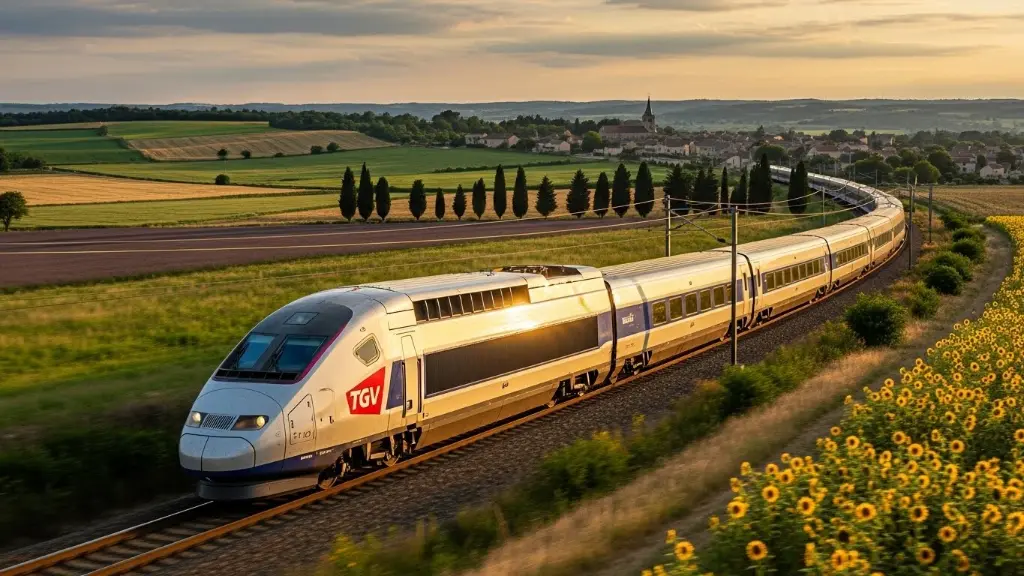
Rail Travel in France: High-Speed TGV and Scenic Routes from Paris to the Alps
It is the country that invented the TGV — and then built a railway network worthy of the name.
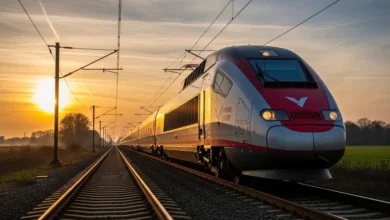
France’s rail system is one of the world’s finest. High-speed TGVs connect Paris to the Mediterranean in three hours. Regional trains wind through lavender fields, Alpine valleys, and Atlantic coastlines. And legendary international routes link France to Britain, Belgium, Germany, Switzerland, Spain, and Italy.
From the Eiffel Tower to the vineyards of Burgundy, from the ski slopes of Chamonix to the beaches of Nice — French trains make it all accessible.
This is your complete guide to exploring France by rail.
France by Train: The Overview
| Fact | Details |
|---|---|
| Total Network | ~28,000 km of railway lines |
| Main Operator | SNCF (state-owned) |
| High-Speed Network | ~2,800 km of dedicated LGV lines |
| Maximum Speed | 320 km/h (commercial), 574.8 km/h (world record, 2007) |
| International Connections | UK, Belgium, Netherlands, Germany, Switzerland, Italy, Spain |
| Eurail/Interrail | Valid on SNCF trains (reservations required for TGV) |
Why Train Travel Works in France
- Paris is the Hub: Almost all major routes pass through Paris — making connections logical.
- TGV Speed: Paris to Lyon in 2 hours. Paris to Marseille in 3 hours. Paris to Bordeaux in 2 hours.
- Scenic Diversity: Mountains, coasts, vineyards, châteaux — French trains pass through extraordinary landscapes.
- International Gateway: Eurostar to London, Thalys to Brussels, TGV to Switzerland and Spain.
- Comprehensive Coverage: Even small villages usually have a railway station.
- Gastronomic Possibilities: Breakfast in Paris, lunch in Lyon, dinner in Marseille — all by train.
The History: France and the Railway Revolution
France was not the first country to build railways, but it became one of the most important — and ultimately revolutionized rail travel with high-speed technology.
The Early Years (1827-1870)
France’s first railway opened in 1827 — a short line near Saint-Étienne for coal transport. The first passenger railway followed in 1837, connecting Paris to Le Pecq.
Under Napoleon III, railway construction accelerated. The famous “Étoile de Legrand” plan created a star-shaped network centered on Paris — a design that still defines French railways today.
By 1870, France had over 17,000 km of railway. The major companies — Compagnie du Nord, PLM (Paris-Lyon-Méditerranée), Compagnie de l’Est, and others — competed fiercely.
Nationalization and SNCF (1938)
The private companies struggled during the Depression. In 1938, the French government nationalized the railways, creating the Société Nationale des Chemins de fer Français (SNCF) — the French National Railway Company.
SNCF became one of the world’s largest railway operators, running everything from suburban commuter trains to international expresses.
The TGV Revolution (1981-Present)
France’s greatest railway achievement came on September 27, 1981: the launch of the TGV (Train à Grande Vitesse) — the high-speed train.
The first LGV (Ligne à Grande Vitesse) connected Paris to Lyon. Trains ran at 260 km/h — unprecedented for regular passenger service. The TGV was a sensation.
Since then, France has built an extensive high-speed network:
- 1989: TGV Atlantique (Paris-Tours-Bordeaux, Paris-Le Mans-Rennes)
- 1993: Eurostar launched (Paris-London via Channel Tunnel)
- 1994: TGV Nord (Paris-Lille-Brussels)
- 2001: TGV Méditerranée (Lyon-Marseille extended)
- 2007: TGV Est (Paris-Strasbourg)
- 2017: LGV Atlantique extensions (Paris-Bordeaux in 2h 04min)
In 2007, a modified TGV set the world rail speed record: 574.8 km/h. No other wheeled train has ever gone faster.
Today, French high-speed trains carry over 100 million passengers annually.
The Operators: Who Runs French Trains?
SNCF (The National Railway)
SNCF is France’s national railway company, operating nearly all passenger trains in the country. It is state-owned but operates commercially.
| Aspect | Details |
|---|---|
| Ownership | State-owned (French government) |
| Network | Nationwide — all regions |
| Train Types | TGV INOUI, OUIGO, Intercités, TER |
| High-Speed Routes | All major TGV lines |
| Regional Services | TER regional trains |
| International | Eurostar, Thalys, TGV Lyria, TGV to Spain/Italy |
| Eurail/Interrail | VALID (reservations required for TGV) |
| Website | sncf-connect.com |
SNCF is actually a group of companies:
- SNCF Voyageurs: Passenger services (TGV, Intercités, TER)
- SNCF Réseau: Infrastructure management
- Keolis: International operations, some regional contracts
Train Types at a Glance
| Train | Speed | Routes | Notes |
|---|---|---|---|
| TGV INOUI | Up to 320 km/h | Major high-speed routes | Premium high-speed service |
| OUIGO | Up to 320 km/h | Selected high-speed routes | Low-cost high-speed |
| Intercités | Up to 200 km/h | Non-high-speed long distance | Connects cities without LGV |
| TER | Up to 160 km/h | Regional services | Regional trains, all areas |
| Eurostar | Up to 320 km/h | Paris-London-Brussels | International to UK/Belgium |
| Thalys | Up to 320 km/h | Paris-Brussels-Amsterdam-Cologne | International to Benelux/Germany |
| TGV Lyria | Up to 320 km/h | Paris-Geneva-Lausanne-Zurich-Basel | International to Switzerland |
OUIGO: The Low-Cost TGV
OUIGO deserves special attention. Launched in 2013, it is SNCF’s low-cost high-speed service — essentially a budget airline model applied to trains.
| Feature | OUIGO | TGV INOUI |
|---|---|---|
| Speed | Same (320 km/h) | Same |
| Stations | Often suburban (e.g., Marne-la-Vallée, Lyon Saint-Exupéry) | Usually central |
| Legroom | Less | More |
| Luggage | Small bag free; larger bags extra | Generous |
| Food/Drink | Buy onboard (no trolley service) | Bar car, seat service in 1st |
| Tickets | Online only | Online or station |
| Changes/Refunds | Very limited | More flexible |
| Price | From €10-19 | From €29-50+ |
OUIGO Verdict: Great for budget travel if you pack light and do not mind suburban stations. Not as comfortable, but the same speed for a fraction of the price.
International Operators
Several international services operate on French rails:
| OperatorRoutesNotesEurostarParis-London, Paris-Brussels, London-AmsterdamThrough the Channel TunnelThalysParis-Brussels-Amsterdam, Paris-CologneBeing merged with EurostarTGV LyriaParis-Switzerland (Geneva, Lausanne, Zurich, Basel)Joint SNCF-SBB ventureRenfe-SNCFParis-Barcelona, Lyon-BarcelonaHigh-speed to SpainDB-SNCFParis-Frankfurt, Paris-Stuttgart, Paris-MunichGerman ICE and French TGVThelloParis-Venice (night train)Currently suspendedNightjetParis-Vienna (planned/new)ÖBB night trains |
|---|
Regional Operators
TER (Transport Express Régional) services are funded by regional governments but operated by SNCF (or, increasingly, private companies).
Some regions have specific characteristics:
- Île-de-France: Transilien suburban network (RER, Transilien lines)
- Corsica: Chemins de fer de la Corse (separate narrow-gauge network)
- Provence: TER Provence-Alpes-Côte d’Azur (scenic coastal and mountain routes)
Train Types: A Complete Guide
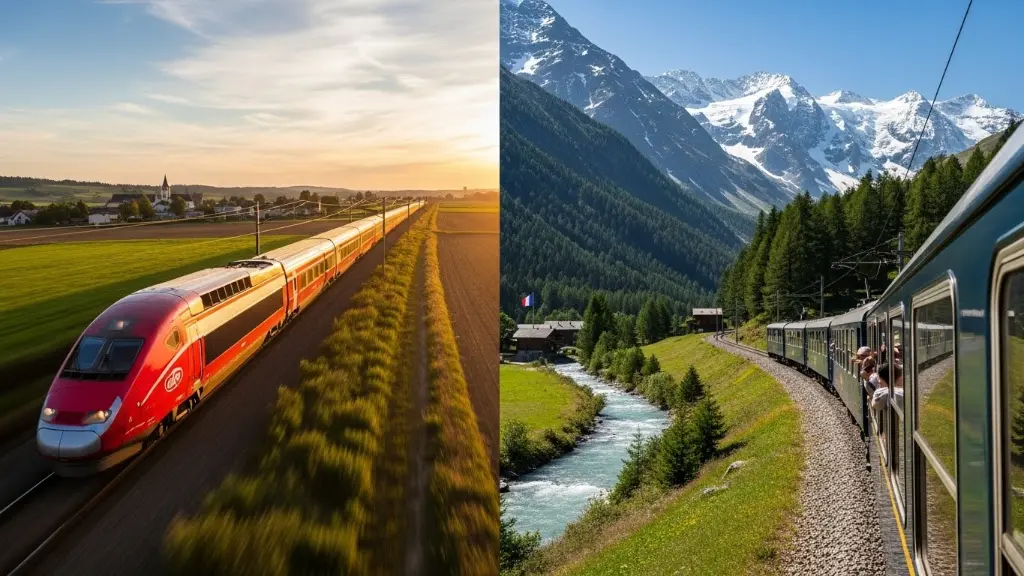
High-Speed Trains
TGV INOUI
The flagship of French rail — fast, comfortable, and extensive.
| Feature | Details |
|---|---|
| Speed | Up to 320 km/h |
| Routes | All major LGV lines |
| Classes | Second Class, First Class, Business Première |
| Amenities | Wi-Fi, power outlets, bar car, family areas |
| Reservation | Mandatory |
| Best For | Long-distance travel, comfort, reliability |
TGV INOUI trains are modern double-deck units (TGV Duplex) or single-deck sets. The service level is high — leather seats in first class, meal service in Business Première, and generally smooth operations.
OUIGO
Budget high-speed — same trains, fewer frills, lower prices.
| Feature | Details |
|---|---|
| Speed | Up to 320 km/h (same as TGV INOUI) |
| Routes | Paris-Lyon, Paris-Marseille, Paris-Bordeaux, Paris-Nantes, Paris-Strasbourg, and more |
| Classes | Single class only |
| Amenities | Basic — no bar car, limited legroom |
| Luggage | Small cabin bag free; hand luggage and large bags cost extra |
| Stations | Often peripheral (Marne-la-Vallée, Lyon Saint-Exupéry, Tourcoing) |
| Reservation | Mandatory (online only) |
| Best For | Budget travelers, light packers, flexible schedules |
OUIGO Tip: Check which station the train uses. Paris “OUIGO” trains often depart from Marne-la-Vallée (Disneyland area) rather than central Paris stations.
OUIGO Train Classique
A newer OUIGO variant using conventional (non-high-speed) trains on regional routes.
| Feature | Details |
|---|---|
| Speed | Conventional (up to 160 km/h) |
| Routes | Paris-Lyon (classic line), Paris-Nantes (classic), and others |
| Price | From €10 |
| Best For | Very budget-conscious travelers with time |
Long-Distance Conventional Trains
Intercités
Long-distance trains on routes without high-speed infrastructure.
| Feature | Details |
|---|---|
| Speed | Up to 200 km/h |
| Routes | Paris-Normandy, Bordeaux-Nice, Paris-Clermont-Ferrand, etc. |
| Classes | Second Class, First Class |
| Reservation | Required on some routes, optional on others |
| Best For | Scenic routes, regional connections, destinations not on LGV |
Intercités trains are slower but often more scenic than TGVs, following older routes through beautiful countryside.
Intercités de Nuit (Night Trains)
France’s overnight train network has shrunk dramatically but still offers key routes.
| Feature | Details |
|---|---|
| Routes | Paris-Briançon (Alps), Paris-Rodez-Toulouse, Paris-Nice (seasonal) |
| Accommodation | Seats, couchettes (4 or 6 berth) |
| Reservation | Mandatory for beds |
| Best For | Budget overnight travel, reaching remote destinations |
The French government has announced plans to revive night trains, with new routes potentially including Paris-Nice and Paris-Tarbes.
Regional Trains
TER (Transport Express Régional)
The backbone of French regional rail — connecting cities, towns, and villages.
| Feature | Details |
|---|---|
| Speed | Up to 160 km/h |
| Routes | Within each region, plus some inter-regional |
| Classes | Second Class, First Class (on some trains) |
| Reservation | Not required (just buy ticket and board) |
| Best For | Short trips, scenic routes, reaching small towns |
TER trains vary dramatically in quality — from modern double-deck trains in Île-de-France to older single cars in rural Brittany. But they reach everywhere, and tickets are cheap.
Important: TER tickets must sometimes be validated (composté) in yellow machines before boarding. This is being phased out but still applies in some regions.
Transilien / RER (Paris Region)
Paris has an extensive suburban rail network:
- RER: Five lines (A, B, C, D, E) crossing Paris through tunnels, connecting suburbs
- Transilien: Surface suburban lines from Paris termini
These are commuter services but essential for reaching airports (RER B to CDG), Versailles (RER C, Transilien L/U), and Disneyland (RER A).
The High-Speed Network: LGV Lines
France pioneered high-speed rail and built the first extensive network in Europe.
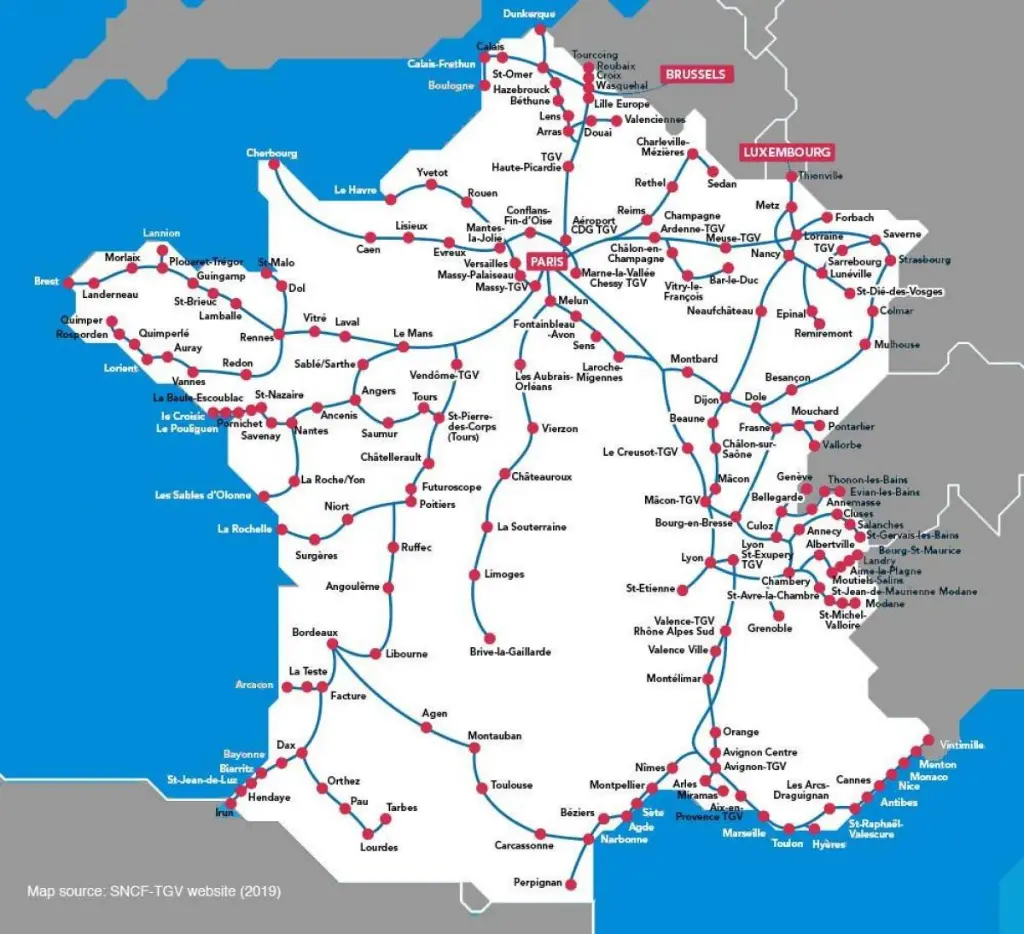
The LGV Map
France’s high-speed lines radiate from Paris like spokes of a wheel:
| Line | Route | Opened | Key Destinations |
|---|---|---|---|
| LGV Sud-Est | Paris → Lyon | 1981-1983 | Lyon, continuing to Marseille, Montpellier |
| LGV Atlantique | Paris → Tours/Le Mans | 1989-1990 | Bordeaux, Nantes, Rennes |
| LGV Nord | Paris → Lille | 1993 | Lille, London (Eurostar), Brussels (Thalys) |
| LGV Rhône-Alpes | Lyon → Valence | 1992-1994 | Connecting to Méditerranée |
| LGV Méditerranée | Valence → Marseille | 2001 | Marseille, Aix-en-Provence, Avignon |
| LGV Est Européenne | Paris → Strasbourg | 2007-2016 | Reims, Metz, Nancy, Strasbourg |
| LGV Rhin-Rhône | Dijon → Mulhouse | 2011 | Connecting to Germany/Switzerland |
| LGV Sud Europe Atlantique | Tours → Bordeaux | 2017 | Bordeaux in 2h 04min from Paris |
| LGV Bretagne-Pays de la Loire | Le Mans → Rennes | 2017 | Rennes in 1h 25min from Paris |
Journey Times from Paris
| Destination | Distance | TGV Time | Trains/Day |
|---|---|---|---|
| Lyon | 465 km | 1h 55min | 25+ |
| Marseille | 775 km | 3h 05min | 17+ |
| Bordeaux | 569 km | 2h 04min | 18+ |
| Strasbourg | 490 km | 1h 46min | 16+ |
| Lille | 225 km | 1h 00min | 20+ |
| Rennes | 370 km | 1h 25min | 12+ |
| Nantes | 395 km | 2h 15min | 14+ |
| Toulouse | 710 km | 4h 15min | 10+ |
| Nice | 960 km | 5h 35min | 6+ |
| Montpellier | 755 km | 3h 20min | 12+ |
Future Expansion
Several new lines are planned or under construction:
| Project | Route | Status |
|---|---|---|
| LGV Bordeaux-Toulouse | Extending south from Bordeaux | Planned |
| LGV PACA | Marseille-Nice high-speed | Long-delayed, controversial |
| LGV Montpellier-Perpignan | Completing Mediterranean corridor | Partially funded |
The Price: What French Trains Cost
French train pricing follows the airline model — prices vary dramatically based on demand, advance booking, and flexibility.
TGV INOUI Pricing
| Route | Lowest Advance | Flexible Standard | First Class |
|---|---|---|---|
| Paris → Lyon | €19-29 | €60-90 | €80-140 |
| Paris → Marseille | €25-39 | €90-130 | €120-180 |
| Paris → Bordeaux | €19-35 | €70-110 | €95-160 |
| Paris → Strasbourg | €25-35 | €70-100 | €90-140 |
| Paris → Nice | €35-59 | €120-160 | €150-220 |
OUIGO Pricing
| Route | Lowest Price | Typical Price |
|---|---|---|
| Paris → Lyon | €10-16 | €19-35 |
| Paris → Marseille | €10-19 | €25-49 |
| Paris → Bordeaux | €10-16 | €19-39 |
| Paris → Strasbourg | €10-16 | €19-35 |
| Paris → Nantes | €10-16 | €19-35 |
Note: OUIGO charges extra for luggage larger than a small cabin bag. Factor this into your price comparison.
Intercités Pricing
| Route | Standard Fare | Advance Fare |
|---|---|---|
| Paris → Rouen | €20-28 | €10-18 |
| Paris → Caen | €30-40 | €15-25 |
| Bordeaux → Nice | €50-80 | €25-45 |
TER Pricing
TER prices are fixed and relatively cheap. No advance booking discount — just buy when you need.
| Example Route | Price |
|---|---|
| Lyon → Annecy | €20-25 |
| Marseille → Cassis | €6-8 |
| Nice → Monaco | €4-5 |
| Bordeaux → Arcachon | €12-15 |
| Strasbourg → Colmar | €13-15 |
How to Get the Best Prices
- Book Early: The best TGV fares (Prem’s/Première) open 4 months in advance and sell out quickly.
- Use OUIGO: If departing from peripheral stations works for you, OUIGO can save 50-70%.
- Be Flexible: Traveling mid-week and at off-peak times is cheaper.
- Carte Avantage: SNCF’s discount cards (see below) provide 30% off for frequent travelers.
- Compare with Intercités: Sometimes the slower train is much cheaper.
- Check for Promos: SNCF runs flash sales, especially for new routes.
SNCF Discount Cards (Cartes Avantage)
SNCF offers discount cards for different traveler categories:
| Card | Who | Cost | Discount |
|---|---|---|---|
| Carte Avantage Jeune | 12-27 years old | €49/year | 30% off TGV, 60% off TER |
| Carte Avantage Adulte | 28-59 years old | €49/year | 30% off TGV when traveling with another person |
| Carte Avantage Senior | 60+ years old | €49/year | 30% off TGV |
| Carte Avantage Famille | Families with children | €49/year | 30% off for up to 3 adults, kids travel at €8 flat |
| Carte Avantage Week-end | All ages | €49/year | 30% off weekend TGV travel |
Are They Worth It? If you take 3-4 TGV trips per year, the card pays for itself. For heavy travelers, it is essential.
Max Jeune and Max Senior
For travelers under 27 or over 60, SNCF offers subscription services:
| Service | Cost | Benefit |
|---|---|---|
| Max Jeune | €79/month | Unlimited TGV travel in 2nd class (subject to availability) |
| Max Senior | €79/month | Same for seniors |
These are extraordinary deals if you travel frequently.
Rail Passes: Are They Worth It?
Eurail / Interrail France Pass
| Pass Type | 3 Days | 4 Days | 5 Days | 8 Days |
|---|---|---|---|---|
| Adult (2nd class) | ~€175 | ~€205 | ~€235 | ~€305 |
| Youth (2nd class) | ~€140 | ~€165 | ~€190 | ~€245 |
What’s Included:
- All SNCF trains (TGV, Intercités, TER)
- Reservation fees are extra (€10-20 for TGV, mandatory)
- Some international trains (Eurostar, Thalys, TGV Lyria) with supplements
What’s NOT Included:
- OUIGO (not covered by rail passes)
- Eurostar/Thalys/Lyria passholder fares are limited and require supplements
Is a Rail Pass Worth It in France?
Probably NOT for France alone.
Here is why:
- TGV reservations are mandatory (€10-20 each)
- Advance TGV tickets can be as cheap as €19-29
- OUIGO (not covered by passes) offers even lower prices
- Passholder quotas on popular TGV trains are limited
Example Calculation:
- Paris → Lyon advance ticket: €25
- Lyon → Marseille advance ticket: €22
- Marseille → Nice advance ticket: €15
- Nice → Paris advance ticket: €39
- Total with tickets: €101 (plus flexibility)
- 3-Day France Pass: €175 + €50+ in reservations = €225+
Individual tickets win clearly — IF you book in advance.
When a Pass DOES Make Sense:
- Spontaneous travel (cannot book ahead)
- Heavy use of TER regional trains (no reservation fees)
- Combined France + other countries (Global Pass)
- Traveling during peak times when advance tickets are sold out
Eurail Global Pass
If you are visiting France as part of a larger European trip, the Global Pass becomes more attractive:
| Pass Type | 4 Days | 5 Days | 7 Days | 15 Days |
|---|---|---|---|---|
| Adult (2nd class) | ~€295 | ~€335 | ~€410 | ~€545 |
The Global Pass works well when you are crossing multiple countries and using a mix of TGV (reserved) and TER/regional (no reservation) trains.
Scenic Routes: The Beautiful Journeys
France is not just about speed. Some of the most rewarding train journeys are the slow ones.
1. The Train des Pignes (Nice → Digne-les-Bains)
The Route: From the Côte d’Azur into the Provençal Alps.
| Details | |
|---|---|
| Distance | 151 km |
| Duration | 3h 15min |
| Train Type | Chemins de fer de Provence (private railway) |
| Scenery | ★★★★★ |
| Highlight | Gorges, Alpine villages, lavender fields, dramatic viaducts |
This narrow-gauge railway climbs from Mediterranean Nice into the wild Haute-Provence, crossing stunning viaducts and passing through 25 tunnels. It is one of France’s most beautiful train rides.
Note: NOT covered by Eurail/Interrail. Buy tickets separately (~€25).
2. The Ligne des Cévennes (Clermont-Ferrand → Nîmes)
The Route: Through the volcanic Auvergne and the wild Cévennes mountains.
| Details | |
|---|---|
| Distance | 306 km |
| Duration | 5-6 hours |
| Train Type | Intercités |
| Scenery | ★★★★★ |
| Highlight | Volcanoes, gorges, viaducts, medieval villages |
The “Cévenol” is France’s most dramatic long-distance scenic train. The route crosses 106 viaducts and passes through 48 tunnels, including the spectacular traverse of the Cévennes mountains.
Pro Tip: The section between Langogne and Alès is the most dramatic. Sit on the right side heading south.
3. The Côte Bleue (Marseille → Miramas via L’Estaque)
The Route: Along the Mediterranean coast west of Marseille.
| Details | |
|---|---|
| Distance | ~55 km |
| Duration | 50 minutes |
| Train Type | TER |
| Scenery | ★★★★★ |
| Highlight | Mediterranean sea, rocky coves, coastal villages, viaducts |
This coastal TER route hugs the rugged Côte Bleue, passing through tunnels carved into cliffs and emerging for stunning sea views. The villages of Niolon, La Redonne, and Carry-le-Rouet are postcard-perfect.
4. The Train Jaune (Villefranche-de-Conflent → Latour-de-Carol)
The Route: Through the French Pyrenees on a historic narrow-gauge railway.
| Details | |
|---|---|
| Distance | 63 km |
| Duration | 2-3 hours |
| Train Type | SNCF TER (special narrow gauge) |
| Scenery | ★★★★★ |
| Highlight | Pyrenean peaks, the Pont Séjourné viaduct, open-air carriages in summer |
The “Yellow Train” (Train Jaune) climbs to 1,593 meters — the highest railway station in France (Bolquère-Eyne). The route passes Catalan villages, mountain pastures, and the famous fortifications of Mont-Louis.
Pro Tip: In summer, ride in the open-air “découverte” carriages for the full experience. Covered by Eurail/Interrail.
5. The Nice → Cuneo Line (Tender Railway)
The Route: From the French Riviera over the Alps into Italy.
| Details | |
|---|---|
| Distance | ~100 km (Nice to Cuneo, Italy) |
| Duration | 2.5-3 hours |
| Train Type | TER |
| Scenery | ★★★★★ |
| Highlight | Roya Valley gorges, spiral tunnels, medieval villages, crossing into Italy |
This engineering marvel climbs from Mediterranean Nice through spectacular gorges, using spiral tunnels to gain altitude, before crossing into Italy. Villages like Breil-sur-Roya, Saorge, and Tende are stunning.
Note: The line was damaged by floods in 2020 and has been partially restored. Check current operations before travel.
6. The TGV Paris → Marseille
The Route: High-speed through Burgundy and the Rhône Valley.
| Details | |
|---|---|
| Distance | 775 km |
| Duration | 3h 05min |
| Train Type | TGV INOUI |
| Scenery | ★★★★ (flashes of beauty at 320 km/h) |
| Highlight | Burgundy vineyards, Rhône Valley, Provençal landscapes |
Even at 320 km/h, the Paris-Marseille TGV offers scenic moments: the rolling Burgundy hills, the industrial Rhône corridor, and the sudden burst of Provençal light as you near the Mediterranean.
7. The Bordeaux → Sarlat Line
The Route: Into the heart of the Dordogne.
| Details | |
|---|---|
| Distance | ~180 km |
| Duration | 2.5-3 hours |
| Train Type | TER |
| Scenery | ★★★★ |
| Highlight | Dordogne Valley, medieval villages, château country |
This route winds through the beautiful Dordogne region — land of châteaux, medieval villages, and foie gras. The train follows the river valley past places like Bergerac and Sarlat-la-Canéda (one of France’s prettiest towns).
8. The Mont Blanc Express (St-Gervais → Vallorcine)
The Route: Through the French Alps toward Chamonix and Switzerland.
| Details | |
|---|---|
| Distance | ~40 km (French section) |
| Duration | 1 hour |
| Train Type | SNCF TER (rack railway section) |
| Scenery | ★★★★★ |
| Highlight | Mont Blanc massif, Alpine glaciers, Chamonix valley |
This mountain railway climbs from St-Gervais-les-Bains to Chamonix and beyond to Vallorcine (where it connects to Switzerland). The views of Mont Blanc and the Aiguille du Midi are breathtaking.
Connection: Continues as the Mont Blanc Express to Martigny, Switzerland.
9. The Ligne de la Maurienne (Chambéry → Modane)
The Route: Through the French Alps toward the Mont Cenis Tunnel and Italy.
| Details | |
|---|---|
| Distance | ~115 km |
| Duration | 1.5-2 hours |
| Train Type | TER, Intercités |
| Scenery | ★★★★★ |
| Highlight | Arc Valley, Alpine peaks, Modane fortress, gateway to Italy |
This historic line climbs the Maurienne valley — the route Napoleon used to cross the Alps. The scenery is dramatic: glaciers, fortress towns, and the high Alps on all sides.
10. The Corsican Railway (Bastia → Ajaccio)
The Route: Across the mountains of Corsica.
| Details | |
|---|---|
| Distance | 158 km |
| Duration | 3.5-4 hours |
| Train Type | Chemins de fer de la Corse (CFC) |
| Scenery | ★★★★★ |
| Highlight | Mountain passes, chestnut forests, the Vizzavona pass, Genoese bridges |
Corsica has its own narrow-gauge railway, completely separate from mainland France. The line between Bastia and Ajaccio crosses the island’s mountainous spine, reaching 906 meters at Vizzavona.
Note: NOT covered by Eurail/Interrail. Buy tickets separately.
Regional Guide: France by Area
Paris and Île-de-France
The hub of French railways — almost all routes pass through the capital.
| Paris Station | Destinations |
|---|---|
| Gare du Nord | London (Eurostar), Brussels (Thalys), Lille, Northern France |
| Gare de l’Est | Strasbourg, Nancy, Metz, Luxembourg, Germany |
| Gare de Lyon | Lyon, Marseille, Provence, Côte d’Azur, Switzerland, Italy |
| Gare Montparnasse | Bordeaux, Nantes, Rennes, Brittany, Southwest France |
| Gare Saint-Lazare | Normandy (Rouen, Caen, Le Havre) |
| Gare d’Austerlitz | Orléans, Toulouse (some trains), Limoges, night trains |
Paris Tips:
- Stations are NOT connected underground. Allow 45+ minutes to transfer between stations.
- The Métro connects all major stations — but with luggage, taxis or Uber may be easier.
- RER B connects Gare du Nord to CDG Airport.
Northern France (Hauts-de-France, Normandy)
| Hub | Key Connections | Notes |
|---|---|---|
| Lille | Paris (1h), London (1h 20min), Brussels (35min) | Gateway to Belgium, high-speed hub |
| Rouen | Paris (1h 15min), Caen, Le Havre | Seine Valley capital |
| Caen | Paris (2h), Cherbourg, Rouen | D-Day beaches accessible by bus |
| Amiens | Paris (1h 10min), Lille | Gothic cathedral city |
Northern Highlights:
- Eurostar to London (2h 15min from Paris)
- Normandy coast (D-Day beaches, Mont-Saint-Michel — bus from Rennes or Pontorson)
- Champagne region (TGV to Reims, 45 minutes from Paris)
Eastern France (Alsace, Lorraine, Burgundy, Franche-Comté)
| Hub | Key Connections | Notes |
|---|---|---|
| Strasbourg | Paris (1h 46min), Frankfurt (1h 50min), Basel (1h 20min) | European Parliament city |
| Colmar | Strasbourg (30min), Basel (45min) | Alsatian wine country |
| Dijon | Paris (1h 40min), Lyon (1h 40min), Besançon | Burgundy wine capital |
| Nancy | Paris (1h 30min), Metz, Strasbourg | Art Nouveau architecture |
Eastern Highlights:
- Strasbourg Christmas markets (December)
- Alsace Wine Route (TER from Strasbourg to Colmar, buses to villages)
- Burgundy vineyards (TER from Dijon through Beaune)
Central France (Auvergne, Centre-Val de Loire)
| Hub | Key Connections | Notes |
|---|---|---|
| Clermont-Ferrand | Paris (3h 30min), Lyon (2h 30min), Nîmes | Volcanic Auvergne gateway |
| Tours | Paris (1h 15min), Bordeaux (2h 30min) | Loire Valley châteaux |
| Orléans | Paris (1h), Tours | Joan of Arc city |
Central Highlights:
- Loire Valley châteaux (TER from Tours to Amboise, Blois, Chenonceau)
- Ligne des Cévennes (Clermont-Ferrand to Nîmes)
- Auvergne volcanoes (TER from Clermont-Ferrand)
Western France (Brittany, Pays de la Loire)
| Hub | Key Connections | Notes |
|---|---|---|
| Rennes | Paris (1h 25min), Nantes, Saint-Malo | Breton capital |
| Nantes | Paris (2h 15min), Bordeaux (3h 30min), Rennes | Loire Atlantique hub |
| Brest | Paris (4h 30min), Rennes (2h) | Far western Brittany |
| Quimper | Paris (4h 15min), Rennes (2h 30min) | Finistère, Celtic Brittany |
Western Highlights:
- Saint-Malo (TER from Rennes, 50 minutes)
- Mont-Saint-Michel (bus from Rennes or Pontorson)
- Quiberon Peninsula (TER from Auray)
- Carnac megaliths (TER to Auray, then bus)
Southwestern France (Nouvelle-Aquitaine, Occitanie)
| Hub | Key Connections | Notes |
|---|---|---|
| Bordeaux | Paris (2h 04min), Toulouse (2h), Spain | Wine capital of the world |
| Toulouse | Paris (4h 15min), Bordeaux, Barcelona (3h) | Aerospace and rugby city |
| Biarritz | Paris (4h 30min), Bordeaux, San Sebastián | Basque coast resort |
| Lourdes | Paris (5h), Toulouse | Pilgrimage town, Pyrenees gateway |
| Montpellier | Paris (3h 20min), Marseille (1h 40min), Barcelona | Mediterranean university city |
Southwestern Highlights:
- Bordeaux wine regions (TER to Saint-Émilion)
- Dordogne Valley (TER from Bordeaux to Sarlat)
- Carcassonne (TGV from Toulouse or Montpellier)
- Pyrenees access from Lourdes and Pau
Southeastern France (Provence, Côte d’Azur, Rhône-Alpes)
| Hub | Key Connections | Notes |
|---|---|---|
| Lyon | Paris (1h 55min), Marseille (1h 40min), Geneva (1h 50min) | Gastronomic capital |
| Marseille | Paris (3h 05min), Lyon, Nice, Barcelona | Mediterranean port city |
| Nice | Paris (5h 35min), Marseille (2h 30min), Monaco | Côte d’Azur capital |
| Avignon | Paris (2h 40min), Marseille (30min), Lyon (1h) | Papal palace, Provence gateway |
| Grenoble | Paris (3h), Lyon (1h 20min), Chambéry | Alpine metropolis |
| Annecy | Lyon (1h 45min), Geneva (45min), Chambéry | Lake and mountain gem |
| Chamonix | St-Gervais (40min), Geneva (2h via bus) | Mont Blanc resort |
Southeastern Highlights:
- Côte d’Azur coastal TER (Nice-Monaco-Menton)
- Provence (Avignon, Aix-en-Provence, Arles — TER network)
- French Alps (TGV to Chambéry or Grenoble, TER into mountains)
- Gorges du Verdon (accessible from Marseille or Nice with bus connections)
The French Riviera: A Special Focus
The Côte d’Azur is one of France’s most popular destinations, and the trains are spectacular.
| Coastal Route | Key Stops | Notes |
|---|---|---|
| Marseille → Toulon | Cassis, La Ciotat, Bandol | Less glamorous but beautiful |
| Toulon → Nice | Saint-Raphaël, Cannes, Antibes | Classic Riviera coastline |
| Nice → Monaco | Villefranche-sur-Mer, Beaulieu, Èze | Stunning cliff-side railway |
| Monaco → Ventimiglia (Italy) | Menton, Italian border | International connection |
Pro Tip: Take TER trains for the coastal scenery. TGVs often bypass the coast via inland tunnels.
Mountains: Alps and Pyrenees
The French Alps
| Station | Ski Resorts Accessible | Summer Activities |
|---|---|---|
| Bourg-Saint-Maurice | Les Arcs, La Rosière, Tignes/Val d’Isère (bus) | Hiking, rafting |
| Moûtiers | Les Trois Vallées (Méribel, Courchevel, Val Thorens) | Hiking |
| Saint-Gervais | Saint-Gervais, Megève, Chamonix (Mont Blanc Express) | Mont Blanc, hiking |
| Grenoble | Chamrousse, Les Deux Alpes (bus), Alpe d’Huez (bus) | Mountain sports |
| Chambéry | Les Karellis, La Norma | Gateway to Vanoise |
| Briançon | Serre Chevalier, Montgenèvre | Highest city in France |
Alps Access: The “TGV des Neiges” services run direct from Paris to Alpine stations during ski season.
The Pyrenees
| Station | Access To | Notes |
|---|---|---|
| Lourdes | Cauterets, Gavarnie | Pilgrimage town + mountain gateway |
| Pau | Winter sports, hiking | Château, mountain views |
| Latour-de-Carol | Andorra (bus), Spain | Train Jaune terminus |
| Ax-les-Thermes | Andorra (bus) | Thermal spa town |
Pyrenees Access: Less developed railway access than the Alps. Buses connect train stations to mountain resorts.
International Connections
France is the European rail crossroads — connected to more countries by high-speed train than any other.
Eurostar (UK, Belgium, Netherlands)
| Route | Duration | Frequency |
|---|---|---|
| Paris Gare du Nord → London St Pancras | 2h 15min | 15+ daily |
| Paris → Brussels Midi | 1h 20min | 10+ daily |
| Paris → Amsterdam Centraal | 3h 20min | 3+ daily |
| London → Brussels | 2h | Multiple daily |
| London → Amsterdam | 4h | Multiple daily |
Eurostar Tips:
- Check in 30+ minutes before departure (security and passport control)
- Eurail/Interrail: passholder fares available but limited and require supplement
- Book early for the best prices (from €39 one-way)
Thalys (Belgium, Netherlands, Germany)
| Route | Duration | Frequency |
|---|---|---|
| Paris → Brussels | 1h 20min | Every 30 min to 1 hour |
| Paris → Amsterdam | 3h 20min | Multiple daily |
| Paris → Cologne | 3h 20min | Multiple daily |
Note: Thalys is being merged with Eurostar into a single operation.
TGV Lyria (Switzerland)
| Route | Duration | Frequency |
|---|---|---|
| Paris → Geneva | 3h 05min | 8+ daily |
| Paris → Lausanne | 3h 40min | Multiple daily |
| Paris → Zurich | 4h 05min | 5+ daily |
| Paris → Basel | 3h 05min | 4+ daily |
Lyria Tips:
- Joint SNCF-SBB operation
- Eurail/Interrail: reservation required, passholder fares available
- Geneva trains often continue to Brig (for Zermatt connections)
TGV to Spain
| Route | Duration | Frequency |
|---|---|---|
| Paris → Barcelona | 6h 25min | 2 daily |
| Lyon → Barcelona | 4h 50min | 2 daily |
| Montpellier → Barcelona | 2h 50min | 4+ daily |
| Marseille → Barcelona | 4h 45min | 2 daily |
Spain Tips:
- Operated jointly by SNCF and Renfe
- Eurail/Interrail requires reservation (€10-30)
- Alternative: TGV to Perpignan, then Renfe AVE to Barcelona
TGV/ICE to Germany
| Route | Duration | Frequency |
|---|---|---|
| Paris → Frankfurt | 3h 50min | 5+ daily |
| Paris → Stuttgart | 3h 10min | 4+ daily |
| Paris → Munich | 5h 40min | 2+ daily |
Germany Tips:
- Mix of French TGV and German ICE trains
- Eurail/Interrail: reservation recommended but not always mandatory
- Strasbourg is a convenient break point
Trains to Italy
| Route | Duration | Notes |
|---|---|---|
| Paris → Turin | 5h 40min | TGV via Modane |
| Paris → Milan | 7h 10min | TGV via Turin or change in Lyon |
| Nice → Genoa | 3h | Regional TER + Trenitalia |
| Nice → Cuneo | 2.5h | TER through spectacular scenery |
Italy Tips:
- High-speed options via TGV to Turin, then Trenitalia
- The Nice-Ventimiglia-Genoa coastal route is scenic but slow
- Thello overnight Paris-Venice is currently suspended
Night Trains: Sleep Your Way Across France
France’s night train network has contracted but is being revived. Current and planned routes:
Current Routes
| Route | Accommodation | Notes |
|---|---|---|
| Paris → Briançon | Couchettes | Through the Alps, arrives in ski country |
| Paris → Latour-de-Carol | Couchettes | Pyrenees, connects to Spain and Train Jaune |
| Paris → Rodez → Toulouse | Couchettes | Southwest France |
| Paris → Nice (seasonal) | Couchettes, sleepers | Summer service, being restored |
Planned/Proposed Routes
The French government has announced plans to revive night trains:
- Paris → Nice (restored/expanded)
- Paris → Tarbes (Pyrenees)
- Connecting routes to Spain and Italy
Night Train Tips
- Book early — couchettes sell out in summer and ski season
- Bring earplugs and an eye mask
- Facilities are basic — shared toilets, no showers on most services
- Arrive at the station early for boarding
Practical Tips for French Train Travel
Buying Tickets
Online (Recommended):
- SNCF Connect — official SNCF booking site
- OUIGO — for OUIGO budget trains
- Trainline — compares SNCF and OUIGO (small fee)
At the Station:
- Ticket machines (touch screen, English available)
- Ticket offices (be prepared to queue)
- OUIGO: online only — cannot buy at stations
Booking Timeline:
- TGV tickets open ~4 months in advance
- The cheapest “Prem’s” fares sell out within days of opening
- Set a calendar reminder for routes you know you will need
Validating Tickets (Compostage)
Historically, French paper tickets required stamping in yellow machines before boarding. This practice is being phased out but may still apply in some cases:
- E-tickets/mobile tickets: No validation needed
- Print-at-home tickets: No validation needed
- Paper tickets from machines (TER, some Intercités): May require validation in some regions
When in doubt, look for the yellow validation machines on platforms and stamp your ticket.
Station Navigation
French stations range from grand 19th-century palaces (Paris Gare de Lyon) to modern high-speed stations (Avignon TGV).
Key Vocabulary:
- “Départs” = Departures
- “Arrivées” = Arrivals
- “Voie” = Platform/Track
- “Quai” = Platform (older terminology)
- “Correspondances” = Connections
- “Accueil” = Information/Help
- “Consigne” = Left luggage
Paris Station Tips:
- Allow ample time between stations (Métro + walking = 45+ minutes)
- Gare du Nord and Gare de l’Est are adjacent — walk between them
- Gare de Lyon and Gare d’Austerlitz are within walking distance
- Montparnasse is isolated on the left bank
On the Train
Seat Numbers: TGV and Intercités trains have assigned seats. Your ticket shows:
- Voiture (carriage number)
- Place (seat number)
Find your carriage on the platform display before boarding.
Luggage:
- No weight limits
- Overhead racks and end-of-carriage storage
- Keep valuables with you
- Large items (bikes, skis) may require reservations
Food and Drink:
- TGV INOUI: Bar car with snacks, drinks, sandwiches, wine
- Business Première: Meal served at seat
- OUIGO: Snack sales on board, but limited selection
- TER/Intercités: Usually no catering — bring your own
Wi-Fi and Power:
- TGV INOUI: Free Wi-Fi, power outlets at most seats
- OUIGO: Wi-Fi available, fewer power outlets
- TER: Variable — newer trains have Wi-Fi, older ones do not
Strikes (Grèves)
French railway workers have a proud tradition of striking. Grèves (strikes) happen periodically.
What to Know:
- Minimum service is usually maintained (1 in 3 or 1 in 5 trains)
- Check SNCF website/app for strike announcements
- TGV services are usually less affected than TER
- Have a backup plan (bus, rental car)
- Your ticket is valid on other trains if yours is cancelled
Delays and Disruptions
During Disruption:
- Check the SNCF Connect app for real-time updates
- Look at departure boards for “Retard” (delay) information
- “Supprimé” = Cancelled
- If your train is significantly delayed, you may be entitled to compensation
Compensation:
- 30+ minute delay on TGV: 25-50% refund
- Request via SNCF website within 60 days
Classes of Service: What to Choose
TGV INOUI
| Class | Features | Who It’s For |
|---|---|---|
| Seconde (2nd Class) | Comfortable seats, power outlets, Wi-Fi | Most travelers |
| Première (1st Class) | More space, larger seats, quieter | Comfort seekers, business travelers |
| Business Première | Premium seats, meal service, lounge access, flexible tickets | Business, luxury |
Is First Class Worth It?
For short journeys (under 2 hours), probably not — second class is comfortable.
For longer journeys (3+ hours), first class offers:
- Larger seats with more recline
- More legroom
- Quieter atmosphere
- Sometimes better availability
Business Première is expensive but includes:
- Lounge access at major stations
- Hot meal at seat
- Fully flexible tickets
- Priority boarding
OUIGO
OUIGO has only one class — equivalent to basic second class but with:
- Less legroom
- No bar car
- Luggage restrictions
- Lower prices
It is fine for short to medium journeys. For 4+ hours, consider paying more for TGV INOUI comfort.
TER Regional Trains
Most TER trains have only second class. Some have first class, but the difference is minimal. Save your money and sit in second.
Common Mistakes to Avoid
1. Missing Trains Due to Station Confusion
Paris has SIX major stations, each serving different destinations. Marseille has two main stations (Saint-Charles and TGV). Check carefully which station your train uses.
2. Not Booking TGV Tickets in Advance
The difference between advance and last-minute TGV prices can be €100+. Book 6-12 weeks ahead for the best deals.
3. Assuming OUIGO Departs from Central Stations
Many OUIGO trains use peripheral stations (Marne-la-Vallée, Lyon Saint-Exupéry, Tourcoing). Check before booking.
4. Forgetting OUIGO Luggage Fees
OUIGO’s headline prices do not include large luggage. A cabin bag is free, but hand luggage and large bags cost extra. Factor this in when comparing prices.
5. Not Reserving TGV with Rail Passes
Eurail/Interrail requires reservations on TGV trains (€10-20 each). Passholder seats are limited — book as early as possible for popular routes.
6. Ignoring Regional Trains
TGV is not always the answer. TER regional trains are:
- Often more scenic
- Cheaper
- No reservation required
- Good for short distances
Paris to Chartres? TER is cheaper and nearly as fast as Intercités.
7. Not Checking for Strikes
Strikes happen. Check SNCF’s website before travel, especially if there is news of industrial action.
8. Trying to Connect Between Paris Stations Too Quickly
Allow at least 60-90 minutes to cross Paris between stations. The Métro is crowded, and stations are large.
9. Assuming All French Trains Have Dining Cars
Only TGV INOUI has proper bar service. Intercités and TER trains usually have nothing. Bring snacks and water.
10. Dismissing Intercités
Intercités trains are slower but often cheaper and more scenic. The Paris-Normandy Intercités are comfortable and frequent. The Cévenol is spectacular.
The Best French Train Journeys: A Summary
| Journey | Why It’s Special |
|---|---|
| Paris → Marseille (TGV) | 3 hours, 775 km — the original TGV route through Provence |
| Ligne des Cévennes | France’s most dramatic scenic railway — volcanoes to Mediterranean |
| Train des Pignes | Nice to the Provençal Alps on a narrow-gauge gem |
| Train Jaune | Through the Pyrenees, open-air carriages, highest station in France |
| Côte Bleue | Marseille to coastal villages on Mediterranean cliffs |
| Nice → Monaco (TER) | Côte d’Azur cliff-hugging coastline |
| Mont Blanc Express | Alpine glaciers and the shadow of Europe’s highest peak |
| Paris → Bordeaux (TGV) | 2 hours to wine country — one of France’s newest LGV lines |
| Corsican Railway | Across the mountains of the island of beauty |
| Eurostar to London | Under the Channel in 2h 15min — engineering marvel |
Summary
France invented the modern high-speed train — and then built a network worthy of the innovation.
The TGV is fast, comfortable, and reaches almost everywhere. Paris to Marseille in 3 hours. Paris to Bordeaux in 2 hours. Paris to London in 2 hours 15 minutes. The speed is extraordinary.
But French rail travel is not just about speed.
The regional trains wind through lavender fields and Alpine valleys. The Train Jaune climbs the Pyrenees. The Train des Pignes explores the forgotten gorges of Provence. The Corsican railway crosses a Mediterranean island that still feels wild.
Two booking systems compete for your business. OUIGO offers €10 fares for those who pack light and do not mind suburban stations. TGV INOUI offers comfort and central stations for those willing to pay more. Advance tickets on either make French train travel surprisingly affordable.
The stations are grand. The café cars serve decent espresso. The views from the window shift from Gothic cathedrals to Mediterranean beaches to snow-capped peaks.
This is a country that takes trains seriously. And in return, the trains reward you with a France that unfolds, kilometer by kilometer, outside your window.
Ready to explore?
- Book SNCF at sncf-connect.com
- Book OUIGO at ouigo.com
- Compare at trainline.com
Download the SNCF Connect app. Book early. And let France’s railways carry you from the Channel to the Mediterranean, from the Atlantic to the Alps.
Bon voyage!