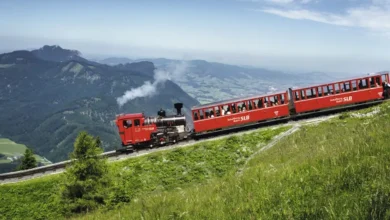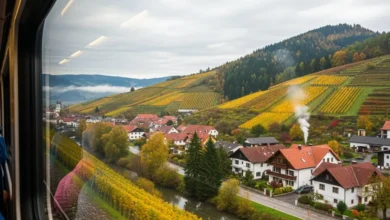
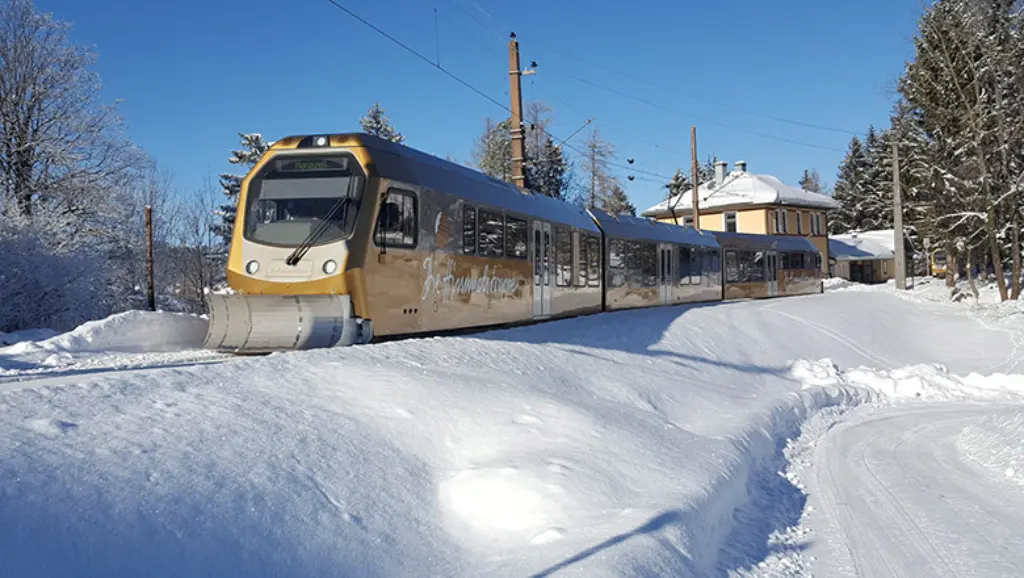
It is the train that climbs a staircase to heaven — quite literally.
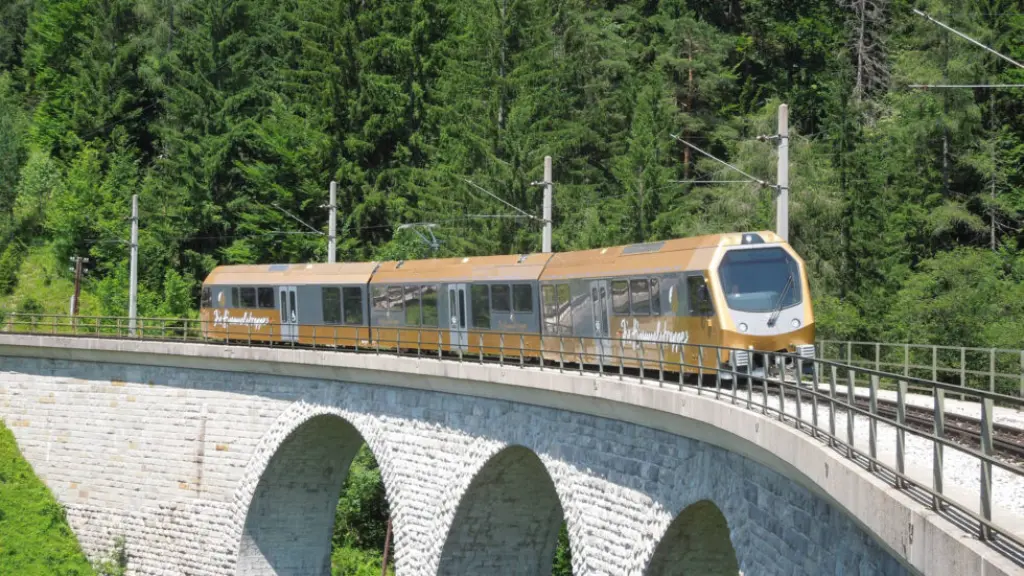
The Mariazellerbahn is Austria’s most scenic narrow-gauge railway, running 84 kilometers from St. Pölten, the capital of Lower Austria, to Mariazell, the country’s most important pilgrimage destination. Along the way, it conquers the Alps using a route so steep and dramatic that the modern panoramic trains are called “Himmelstreppe” — the Sky Staircase.
This is not just a railway. It is a 126-year-old engineering masterpiece that still carries pilgrims, hikers, and curious travelers into the heart of the Austrian Alps.
Here is the complete guide to riding Austria’s most beautiful narrow-gauge line.
The History: A Railway for Pilgrims
Mariazell has been a pilgrimage destination for over 850 years.
Since the 12th century, the faithful have traveled to this small Alpine town to visit the Basilica of the Birth of the Virgin Mary and pray before the miraculous statue of the Madonna. For centuries, pilgrims walked. Some crawled on their knees. The journey was part of the devotion.
Then came the railway age.
In 1898, the Mariazellerbahn opened, transforming a multi-day walk into a comfortable journey. Suddenly, pilgrims from Vienna and beyond could reach Mariazell in hours instead of days.
But building the railway was no simple task:
- Narrow Gauge: The standard gauge was impossible in the tight valleys. The Mariazellerbahn uses 760mm track — the “Bosnian gauge” common in the Habsburg Empire.
- Steep Gradients: The line climbs over 600 meters, with gradients up to 2.7%.
- Tight Curves: Some curves have a radius of just 120 meters — the train practically spirals up the mountain.
- Electrification: In 1911, the line became one of the first electrified railways in Austria — steam locomotives struggled with the steep grades.
126 years later, the Mariazellerbahn continues to operate. Modern panoramic trains share the tracks with historic locomotives, and the pilgrims keep coming.
The Journey: 84 Kilometers of Alpine Wonder
The Mariazellerbahn is divided into two distinct sections, each with its own character.
Part 1: The Pielachtal (St. Pölten → Gösing)
This is the gentler half — the train follows the Pielach River through a pastoral Alpine valley.
St. Pölten Hauptbahnhof
- Starting Point: The capital of Lower Austria. The Mariazellerbahn departs from a dedicated narrow-gauge platform at the main station.
- Elevation: 267 meters
- The Vibe: Modern Austrian city with a Baroque old town. Most travelers are here just to catch the train.
- Pro Tip: The Himmelstreppe trains have a café on board. No need to stock up before boarding.
St. Pölten → Ober-Grafendorf
- What You See: The train winds through the outskirts of St. Pölten, passing suburbs, farms, and the first glimpses of forested hills.
- Highlight: The transition from city to countryside happens quickly. Within minutes, you are in rural Austria.
- Pro Tip: Sit on the RIGHT side for the best river views in the first section.
Ober-Grafendorf → Kirchberg an der Pielach
- What You See: The Pielach Valley opens up. The train follows the crystal-clear river, passing through meadows, small villages, and traditional farmhouses.
- Highlight: Watch for fishermen in the river — the Pielach is famous for trout.
- The Vibe: Peaceful. Pastoral. The kind of Austrian countryside that inspired postcards.
Kirchberg an der Pielach → Loich
- What You See: The valley narrows. Forested slopes rise on both sides. The train begins climbing more noticeably.
- Highlight: The Dirndln (cornelian cherries) for which the valley is famous. In spring, the hillsides bloom with yellow flowers. In autumn, the red berries are harvested for schnapps and jam.
- Fun Fact: This region is called “Dirndltal” (Dirndl Valley) after the fruit, not the traditional dress.
Loich → Schwarzenbach an der Pielach
- What You See: The landscape becomes wilder. Steep cliffs appear. The river tumbles over rocks below.
- Highlight: The train passes through short tunnels and crosses stone bridges — you can feel the engineering challenges intensifying.
- The Vibe: Anticipation builds. The real climb is coming.
Schwarzenbach → Laubenbachmühle
- What You See: The Pielach Valley reaches its end. The mountains close in.
- Highlight: Laubenbachmühle is a junction station. Here, trains reverse direction to tackle the steepest section.
- Important: This is where the Himmelstreppe panoramic trains pause. Get a coffee from the café car and prepare for the spectacle.
Part 2: The “Bergstrecke” (Laubenbachmühle → Mariazell)
This is the legendary section — the “mountain route” that justifies the railway’s fame.
Laubenbachmühle → Puchenstuben
- What You See: The train begins its dramatic ascent. The gradient steepens. The curves tighten. You climb through dense forest, switchbacking up the mountainside.
- Highlight: The train crosses the Pielach Viaduct — a stunning stone bridge high above the valley floor.
- The Experience: You can feel the train working. The motors hum louder. The wheels grip the narrow rails.
The Gösingtunnel and Summit
- What Happens: The train enters the Gösingtunnel (322 meters) and emerges at the highest point of the journey.
- Elevation: 892 meters — you have climbed over 600 meters from St. Pölten.
- Highlight: The Gösingkogel peak rises above the tunnel portal. On clear days, the views back down the valley are breathtaking.
- Pro Tip: Have your camera ready as you exit the tunnel — the panorama reveals itself suddenly.
Gösing → Annaberg
- What You See: The train descends slightly into a high Alpine plateau. The landscape opens up — green meadows, wooden chalets, and the Ötscher massif (1,893m) dominating the horizon.
- Highlight: The Ötscher is the “Father of Lower Austria” — the region’s highest and most sacred peak. It watches over the railway like a guardian.
- Pro Tip: Switch to the LEFT side for the best Ötscher views.
Annaberg → Wienerbruck-Josefsberg
- What You See: The plateau continues. Tiny farming villages. Alpine pastures with grazing cattle. The air feels different — crisper, cleaner, thinner.
- Highlight: Wienerbruck is the gateway to the Ötschergräben — the “Grand Canyon of Austria” (more on this below).
- Optional Stop: Get off here for one of Austria’s most spectacular hikes.
Wienerbruck-Josefsberg → Mitterbach
- What You See: The train descends toward the Erlaufsee, a pristine Alpine lake surrounded by forest.
- Highlight: The lake appears suddenly through the trees — deep blue-green, perfectly still, framed by mountains.
- The Vibe: You are deep in the Alps now. The outside world feels very far away.
Mitterbach → Mariazell
- What You See: The final stretch. The train follows the Salza River valley, passing through the small villages that have served pilgrims for centuries.
- Highlight: The first glimpse of the Mariazell Basilica — its twin towers rising above the trees. For pilgrims, this moment is the culmination of their journey.
Mariazell
- Elevation: 868 meters
- Arrival: The train pulls into this small Alpine town, dominated by the magnificent Baroque basilica.
- The Vibe: Part pilgrimage site, part mountain resort, part living museum of Austrian tradition.
- Pro Tip: The return journey is equally beautiful — consider different seating for new perspectives.
The Himmelstreppe: The Sky Staircase Train
The Mariazellerbahn offers two types of trains. The star of the show is the Himmelstreppe.
What is the Himmelstreppe?
The Himmelstreppe (“Sky Staircase”) is a modern panoramic train designed specifically for this route. Introduced in 2013, these trains combine 21st-century comfort with the historic 760mm narrow-gauge track.
Features of the Himmelstreppe
| Feature | Details |
|---|---|
| Panoramic Windows | Floor-to-ceiling glass for unobstructed mountain views |
| Modern Comfort | Air conditioning, spacious seats, smooth ride |
| Café Car | Onboard café serving coffee, snacks, and local specialties |
| Glass Roof Sections | Look up at the peaks as you pass through the mountains |
| Accessible Design | Wheelchair spaces and step-free boarding at most stations |
| Audio Guide | Available in multiple languages (via app or on request) |
Himmelstreppe vs. Regular Trains
| Himmelstreppe | Regular Train | |
|---|---|---|
| Windows | Panoramic | Standard |
| Café | Yes | No |
| Comfort | Higher | Basic |
| Price | Higher | Lower |
| Frequency | 2-4 times daily | More frequent |
| Experience | Tourist-oriented | Local commuter feel |
My Recommendation: Take the Himmelstreppe at least one way. The panoramic windows genuinely transform the experience, especially on the mountain section.
What Makes It Special?
| Feature | Details |
|---|---|
| Narrow Gauge (760mm) | The “Bosnian gauge” — intimate and closer to the landscape |
| 126 Years of History | One of Austria’s oldest mountain railways |
| 600+ Meters of Climbing | From the Pielach Valley floor to the Alpine highlands |
| Himmelstreppe Panoramic Trains | Modern trains with glass roofs and café service |
| The Ötscher Massif | Lower Austria’s highest peak — visible throughout the journey |
| Mariazell Pilgrimage | Austria’s most important Catholic pilgrimage site |
| The Ötschergräben Gorge | Access to the “Grand Canyon of Austria” |
| Early Electrification | Electric since 1911 — a pioneer of Alpine railway technology |
The Price (Good Value for a Premium Experience)
The Mariazellerbahn offers different ticket options depending on the train type.
Standard Train Fares (St. Pölten → Mariazell)
| Class | One-Way | Round-Trip |
|---|---|---|
| Standard | €23 – €28 | €42 – €50 |
| Children (6-15) | ~50% off | ~50% off |
Himmelstreppe Panoramic Train
| Ticket Type | One-Way | Round-Trip |
|---|---|---|
| Himmelstreppe | €35 – €42 | €60 – €72 |
| Himmelstreppe Premium | €45 – €55 | €80 – €95 |
| Children (6-15) | ~50% off | ~50% off |
Premium tickets include a reserved seat with the best views and café vouchers.
Rail Pass Discounts
| Pass | What You Get |
|---|---|
| Eurail / Interrail | NOT included — the Mariazellerbahn is a private railway (NÖVOG) |
| ÖBB Vorteilscard | May offer small discounts — check locally |
| Niederösterreich-CARD | Free travel on the entire line (great for regional tourism) |
Pro Tip: Buy tickets online at mariazellerbahn.at for the best prices and guaranteed Himmelstreppe seats.
Is It Worth It?
ABSOLUTELY YES, if:
- You love narrow-gauge railways. The 760mm track creates an intimate, close-to-the-landscape experience.
- You want true panoramic views. The Himmelstreppe trains deliver genuine floor-to-ceiling windows.
- You appreciate Austrian tradition. Mariazell is the spiritual heart of Catholic Austria.
- You want to combine train travel with hiking. The Ötschergräben is Austria’s most spectacular gorge.
- You are traveling with family. Kids love the narrow-gauge trains and the café car.
- You want a day trip from Vienna. St. Pölten is just 30 minutes from Vienna by fast train.
MAYBE NOT, if:
- You only have a Eurail/Interrail pass. This private railway is not included — you will pay full fare.
- You are looking for high-speed travel. The journey takes 2.5 hours for 84 kilometers — this is slow travel.
- You are not interested in pilgrimage sites. Mariazell’s main attraction is its religious significance.
- You expect high-altitude drama. The summit is under 900 meters — no glaciers or eternal snow.
The Best Seat Strategy
| Direction | Best Side | Why |
|---|---|---|
| St. Pölten → Mariazell | RIGHT, then LEFT | Right for Pielach Valley; Left for Ötscher views after Gösing |
| Mariazell → St. Pölten | LEFT, then RIGHT | Reverse of above |
For the Himmelstreppe:
- The glass roof sections are in the middle of the train — try to sit there for the tunnel exits.
- Premium seats are typically on the right side (southbound) for the best valley views.
Pro Tip: The Himmelstreppe is rarely completely full except on weekends and holidays. You can often move around to catch the best views.
Best Time to Ride
| Season | Experience |
|---|---|
| Spring (April-May) | Dirndln blossoms, waterfalls at full flow, fresh green meadows |
| Summer (June-August) | Perfect hiking weather, longest days, Ötschergräben at its best |
| Autumn (September-October) | Golden forests, harvest festivals, crisp mountain air |
| Winter (November-March) | Snow-covered landscape, Christmas markets in Mariazell, magical atmosphere |
| Advent Season (December) | Special Advent trains to Mariazell Christmas market — extremely popular |
Best for Photography: Autumn brings golden larch forests and often the clearest skies. Spring offers dramatic waterfalls and wildflowers.
Most Popular Season: The Advent/Christmas season — book Himmelstreppe tickets well in advance for December weekends.
What to Do at Each End
In St. Pölten
- Altstadt (Old Town): Baroque architecture, the Cathedral, and the Rathaus (City Hall).
- Landhausviertel: The modern government quarter with striking contemporary architecture.
- Klangturm: An interactive sound tower — surprisingly fun.
- Day Trip Base: St. Pölten is 30 minutes from Vienna — easy to combine with a Mariazellerbahn adventure.
In Mariazell
- Mariazell Basilica: Austria’s most important pilgrimage church. The Gothic-Baroque interior is stunning. The miraculous Madonna statue has attracted pilgrims since the 12th century.
- Lebkuchen (Gingerbread): Mariazell is famous for its traditional gingerbread. Visit the bakeries on the main square.
- Bürgeralpe Cable Car: Ride up to 1,267 meters for panoramic views. In winter, this is a small ski area.
- Erlaufsee: A pristine Alpine lake just outside town — perfect for swimming in summer or peaceful walks year-round.
- Mechanical Nativity Scene: The Mariazeller Heimathaus has a famous mechanical Christmas crèche with over 100 moving figures.
- Pilgrimage Trail: Walk a section of the historic pilgrimage path that leads to Vienna.
The Ötschergräben: Austria’s Grand Canyon
One of the best reasons to ride the Mariazellerbahn has nothing to do with staying on the train.
The Ötschergräben is a dramatic gorge carved by the Ötscherbach river at the foot of the Ötscher massif. It is often called the “Grand Canyon of Austria” — and while the comparison is exaggerated, the gorge is genuinely spectacular.
How to Get There
- Take the Mariazellerbahn to Wienerbruck-Josefsberg station.
- Follow the signs to the Ötschergräben.
- Hike through the gorge on wooden walkways and bridges.
The Hike
| Route | Length | Duration | Difficulty |
|---|---|---|---|
| Short Loop | 6 km | 2-3 hours | Easy-Moderate |
| Full Traverse | 15 km | 5-6 hours | Moderate |
| With Ötscher Summit | 20+ km | 8-10 hours | Challenging |
What You Will See
- Turquoise pools and rushing waterfalls
- Wooden walkways bolted into cliff faces
- The Mirafall waterfall — one of Austria’s most beautiful
- Lush canyon vegetation
- The towering Ötscher peak above
Pro Tip
The easiest option is the short loop from Wienerbruck. Hike into the gorge, reach the Mirafall, and return the same way. Then catch a later Mariazellerbahn train to continue your journey.
Important: The Ötschergräben is only open from May to October. In winter and early spring, the paths are closed due to ice and rockfall danger.
Combine It With…
The Mariazellerbahn is perfect for day trips from Vienna or multi-day Austrian adventures.
Day Trip from Vienna
| Leg | Route | Duration |
|---|---|---|
| 1 | Vienna Hbf → St. Pölten (ÖBB Railjet) | 30 minutes |
| 2 | St. Pölten → Mariazell (Mariazellerbahn Himmelstreppe) | 2.5 hours |
| 3 | Explore Mariazell | 2-3 hours |
| 4 | Mariazell → St. Pölten → Vienna | 3 hours |
Leave Vienna at 7:00 AM, return by 9:00 PM. A full day in the Alps without needing a car.
Ötschergräben Hiking Day
| Leg | Route | Duration |
|---|---|---|
| 1 | Vienna → St. Pölten → Wienerbruck | 3 hours |
| 2 | Ötschergräben hike | 3-5 hours |
| 3 | Wienerbruck → St. Pölten → Vienna | 3 hours |
Start early. This is a full-day adventure.
Mariazell + Semmering
- Day 1: Vienna → Mariazellerbahn → Mariazell (overnight in Mariazell)
- Day 2: Mariazell → Bus to Mürzzuschlag → Semmering Railway → Vienna
Combine Austria’s two greatest historic railways in one two-day trip.
Lower Austria Railway Triangle
- Mariazellerbahn: St. Pölten → Mariazell
- Bus or drive: Mariazell → Erlaufklause → Gaming
- Visit Gaming Charterhouse (Kartause Gaming — a stunning former monastery)
- Return to St. Pölten or Vienna
Explore the quiet heart of Lower Austria.
Special Trains and Events
The Mariazellerbahn runs numerous special services throughout the year.
Nostalgiefahrten (Heritage Trains)
On select dates, historic trains operate on the line:
- Electric Heritage Locomotives: Original 1911 electric engines
- Steam Trains: Rare but magical — usually for special events
- Historic Carriages: Wooden carriages from the early 20th century
Check the Mariazellerbahn website for heritage train schedules.
Advent Express
During the Christmas season (late November to December 24), special Advent Express trains run to the famous Mariazell Christmas Market.
| Feature | Details |
|---|---|
| Decorated trains | Festive lights and holiday atmosphere |
| Christmas market | Traditional Austrian market in Mariazell |
| Krampus runs | See the terrifying Alpine Christmas demons |
| Glühwein | Mulled wine on the train and at the market |
| Lebkuchen | Mariazell’s famous gingerbread |
Warning: Advent trains are EXTREMELY popular. Book weeks in advance — they often sell out completely.
Ötscherland Express
Special themed trains focusing on the Ötscher region and its hiking opportunities. Usually run in summer and autumn.
Practical Tips
Getting to St. Pölten
| From | Route | Duration |
|---|---|---|
| Vienna Hbf | Railjet or REX train | 25-35 minutes |
| Vienna Airport | Train to Wien Hbf, then Railjet | 1-1.5 hours |
| Linz | Railjet | 1 hour |
| Salzburg | Railjet | 2 hours |
The Mariazellerbahn platform is within St. Pölten Hauptbahnhof — an easy transfer.
Tickets and Booking
- Online: mariazellerbahn.at — best prices, guaranteed Himmelstreppe seats
- At the Station: Ticket office at St. Pölten Hauptbahnhof
- On the Train: Conductors sell tickets, but prices may be higher
Pro Tip: For Himmelstreppe, book online at least a few days ahead, especially for weekends and the Advent season.
What to Bring
- Camera: Obvious, but important. The views are constant.
- Layers: Mountain weather changes quickly. Even in summer, mornings can be cool.
- Snacks: The café car is good but limited. Bring some backup treats.
- Cash: Mariazell is a small town. Not everywhere accepts cards.
- Hiking Shoes: If you plan to visit the Ötschergräben or explore around Mariazell.
Language
- German is the primary language.
- English is understood in tourist areas but less common in small villages along the line.
- The Himmelstreppe audio guide is available in English.
Accessibility
- Himmelstreppe trains are wheelchair accessible.
- Most stations have level boarding.
- Check with NÖVOG for specific accessibility needs.
Why the Mariazellerbahn Matters
There are more dramatic railways in Austria. The Semmering is a UNESCO World Heritage Site. The Arlberg has longer tunnels. The Tauern route crosses higher peaks.
But the Mariazellerbahn has something none of them have: a destination with centuries of meaning.
For over 850 years, pilgrims have walked to Mariazell. They came seeking miracles, forgiveness, hope. They still come — some by foot, some by train.
The Mariazellerbahn was built to serve that ancient journey. Every station along the line was once a resting point for exhausted pilgrims. Every village offered food, shelter, and prayers.
Today, you do not need to be a believer to appreciate what this railway represents. It is a connection to something older than modernity. A train that climbs toward something beyond just a mountain destination.
And even if you have no interest in pilgrimage, the journey itself is worth the devotion.
Summary
The Mariazellerbahn is Austria’s most charming narrow-gauge railway — a 126-year-old engineering marvel that still serves pilgrims, hikers, and travelers seeking escape from the ordinary.
84 kilometers. 600 meters of climbing. Panoramic windows. A café car. The “Grand Canyon of Austria” along the way. And at the end, a Baroque basilica that has drawn the faithful for nearly a millennium.
The Himmelstreppe — the Sky Staircase — is more than a marketing name. It is an accurate description. This train climbs toward something: toward the peaks, toward the pilgrimage, toward that rare feeling of having traveled somewhere that matters.
Whether you come for the faith or just the views, the Mariazellerbahn delivers.
Ready to climb the Sky Staircase? Book your Himmelstreppe tickets at mariazellerbahn.at. Trains run daily from St. Pölten. Connect from Vienna in just 30 minutes.
The pilgrims have been making this journey for 850 years. It is your turn.