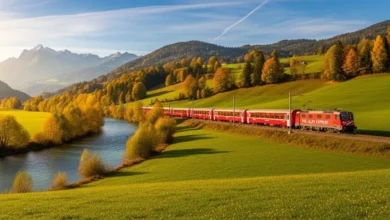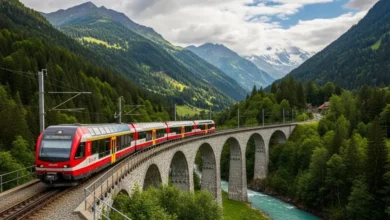
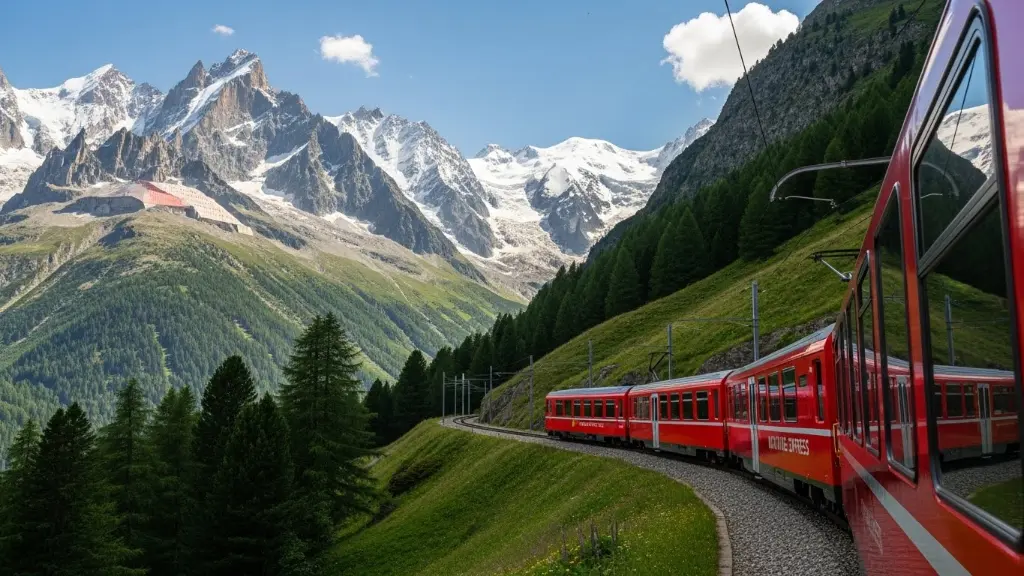
It takes you from Swiss vineyards to the foot of Western Europe’s tallest mountain — in under 2 hours.
The Mont Blanc Express connects Martigny in Switzerland’s Rhône Valley to Chamonix in the French Alps. Along the way, you climb through wild gorges, cross the border into France, and end up staring at the mighty Mont Blanc (4,808m) — the roof of Europe.
This is not just a train ride. It is a gateway between two countries, two cultures, and two completely different Alpine worlds.
Here is everything you need to know about this cross-border adventure.
The Journey: From Vineyards to Glaciers
The Mont Blanc Express packs an incredible variety of scenery into a short journey.
Martigny → Vernayaz
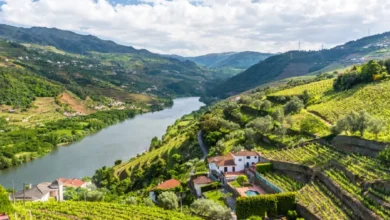
- What You See: The train leaves Martigny and passes through the flat Rhône Valley floor. Vineyards stretch across the sunny hillsides — this is one of Switzerland’s top wine regions.
- Highlight: Look for the medieval Bâtiaz Castle perched on a hill as you leave Martigny.
- Pro Tip: Sit on the RIGHT side of the train when leaving Martigny for the best views throughout the journey.
Vernayaz → Salvan
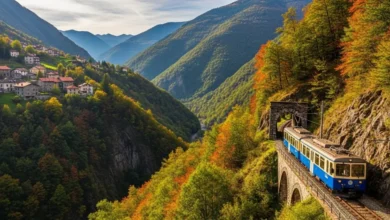
- What You See: The train suddenly starts climbing — steeply. The cogwheel system kicks in as you ascend 800 meters through dense forests and past thundering waterfalls.
- Highlight: The Gorges du Trient — a dramatic ravine carved by the Trient River. You can glimpse it from the train, but it is worth a separate visit.
- The Vibe: The climb is intense. Your ears might pop as you gain altitude quickly.
Salvan → Finhaut
- What You See: The valley opens up. Tiny mountain villages cling to the slopes. The views back toward the Rhône Valley are spectacular.
- Fun Fact: Salvan is where Albert Einstein spent summers as a young man. He reportedly found inspiration for his theories while hiking these mountains.
Finhaut → Le Châtelard-Frontière
- What You See: The train continues climbing through forests and tunnels. The wild Trient Valley feels remote and untouched.
- Highlight: Le Châtelard-Frontière is the border station. Welcome to France.
Le Châtelard → Vallorcine
- What You See: You cross into France and enter the Vallorcine valley. The scenery changes — more rugged, more dramatic. Glaciers start appearing on distant peaks.
- Pro Tip: This is where Mont Blanc first comes into view. Have your camera ready.
Vallorcine → Chamonix-Mont-Blanc
- What You See: The final descent into the Chamonix valley is breathtaking. The Aiguilles (needle-like peaks) of the Mont Blanc massif tower above you. Glaciers hang from the mountainsides.
- Highlight: Arriving in Chamonix with Mont Blanc dominating the skyline. It does not get more dramatic than this.
Optional: Chamonix → Saint-Gervais-les-Bains
- What You See: If you continue beyond Chamonix, the train descends through more French Alpine villages to Saint-Gervais — the end of the line.
- Highlight: The Bionnassay Glacier views and classic French mountain architecture.
What Makes It Special?
| Feature | Details |
|---|---|
| Mont Blanc Views | Direct views of Western Europe’s highest peak (4,808m) |
| Two Countries | Start in Switzerland, end in France |
| Cogwheel Sections | Steep climbs using rack-and-pinion technology |
| Wild Gorges | The Trient Gorge is one of Switzerland’s most dramatic canyons |
| Glacier Views | Multiple glaciers visible from the train, especially near Chamonix |
| Authentic Alpine Villages | Tiny mountain communities that feel frozen in time |
The Price (Cross-Border Bargain)
A one-way ticket from Martigny to Chamonix costs approximately:
- Second Class: CHF 32 – CHF 38 / €30 – €35
- First Class: CHF 52 – CHF 60 / €48 – €55
Rail Pass Discounts
| Pass | What You Get |
|---|---|
| Swiss Travel Pass | FREE for the Swiss section (Martigny → Le Châtelard). French section costs ~€18. |
| Eurail / Interrail | The entire route is included — both Switzerland AND France. |
| Half-Fare Card | 50% off the Swiss section only. |
| Mont Blanc Multipass | Various regional passes cover the full route — check locally. |
Pro Tip: No reservation required. Trains run multiple times per day. Just show up and buy a ticket.
Is It Worth It?
ABSOLUTELY YES, if:
- You want to see Mont Blanc. This train delivers you directly to the base of Europe’s highest mountain.
- You love cross-border adventures. Swiss breakfast, French lunch — all in one morning.
- You want to visit Chamonix. The train is the most scenic way to get there from Switzerland.
- You have a Eurail/Interrail pass. The entire journey is included.
- You appreciate dramatic mountain scenery. Glaciers, gorges, and needle-sharp peaks await.
MAYBE NOT, if:
- You expect a luxury panoramic train. This is a regional mountain train with normal windows.
- You are short on time. The journey is relatively slow due to the steep cogwheel sections.
- You get motion sickness. The climb is steep and winding — some people feel it.
- The weather is bad. Mont Blanc disappears completely in clouds or fog.
The Best Seat Strategy
| Direction | Best Side | Why |
|---|---|---|
| Martigny → Chamonix | RIGHT | Best views of gorges, valleys, and Mont Blanc massif |
| Chamonix → Martigny | LEFT | Same views in reverse |
Pro Tip: The train is rarely packed. Move between sides to catch all the scenery.
Best Time to Ride
| Season | Experience |
|---|---|
| Spring (April-May) | Waterfalls at full power, snow still on peaks, wildflowers blooming |
| Summer (June-August) | Best weather, longest days, clearest mountain views |
| Autumn (September-October) | Golden larch forests, fewer crowds, crisp mountain air |
| Winter (November-March) | Snow-covered landscape, but check schedules — some services reduced |
Weather Warning: Always check the weather before you go. Clear skies = unforgettable. Clouds = you will miss Mont Blanc entirely.
What to Do at Each End
In Martigny (Switzerland)
- Visit the Fondation Pierre Gianadda — a world-class art museum in a small town.
- Explore the Roman amphitheater — Martigny was an important Roman settlement.
- Take a side trip to the Great St. Bernard Pass and meet the famous rescue dogs.
- Sample local wines — the Rhône Valley produces excellent Swiss wines.
In Chamonix (France)
- Ride the Aiguille du Midi cable car to 3,842m for jaw-dropping Mont Blanc views.
- Take the Montenvers Railway to the Mer de Glace — France’s largest glacier.
- Walk through the town center — a charming mix of mountain village and international resort.
- Have lunch at a French café — the croissants are better on this side of the border.
- Hike the famous trails around the valley — from easy walks to serious alpine routes.
Combine It With…
The Mont Blanc Express connects perfectly with other Swiss adventures.
The Alpine Crossing
- Zermatt → Visp → Martigny (regional trains)
- Martigny → Chamonix (Mont Blanc Express)
See the Matterhorn AND Mont Blanc in one day — Switzerland’s two most famous peaks.
Grand Tour of Switzerland Route
The Mont Blanc Express is part of the official “Grand Tour of Switzerland” — a 1,600 km road trip through the country’s highlights. You can follow parts of the route by train.
Rhône Valley Wine and Mountains
- Morning: Wine tasting in Martigny or Sion
- Afternoon: Mont Blanc Express to Chamonix
- Evening: Dinner with a view in Chamonix
French-Swiss Loop
- Geneva → Martigny (regular train)
- Martigny → Chamonix (Mont Blanc Express)
- Chamonix → Geneva (bus via Mont Blanc Tunnel or train via Saint-Gervais and Annecy)
A perfect two-day loop exploring both sides of the Alps.
Practical Tips
- Passport/ID: You are crossing an international border. Carry identification, even though checks are rare.
- Currency: Switzerland uses Francs (CHF), France uses Euros (€).
- Language: French is spoken on both sides — but the Swiss side has more German and Italian influence.
- Phone/Data: Check roaming! You are entering the EU zone (France).
- Food: No dining car on the train. Grab provisions in Martigny before boarding.
- Connections: From Chamonix, buses connect to Geneva (about 1.5 hours) and Courmayeur, Italy (via the Mont Blanc Tunnel).
Side Trip: The Trient Gorge
If you have extra time, stop in Vernayaz on the way back and visit the Gorges du Trient.
- A wooden walkway leads deep into the narrow canyon carved by the Trient River.
- Waterfalls crash around you.
- The gorge is about 200 meters deep and incredibly narrow — walls just a few meters apart.
- Entry: ~CHF 10. Time needed: 1-2 hours.
The train stops right at the gorge entrance — an easy addition to your Mont Blanc Express journey.
Alternative: The Tramway du Mont-Blanc
If you continue past Chamonix to Saint-Gervais-les-Bains, you can connect to the Tramway du Mont-Blanc — France’s highest railway.
- The historic tramway climbs to 2,372m at the Nid d’Aigle (Eagle’s Nest) station.
- From there, hikers can continue toward the Mont Blanc summit on foot (serious mountaineering experience required).
- Even if you do not hike, the views of glaciers and the Bionnassay peak are incredible.
Summary
The Mont Blanc Express is a small train with a big destination. In under two hours, you travel from the sunny Swiss Rhône Valley to the shadow of Europe’s highest mountain.
Wild gorges. Tiny villages. Glaciers. And then — Mont Blanc.
It is not famous like the Glacier Express. It is not crowded like the Jungfrau Railway. But for sheer alpine drama and cross-border adventure, the Mont Blanc Express punches way above its weight.
Pack your passport, grab a window seat, and let the train carry you to the roof of Europe.
Ready to go? Check schedules on the SBB website, the TMR website, or the SNCF website. No reservation needed — just show up and enjoy.