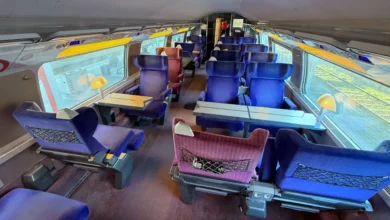
There is nothing quite as scary for a modern traveler as watching your battery percentage turn red.
You are on a train from Berlin to Prague. Your tickets are on your phone. Your map to the hotel is on your phone. You’ve been taking 4K videos of the countryside for two hours. And suddenly—10% battery remaining.
The panic sets in. Do European trains have power outlets? Can you plug your American iPhone charger into them? Or are you going to arrive in Prague with a dead brick in your pocket?
Here is the technical lowdown on keeping your devices juiced up while riding the rails.
The Good News: Yes, There Are Outlets
On almost all modern, long-distance European trains (like the ICE in Germany, TGV in France, Frecciarossa in Italy, and the Eurostar), you will find power outlets.
Rail companies know that passengers are using laptops and tablets, so power is now standard in both First and Second Class.
However, if you are taking a slower “Regional” train (often marked as RE, R, or TER) or an older train in Eastern Europe, outlets might be scarce. In those cases, you might only find one outlet per car (usually near the bathroom or the door) rather than at your seat.
The Catch: You Need an Adapter!
Do not attempt to force your American plug into a European socket. It won’t fit, and you might break it.
- The US Standard: Two flat parallel prongs (Type A/B).
- The European Standard: Two round pins (Type C or F).
You absolutely need a US-to-EU Plug Adapter. This is the simple plastic chunk that changes the shape of your plug.
⚠️ Important Note on The UK: If your trip starts in London, remember that the UK uses a totally different plug (Type G – three big rectangular pins). If you are doing a multi-country trip, your best bet is to buy a Universal Travel Adapter that covers the UK, EU, and US all in one block.
What About Voltage? (Don’t Fry Your Electronics)
Europe runs on 220 volts. The US runs on 110 volts.
- Safe: Phone chargers (Apple/Android), laptop chargers (MacBook/PC), and camera battery chargers. Look at the fine print on your power block. If it says “Input: 100-240V”, you are safe. You just need the adapter tip.
- Not Safe: Hair dryers, straighteners, and curling irons. Unless they are dual-voltage travel specific, do not plug them in on the train. You will blow the fuse or melt your device.
USB Ports vs. Standard Outlets
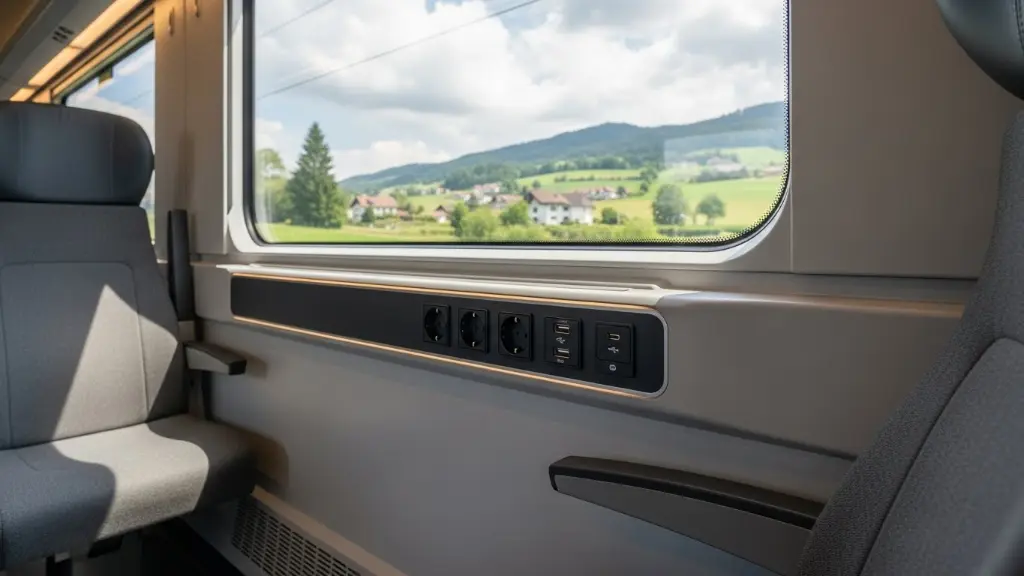
Many newer trains (refurbished in the last 5-10 years) have added USB-A ports directly to the seats.
- The Pro: You don’t need the bulky plastic adapter! You just need your cable.
- The Con: These USB ports often charge very slowly. If you are using your phone for GPS and Spotify while it’s plugged in, the battery might just stay flat rather than go up.
- The Advice: Always prioritize the standard wall outlet if you need a fast charge. Use the USB only for “maintaining” battery or charging smaller devices like headphones.
Troubleshooting: “I Can’t Find the Outlet!”
You get to your seat, you have your adapter ready, but you can’t see the plug. Don’t panic—train designers love to play hide-and-seek.
Check these locations:
- Between the seats: Look down between your seat and your neighbor’s. It is often hidden below knee level.
- Under the seat cushion: Literally feel under the lip of your own seat. Sometimes they face the floor.
- On the wall: If you are in a window seat, it might be on the wall panel or in the little trash bin ledge.
- The Overhead Light: On older trains, sometimes the only outlet is actually above your head near the reading light (originally meant for electric shavers!).
What if the Outlet Doesn’t Work?
Sometimes you plug in, and… nothing happens.
- Is the train moving? Some older trains cut power to the outlets when the engine is off at a station to save the battery. Wait until the train starts moving.
- Is it a “loose” fit? Train outlets get used thousands of times. Sometimes they are worn out and your heavy adapter falls out slightly. Try wiggling it or propping it up with your bag.
- Is the breaker tripped? Sometimes a whole car loses power. Try an outlet in the vestibule (by the doors) or ask the conductor.
Summary
Bring a European Type C adapter. Don’t rely solely on USB ports. And start your scavenger hunt for the outlet as soon as you sit down—sometimes they are hidden under your own legs!
Keep that battery at 100%, and keep snapping those photos! 🔋📸