Traveling by Rail in Spain: High-Speed AVE Trains and Breathtaking Routes
It is the country that quietly built one of the world’s greatest high-speed rail networks — and then started a price war.
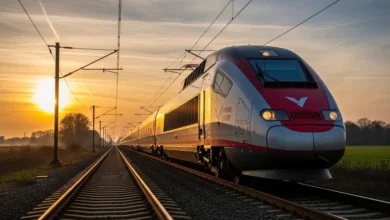
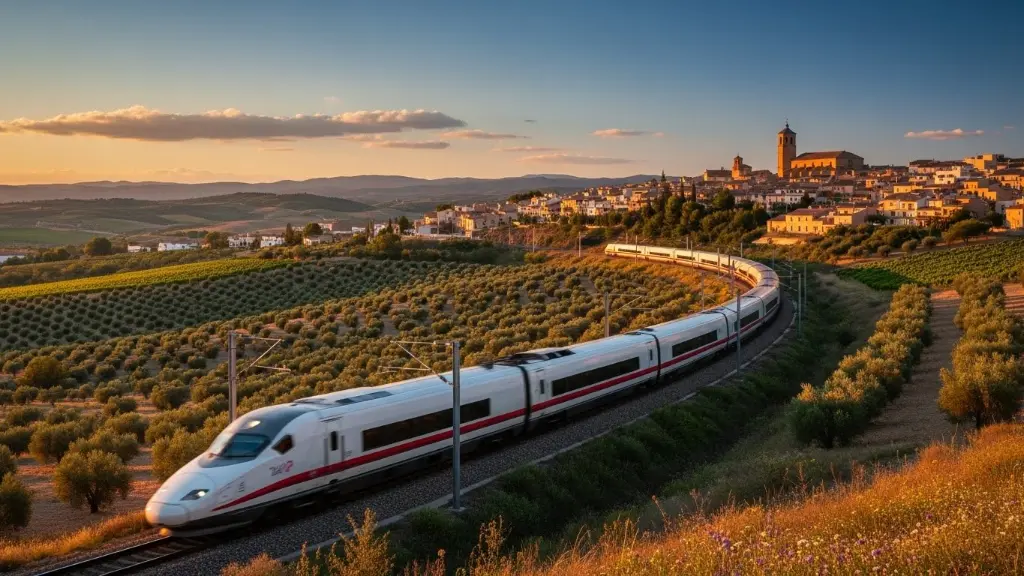
Spain operates the second-largest high-speed railway in the world (after China) and the largest in Europe. Sleek AVE trains connect Madrid to Barcelona in 2.5 hours, to Seville in 2.5 hours, and to Valencia in 1.5 hours. And in the green mountains of the north, narrow-gauge trains wind along cliffs above the Cantabrian Sea, unchanged for a century.
Add fierce competition that has slashed prices, scenic routes through Moorish Andalusia and wild Galicia, and connections to France and Portugal — and you have a country that rewards rail travelers like few others.
This is your complete guide to exploring Spain by train.
Spain by Train: The Overview
| Fact | Details |
|---|---|
| Total Network | ~15,500 km of railway lines |
| High-Speed Network | ~3,800 km (largest in Europe, second globally) |
| Main Operator | Renfe (state-owned) |
| Competitors | Ouigo España, Iryo (high-speed only) |
| Maximum Speed | 310 km/h (AVE S-103 and S-112) |
| Gauge Issue | Two gauges — Iberian (1,668mm) and Standard (1,435mm for AVE) |
| International Connections | France (TGV/AVE), Portugal (limited) |
| Eurail/Interrail | Valid on Renfe (reservation required for AVE/long-distance) |
Why Train Travel Works in Spain
- Speed: Madrid to Barcelona in 2h 30min. Madrid to Seville in 2h 20min. Faster than flying.
- Competition: Three operators now compete on major routes — prices have dropped dramatically.
- Network: High-speed lines reach most major cities, with expansion continuing.
- Scenery: From Andalusian olive groves to Cantabrian cliffs, Spanish trains traverse extraordinary landscapes.
- City Centers: Trains arrive downtown — Atocha in Madrid, Sants in Barcelona, Santa Justa in Seville.
- The North: The narrow-gauge FEVE network offers some of Europe’s most scenic slow travel.
The History: From Iberian Isolation to European Leader
Spain’s railway history is a story of overcoming geographical and political isolation.
The Gauge Decision (1848)
Spain’s first railway opened in 1848 between Barcelona and Mataró. But a fateful decision would shape Spanish railways for over 150 years: Spain chose a different track gauge.
While most of Europe adopted “standard gauge” (1,435mm), Spain selected “Iberian gauge” (1,668mm) — wider, to accommodate more powerful locomotives for climbing the Iberian mountains (and, some say, to prevent French invasion by rail).
This decision isolated Spain from the European railway network for generations. Passengers and freight had to change at the French border.
The National Railway (1941-1992)
After the Spanish Civil War, the Franco government nationalized the fragmented private railways, creating RENFE (Red Nacional de los Ferrocarriles Españoles) in 1941.
RENFE operated a vast but aging network. By the 1980s, Spanish railways were slow, outdated, and losing passengers to roads and airlines. Something had to change.
The AVE Revolution (1992-Present)
Everything changed on April 21, 1992, when Spain launched the AVE (Alta Velocidad Española) — its first high-speed train.
The inaugural line connected Madrid to Seville, built for the Expo ’92 World’s Fair. Crucially, it used standard gauge (1,435mm), allowing future connections to France and Europe.
The AVE was a sensation. Journey time dropped from 6 hours to 2.5 hours. Punctuality became a point of pride — Renfe offered refunds for delays over 5 minutes.
Since then, Spain has built aggressively:
- 2003: Madrid-Zaragoza-Lleida (toward Barcelona)
- 2008: Madrid-Barcelona complete (2h 30min)
- 2010: Madrid-Valencia (1h 35min)
- 2013: Barcelona-French border (connecting to Paris)
- 2015: Madrid-León-Asturias extensions
- 2021: Madrid-Galicia (Santiago, A Coruña)
- 2023: Further extensions to Murcia, Extremadura
Today, Spain has over 3,800 km of high-speed track — more than France, Germany, or Japan.
The Competition Era (2021-Present)
In 2021, Spain opened its high-speed network to competition — a first in Europe:
- Ouigo España: SNCF’s budget brand, operating French trains on Spanish tracks
- Iryo: A new Spanish private operator (joint venture with Trenitalia)
The result? A price war. Madrid-Barcelona tickets that once cost €100+ now start at €9. Spanish high-speed rail became the best value in Europe.
The Operators: Who Runs Spanish Trains?
Renfe (The National Railway)
Renfe is Spain’s state-owned railway operator, running everything from high-speed AVE to suburban Cercanías.
| Aspect | Details |
|---|---|
| Ownership | State-owned (Spanish government) |
| Network | Nationwide — all regions |
| Train Types | AVE, Avlo, Alvia, Euromed, Intercity, Cercanías, FEVE narrow-gauge |
| High-Speed Routes | All AVE lines |
| Regional Services | Media Distancia and Cercanías |
| International | Paris (with SNCF), Marseille, Portugal |
| Eurail/Interrail | VALID (reservation required for AVE/long-distance) |
| Website | renfe.com |
Renfe Strengths:
- Widest network coverage
- Only operator on regional and narrow-gauge routes
- Premium service levels on AVE
Renfe Challenges:
- Website notoriously difficult (improving but still frustrating)
- Booking international tickets can be problematic
- Competition has exposed price inefficiencies
Ouigo España (The French Disruptor)
SNCF brought its budget brand to Spain in 2021, operating TGV trains on Spanish high-speed tracks.
| Aspect | Details |
|---|---|
| Ownership | SNCF (French National Railways) |
| Network | High-speed only — Madrid, Barcelona, Valencia, Seville, Málaga, Alicante |
| Train Type | TGV Duplex (French double-deck trains) |
| Classes | Single class only |
| Amenities | Basic — no bar car, luggage restrictions |
| Eurail/Interrail | NOT VALID |
| Website | ouigo.com/es |
Ouigo España Model:
- Rock-bottom prices (from €9)
- No frills service
- Small bag free, larger luggage costs extra
- Online booking only
- No changes/refunds on cheapest tickets
Ouigo Routes:
- Madrid ↔ Barcelona
- Madrid ↔ Valencia
- Madrid ↔ Seville
- Madrid ↔ Málaga
- Madrid ↔ Alicante
Iryo (The Italian-Spanish Challenger)
Iryo launched in 2022 as a premium alternative to Renfe, jointly owned by Trenitalia (Italian railways) and Air Nostrum (Spanish regional airline).
| Aspect | Details |
|---|---|
| Ownership | Trenitalia (50%) + Air Nostrum (50%) |
| Network | High-speed only — major corridors |
| Train Type | Frecciarossa 1000 (Italy’s fastest trains) |
| Classes | Four classes — Inicial, Singular, Only You, Infinita |
| Amenities | High quality — Wi-Fi, power, food service, spacious seats |
| Eurail/Interrail | NOT VALID |
| Website | iryo.eu |
Iryo Positioning:
- Premium service at competitive prices
- Italian Frecciarossa trains (sleek, modern)
- Free Wi-Fi, generous legroom
- Four-class system from budget to business
- Competitive pricing (often between Ouigo and Renfe)
Iryo Routes:
- Madrid ↔ Barcelona
- Madrid ↔ Valencia
- Madrid ↔ Seville ↔ Málaga
- Madrid ↔ Zaragoza
Operator Comparison: The Price War
The three-way competition has transformed Spanish rail pricing:
| Route | Renfe AVE | Renfe Avlo | Ouigo | Iryo |
|---|---|---|---|---|
| Madrid → Barcelona | €35-130 | €7-35 | €9-45 | €18-80 |
| Madrid → Valencia | €25-80 | €7-25 | €9-35 | €15-50 |
| Madrid → Seville | €35-100 | €7-30 | €9-40 | €18-65 |
| Madrid → Málaga | €40-110 | €9-35 | €9-45 | €20-70 |
Winner: Travelers. Prices have dropped 30-50% since competition began.
FEVE / Renfe Narrow-Gauge (Northern Spain)
The narrow-gauge network of northern Spain — now operated by Renfe — deserves special attention.
| Aspect | Details |
|---|---|
| Official Name | Renfe Feve (formerly FEVE) |
| Network | Northern coast: Galicia, Asturias, Cantabria, Basque Country |
| Gauge | Narrow gauge (1,000mm) |
| Scenery | ★★★★★ — mountains, coast, green valleys |
| Speed | Slow (often 50-60 km/h) |
| Eurail/Interrail | Valid (no reservation needed) |
| Website | renfe.com (search for Feve routes) |
This network is one of Europe’s best-kept secrets. More on this in the scenic routes section.
Train Types: A Complete Guide
Spain has a complex hierarchy of train types. Here is what each one means.
High-Speed Trains
AVE (Alta Velocidad Española)
Spain’s flagship high-speed train — fast, comfortable, and extensive.
| Feature | Details |
|---|---|
| Speed | Up to 310 km/h |
| Routes | All major high-speed corridors |
| Classes | Turista (2nd), Turista Plus, Preferente (1st), Club (premium) |
| Amenities | Wi-Fi, power outlets, dining car/at-seat service (1st), films |
| Reservation | Mandatory |
| Best For | Long-distance travel, speed, comfort |
AVE Train Types:
| Model | Max Speed | Routes | Notes |
|---|---|---|---|
| S-102/S-112 (Talgo) | 330 km/h | Madrid-Seville, Madrid-Málaga | Spanish-built Talgo trains |
| S-103 (Siemens Velaro) | 350 km/h | Madrid-Barcelona, Madrid-Valencia | German technology |
| S-100 (Alstom) | 300 km/h | Various | Original AVE design |
| S-106 (Talgo Avril) | 330 km/h | Madrid-Galicia | Newest fleet |
Avlo (Low-Cost AVE)
Renfe’s budget high-speed brand — same tracks, fewer frills, lower prices.
| Feature | Details |
|---|---|
| Speed | Same as AVE (up to 310 km/h) |
| Routes | Madrid-Barcelona, Madrid-Seville, Madrid-Valencia, Madrid-Alicante |
| Classes | Single class only |
| Amenities | Basic — limited luggage, no food service |
| Reservation | Mandatory |
| Price | From €7 (advance booking) |
| Best For | Budget travelers, simple journeys |
Avlo vs. Ouigo:
Both offer budget high-speed travel. Avlo uses Renfe’s trains and serves Renfe stations; Ouigo uses French TGV trains. Prices are similar; comfort is comparable.
Euromed
High-speed trains on the Mediterranean corridor (not full AVE speed).
| Feature | Details |
|---|---|
| Speed | Up to 200 km/h |
| Routes | Barcelona-Valencia-Alicante corridor |
| Classes | Turista, Preferente |
| Best For | Mediterranean coast travel |
Long-Distance Conventional Trains
Alvia
Long-distance trains that run on both high-speed and conventional tracks. Dual-gauge capability.
| Feature | Details |
|---|---|
| Speed | Up to 250 km/h (on high-speed sections) |
| Routes | Madrid to northern Spain (Bilbao, Santander, Gijón), Madrid-Cádiz, Barcelona-Bilbao |
| Technology | Gauge-changing trains (can switch between standard and Iberian gauge) |
| Classes | Turista, Preferente |
| Reservation | Mandatory |
| Best For | Destinations not on pure high-speed lines |
Alvia trains are a Spanish innovation — they can physically change their wheel gauge at special installations, allowing seamless travel between the standard-gauge AVE network and the Iberian-gauge conventional network.
Intercity
Long-distance conventional trains on Iberian gauge.
| Feature | Details |
|---|---|
| Speed | Up to 160 km/h |
| Routes | Secondary long-distance routes |
| Classes | Turista, Preferente |
| Reservation | Required on most services |
| Best For | Routes without high-speed or Alvia service |
Talgo
Traditional locomotive-hauled trains using Spanish Talgo technology.
| Feature | Details |
|---|---|
| Speed | Up to 200 km/h |
| Routes | Select long-distance routes |
| Technology | Talgo articulated design — low-slung, smooth ride |
| Best For | Overnight services, international trains |
Regional Trains
Media Distancia (MD)
Regional trains connecting cities within the same region or neighboring regions.
| Feature | Details |
|---|---|
| Speed | Up to 160 km/h |
| Routes | Regional connections throughout Spain |
| Reservation | Usually not required |
| Best For | Medium distances, regional exploration |
Avant
High-speed commuter trains for short distances on AVE lines.
| Feature | Details |
|---|---|
| Speed | Up to 250 km/h |
| Routes | Short high-speed hops: Madrid-Toledo, Seville-Córdoba, Barcelona-Lleida |
| Reservation | Required |
| Best For | Day trips on high-speed lines |
Cercanías
Suburban commuter trains serving major cities.
| Feature | Details |
|---|---|
| Speed | Up to 100 km/h |
| Routes | Urban and suburban areas around Madrid, Barcelona, Valencia, Seville, Bilbao, etc. |
| Frequency | Every 5-30 minutes |
| Tickets | Zone-based local pricing |
| Best For | City transport, airport connections |
Major Cercanías networks:
- Madrid: Extensive network covering the metropolitan area
- Barcelona (Rodalies): Urban network plus airport connection
- Valencia: City and surrounding area
- Seville, Málaga, Bilbao: Smaller networks
Narrow-Gauge Trains (FEVE/Renfe)
FEVE Regional Trains
The narrow-gauge network of northern Spain.
| Feature | Details |
|---|---|
| Gauge | 1,000mm (meter gauge) |
| Routes | Ferrol-Bilbao (with branches), Bilbao-León, Santander-Liébana |
| Speed | Slow (40-60 km/h) |
| Scenery | ★★★★★ |
| Reservation | Not required |
| Best For | Scenic travel, authentic experience |
More details in the scenic routes section.
The High-Speed Network: AVE Lines
Spain’s alta velocidad network is the largest in Europe.
The AVE Map
Spain’s high-speed lines radiate from Madrid like a star:
| Line | Route | Opened | Journey Time |
|---|---|---|---|
| LAV Madrid-Sevilla | Madrid → Córdoba → Seville | 1992 | 2h 20min |
| LAV Madrid-Barcelona | Madrid → Zaragoza → Lleida → Barcelona | 2003-2008 | 2h 30min |
| LAV Madrid-Valencia | Madrid → Cuenca → Valencia | 2010 | 1h 35min |
| LAV Madrid-Málaga | Córdoba → Antequera → Málaga | 2007 | 2h 25min |
| LAV Madrid-Valladolid | Madrid → Segovia → Valladolid | 2007 | 55min |
| LAV Madrid-León | Valladolid → Palencia → León | 2015 | 2h 05min |
| LAV Madrid-Galicia | León → Ourense → Santiago → A Coruña | 2021 | 2h 15min (to Santiago) |
| LAV Barcelona-France | Barcelona → Girona → Figueres → France | 2013 | Connects to Paris |
| LAV Levante | Madrid → Albacete → Alicante | 2013 | 2h 20min |
| LAV Murcia | Alicante → Murcia | 2022 | 30min |
| LAV Antequera-Granada | Antequera → Granada | 2019 | 1h 25min (Madrid-Granada) |
Journey Times from Madrid
| Destination | Distance | AVE Time | Trains/Day |
|---|---|---|---|
| Barcelona | 620 km | 2h 30min | 25+ |
| Seville | 470 km | 2h 20min | 20+ |
| Valencia | 350 km | 1h 35min | 18+ |
| Málaga | 515 km | 2h 25min | 12+ |
| Alicante | 445 km | 2h 20min | 10+ |
| Córdoba | 345 km | 1h 45min | 20+ |
| Zaragoza | 315 km | 1h 20min | 25+ |
| Toledo | 75 km | 30min | 12+ |
| Valladolid | 180 km | 55min | 15+ |
| Santiago de Compostela | 600 km | 2h 15min | 6+ |
| Granada | 420 km | 3h 10min | 6+ |
Journey Times from Barcelona
| Destination | Distance | AVE Time | Trains/Day |
|---|---|---|---|
| Madrid | 620 km | 2h 30min | 25+ |
| Valencia | 350 km | 2h 50min | 10+ |
| Seville | 1,000+ km | 5h 30min | 3+ |
| Zaragoza | 315 km | 1h 30min | 15+ |
| Girona | 100 km | 38min | 15+ |
| Figueres | 140 km | 55min | 10+ |
| Paris | 1,050 km | 6h 30min | 2-3 |
Future Expansion
| Project | Route | Status | Expected |
|---|---|---|---|
| Y Vasca | Bilbao-Vitoria-San Sebastián-France | Under construction | 2027+ |
| Extremadura | Madrid-Cáceres-Badajoz-Portugal | Partially open | 2025+ |
| Almería | Granada-Almería | Under construction | 2026+ |
| Atlantic Corridor | Seville-Huelva-Portugal | Planning | 2030+ |
The Price: What Spanish Trains Cost
Spanish train pricing has been revolutionized by competition. Here is the current landscape.
High-Speed Pricing (2024)
The three operators offer dramatically different pricing:
Madrid → Barcelona (2h 30min)
| Operator | Lowest Price | Typical Price | Premium |
|---|---|---|---|
| Ouigo | €9 | €19-35 | N/A |
| Avlo (Renfe) | €7 | €15-30 | N/A |
| Iryo | €18 | €35-55 | €65-90 |
| Renfe AVE | €35 | €60-90 | €110-160 |
Madrid → Seville (2h 20min)
| Operator | Lowest Price | Typical Price | Premium |
|---|---|---|---|
| Ouigo | €9 | €19-35 | N/A |
| Avlo (Renfe) | €9 | €15-30 | N/A |
| Iryo | €18 | €30-50 | €60-80 |
| Renfe AVE | €30 | €50-75 | €90-130 |
Madrid → Valencia (1h 35min)
| Operator | Lowest Price | Typical Price | Premium |
|---|---|---|---|
| Ouigo | €9 | €15-25 | N/A |
| Avlo (Renfe) | €7 | €12-22 | N/A |
| Iryo | €15 | €25-40 | €50-65 |
| Renfe AVE | €25 | €40-55 | €70-100 |
Conventional Long-Distance Pricing
Routes without competition remain more expensive:
| Route | Typical Price |
|---|---|
| Madrid → Bilbao (Alvia) | €40-70 |
| Madrid → Santander (Alvia) | €40-65 |
| Barcelona → Bilbao (Alvia) | €50-80 |
| Madrid → A Coruña (AVE) | €45-90 |
| Seville → Cádiz | €20-35 |
Regional Train Pricing
Media Distancia and Cercanías offer fixed, affordable prices:
| Example Route | Price |
|---|---|
| Madrid → Toledo (Avant) | €13-15 |
| Barcelona → Sitges (Rodalies) | €5-7 |
| Seville → Córdoba (MD) | €15-20 |
| Valencia → Gandía | €6-8 |
| Bilbao → San Sebastián (FEVE narrow-gauge) | €12-15 |
How to Get the Best Prices
- Compare All Three Operators: For Madrid-Barcelona/Seville/Valencia/Málaga, always check Renfe, Ouigo, AND Iryo.
- Book Early: The cheapest fares (€7-15) appear 30-60 days before travel and sell out quickly.
- Be Flexible: Tuesday-Thursday travel is cheapest; Friday/Sunday most expensive.
- Consider Avlo/Ouigo: Same speed as AVE, 50-70% cheaper.
- Use Iryo for Value+Comfort: Often cheaper than Renfe AVE but much more comfortable than Ouigo/Avlo.
- Check Round-Trip Deals: Renfe offers “Ida y Vuelta” discounts (10-20% off round trips).
- Youth/Senior Discounts: Renfe offers Tarjeta Joven (under 26) and Tarjeta Dorada (over 60) cards.
Renfe Discount Cards
| Card | Who | Annual Cost | Discount |
|---|---|---|---|
| Tarjeta Dorada | 60+ years, disabled persons | €6 | 25-40% off most trains |
| Tarjeta Joven | 14-25 years | Free (with youth card) | 25-30% off most trains |
| Tarjeta + Renfe Joven 50 | 14-25 years | €50/year | 50% off AVE |
| Abono Renfe | Commuters | Varies | Unlimited travel on select routes |
Rail Passes: Are They Worth It?
Eurail / Interrail Spain Pass
| Pass Type | 3 Days | 4 Days | 5 Days | 8 Days |
|---|---|---|---|---|
| Adult (2nd class) | ~€195 | ~€225 | ~€260 | ~€340 |
| Youth (2nd class) | ~€155 | ~€180 | ~€210 | ~€275 |
What’s Included:
- All Renfe trains (AVE, Alvia, Intercity, Media Distancia, Cercanías, FEVE)
- Reservation fees extra (€10 for AVE, €6.50 for other long-distance)
What’s NOT Included:
- Ouigo (requires separate tickets)
- Iryo (requires separate tickets)
- Trenhotel night trains (supplement required)
- Private tourist railways
Is a Rail Pass Worth It in Spain?
Usually NO — and here is why:
The price war has made Spanish trains incredibly cheap. When Madrid-Barcelona costs €9-18 with Ouigo or Avlo, a rail pass is hard to justify.
Example Calculation:
Without pass (booking Ouigo/Avlo/Iryo advance):
- Madrid → Barcelona: €15
- Barcelona → Valencia: €15
- Valencia → Madrid: €12
- Total: €42
With 3-Day Spain Pass:
- Pass: €195
- Reservations: €30 (3 x €10)
- Total: €225
The pass costs 5x more!
When a Pass DOES Make Sense:
- Spontaneous travel (cannot book ahead)
- Peak season when budget trains are sold out
- Heavy use of FEVE narrow-gauge in the north (included, no reservations)
- Combined Spain + other countries (Global Pass)
- Lots of regional train travel
Eurail Global Pass
If visiting Spain as part of a larger European trip:
| Pass Type | 4 Days | 5 Days | 7 Days | 15 Days |
|---|---|---|---|---|
| Adult (2nd class) | ~€295 | ~€335 | ~€410 | ~€545 |
The Global Pass becomes more attractive when crossing multiple countries where competition has not reduced prices.
Scenic Routes: The Beautiful Journeys
Spain offers dramatic scenic railways — from the high-speed glimpses of Castilian plains to the narrow-gauge wonders of the north.
1. The Transcantábrico: Ferrol → Bilbao (FEVE Narrow-Gauge)
The Route: Along the entire Cantabrian coast — green mountains meet Atlantic waves.
| Details | |
|---|---|
| Distance | ~650 km |
| Duration | 12+ hours (or multi-day luxury train) |
| Train Type | Renfe Feve (narrow gauge) |
| Scenery | ★★★★★ |
| Highlight | Coastal cliffs, fishing villages, green mountains, Picos de Europa |
This is Spain’s most spectacular scenic railway. The narrow-gauge line hugs the Cantabrian coast, passing through Galicia, Asturias, Cantabria, and the Basque Country. The journey can be done on regular FEVE trains (cheap but slow) or the luxury Transcantábrico tourist train (expensive but all-inclusive).
Regular FEVE Option:
- Break the journey over several days
- Stop in Oviedo, Santander, Llanes
- Covered by Eurail/Interrail
Luxury Transcantábrico:
- 8-day cruise-style train journey
- All meals, excursions, and hotels included
- €4,000-8,000 per person
- Book through Renfe’s luxury train division
Pro Tip: The section from Llanes to Santander is particularly spectacular, with dramatic coastal cliffs and the Picos de Europa mountains as a backdrop.
2. The Bilbao → León Line (FEVE)
The Route: From the Basque Country through the Cantabrian Mountains to Castile.
| Details | |
|---|---|
| Distance | ~300 km |
| Duration | 5-6 hours |
| Train Type | Renfe Feve (narrow gauge) |
| Scenery | ★★★★★ |
| Highlight | Mountain passes, gorges, remote villages |
This line climbs from the industrial Basque Country into the wild Cantabrian Mountains, then descends onto the Castilian plateau. It passes through landscapes that feel like the Spanish Pyrenees — rugged, green, and almost untouched.
3. The Seville → Ronda Route (Conventional)
The Route: Into the heart of Andalusia’s white villages and dramatic gorges.
| Details | |
|---|---|
| Distance | ~135 km |
| Duration | 2-2.5 hours |
| Train Type | Media Distancia |
| Scenery | ★★★★★ |
| Highlight | Andalusian countryside, Ronda gorge, white villages |
The approach to Ronda — a town dramatically perched above a deep gorge — is one of Spain’s most scenic train rides. Olive groves, cork forests, and distant mountains create a quintessentially Andalusian landscape.
4. The Tren de Sóller (Mallorca)
The Route: From Palma across the Tramuntana Mountains to Sóller.
| Details | |
|---|---|
| Distance | 27 km |
| Duration | 1 hour |
| Train Type | Heritage wooden train (narrow gauge) |
| Scenery | ★★★★★ |
| Highlight | Mountain tunnels, orange groves, Sierra de Tramuntana |
This century-old wooden train climbs from Palma over the Tramuntana Mountains, passing through 13 tunnels and offering stunning views of the UNESCO-listed mountain range. At Sóller, a vintage tram continues to Port de Sóller on the coast.
Note: Not covered by Eurail/Interrail. Tickets: ~€25-30 round trip.
5. The Madrid → Seville AVE (High-Speed Scenery)
The Route: High-speed through the heart of Castile and Andalusia.
| Details | |
|---|---|
| Distance | 470 km |
| Duration | 2h 20min |
| Train Type | AVE |
| Scenery | ★★★★ |
| Highlight | Castilian meseta, olive plantations, Córdoba stop |
Even at 300 km/h, the Madrid-Seville AVE offers spectacular glimpses of Spain. The train crosses the endless Castilian plateau, then descends through the olive-covered hills of Andalusia. The stop at Córdoba allows a break to visit the Mezquita.
6. The Cercedilla → Los Cotos Mountain Railway (Guadarrama)
The Route: Into the mountains north of Madrid.
| Details | |
|---|---|
| Distance | 18 km |
| Train Type | Cercanías mountain line |
| Scenery | ★★★★ |
| Highlight | Sierra de Guadarrama, pine forests, Puerto de Navacerrada |
This commuter line climbs into the Guadarrama Mountains, reaching 1,888 meters at Los Cotos. Popular with hikers and skiers, it offers easy access to mountain scenery just an hour from Madrid.
7. The Costa Brava Line: Barcelona → Portbou
The Route: Along Catalonia’s coast to the French border.
| Details | |
|---|---|
| Distance | ~180 km |
| Duration | 2-2.5 hours |
| Train Type | Rodalies/Regional |
| Scenery | ★★★★ |
| Highlight | Mediterranean coast, Costa Brava views, Dalí country |
The regional trains along the Costa Brava offer beautiful coastal scenery, especially north of Blanes. The train passes near Figueres (Dalí Museum) and terminates at Portbou, where the border station sits dramatically above the Mediterranean.
Pro Tip: The most scenic section is between Blanes and the French border.
8. The Cremallera de Montserrat (Rack Railway)
The Route: Up the mountain to Montserrat Monastery.
| Details | |
|---|---|
| Distance | 5 km |
| Duration | 15 minutes |
| Train Type | Rack railway (cogwheel) |
| Scenery | ★★★★★ |
| Highlight | Montserrat rock formations, monastery views |
The Cremallera rack railway climbs from Monistrol de Montserrat up the dramatic mountain to the ancient monastery. The strange serrated rock formations of Montserrat are unlike anywhere else in Spain.
Connection: Regular trains from Barcelona to Monistrol de Montserrat connect with the rack railway.
9. The Galician Coast (Ferrol → A Coruña → Santiago)
The Route: Through Galicia’s Celtic coast.
| Details | |
|---|---|
| Distance | ~150 km |
| Duration | 2-3 hours |
| Train Type | Regional/Media Distancia |
| Scenery | ★★★★ |
| Highlight | Atlantic coast, green hills, pilgrimage route approach |
Galicia feels different from the rest of Spain — greener, wetter, Celtic. The railway along the coast passes through a landscape of fjord-like rías, fishing villages, and eucalyptus forests before arriving in Santiago de Compostela, the pilgrimage city.
10. The Algeciras → Ronda Route
The Route: From the Gibraltar Strait into the Andalusian mountains.
| Details | |
|---|---|
| Distance | ~100 km |
| Duration | 1h 40min |
| Train Type | Media Distancia |
| Scenery | ★★★★★ |
| Highlight | Wild mountains, cork forests, remote valleys |
One of Spain’s most underrated scenic routes, climbing from sea level at Algeciras into the rugged Serranía de Ronda mountains. The landscape is wilder and less cultivated than most of Andalusia.
Regional Guide: Spain by Area
Madrid and Castile
The central hub from which Spain’s railway network radiates.
| Hub | Key Connections | Notes |
|---|---|---|
| Madrid Puerta de Atocha | Barcelona (2.5h), Seville (2.3h), Valencia (1.5h), Málaga (2.4h) | Main high-speed station |
| Madrid Chamartín | Northern Spain (Galicia, Asturias, Basque Country), some AVE | Northern departures |
| Toledo | Madrid (30min Avant) | Day trip for imperial capital |
| Segovia | Madrid (27min AVE) | Aqueduct, alcázar |
| Valladolid | Madrid (55min) | Castilian plain hub |
Madrid Tips:
- Atocha and Chamartín are connected by Cercanías (25 minutes) — allow time for transfers
- Atocha has a famous indoor tropical garden
- New Chamartín-Clara station (2024) is consolidating more services
Madrid Highlights:
- AVE to Toledo (30 min) for a day trip
- AVE to Segovia Guiomar (27 min) for the Roman aqueduct
- AVE to Córdoba (1h 45min) for the Mezquita
Barcelona and Catalonia
Spain’s second city and gateway to the Mediterranean and France.
| Hub | Key Connections | Notes |
|---|---|---|
| Barcelona Sants | Madrid (2.5h), Paris (6.5h), Valencia (3h) | Main station |
| Barcelona Passeig de Gràcia | Central Barcelona stop for some AVE | City center option |
| Girona | Barcelona (38min AVE) | Medieval old town |
| Figueres | Barcelona (55min AVE) | Dalí Museum |
| Tarragona | Barcelona (35min) | Roman ruins |
Catalonia Highlights:
- AVE to Paris (6h 30min direct)
- Rodalies to Sitges (30 min) for beach day trip
- Montserrat rack railway for mountain monastery
- Costa Brava regional trains for coastal scenery
Andalusia
The romantic south — Moorish heritage, white villages, and flamenco.
| Hub | Key Connections | Notes |
|---|---|---|
| Seville Santa Justa | Madrid (2.3h), Córdoba (45min), Málaga (2h) | Main Andalusian hub |
| Córdoba | Madrid (1.75h), Seville (45min), Granada (1.5h direct) | Mezquita |
| Málaga María Zambrano | Madrid (2.4h), Seville (2h) | Costa del Sol gateway |
| Granada | Madrid (3.1h), Seville (2.5h) | Alhambra |
| Cádiz | Seville (1.75h) | Atlantic coast |
Andalusia Highlights:
- Seville-Córdoba-Granada triangle by train
- Ronda scenic route from Algeciras or Seville
- Costa del Sol connections from Málaga
- AVE speed across the olive-covered hills
Valencia and the Levante
Mediterranean coast from Catalonia to Murcia.
| Hub | Key Connections | Notes |
|---|---|---|
| Valencia Joaquín Sorolla | Madrid (1.5h), Barcelona (3h) | High-speed station |
| Valencia Nord | Regional/conventional trains | City center, beautiful modernist building |
| Alicante | Madrid (2.3h) | Costa Blanca |
| Murcia | Madrid/Alicante connections | Southeast gateway |
Valencia Highlights:
- Direct AVE from Madrid (1h 35min)
- Coastal Cercanías to beach towns
- Euromed along the Mediterranean to Barcelona
The Basque Country, Navarra, and La Rioja
Green mountains, industrial heritage, and gastronomic culture.
| Hub | Key Connections | Notes |
|---|---|---|
| Bilbao Abando | Madrid (4.5h Alvia) | Guggenheim city |
| San Sebastián | Madrid (5h), Bilbao (2.5h FEVE or bus) | Coastal beauty, pintxos |
| Vitoria-Gasteiz | Madrid, Bilbao | Future Y Vasca AVE hub |
| Pamplona | Madrid (3h), Zaragoza | Running of the bulls |
| Logroño | Zaragoza, Bilbao | La Rioja wine capital |
Basque Country Tips:
- High-speed connection to France via Y Vasca is under construction (2027+)
- Currently, Alvia trains use gauge-changing technology
- FEVE narrow-gauge connects Bilbao to Santander (scenic alternative)
Northern Spain (Galicia, Asturias, Cantabria)
Green, Atlantic, and dramatically beautiful.
| Hub | Key Connections | Notes |
|---|---|---|
| Santiago de Compostela | Madrid (2.25h AVE since 2021) | Pilgrimage cathedral |
| A Coruña | Madrid (3h+ AVE) | Galician coast |
| Oviedo | Madrid (3.5h Alvia), León | Asturian capital |
| Santander | Madrid (4h Alvia) | Cantabrian coast |
| Gijón | Oviedo connections | Cider culture |
Northern Spain Highlights:
- New Madrid-Galicia AVE (completed 2021-2022)
- FEVE narrow-gauge along the entire Cantabrian coast
- Picos de Europa accessible from multiple stations
The Islands
Mallorca
| Station | Notes |
|---|---|
| Palma Intermodal | Central hub, connections to Inca, Manacor |
| Sóller | Separate heritage railway from Palma |
Mallorca has two railway networks:
- Modern TIB trains to Inca, Sa Pobla, Manacor
- Historic Tren de Sóller to Sóller (must-do scenic route)
Other Islands
Menorca, Ibiza, Tenerife, Gran Canaria, and other islands have no railway networks. Use buses, taxis, or rental cars.
International Connections
Spain connects to France by high-speed rail and to Portugal by conventional trains.
France (High-Speed)
| Route | Duration | Operator | Frequency |
|---|---|---|---|
| Barcelona → Paris | 6h 30min | Renfe-SNCF | 2-3 daily |
| Barcelona → Lyon | 4h 50min | Renfe-SNCF | 1-2 daily |
| Barcelona → Marseille | 4h 30min | Renfe-SNCF | 1-2 daily |
| Barcelona → Toulouse | 3h 15min | Renfe-SNCF | 1-2 daily |
| Barcelona → Montpellier | 2h 50min | Renfe-SNCF | 2-3 daily |
| Madrid → Marseille | 7h 30min | Renfe-SNCF | 1 daily |
France Tips:
- Through TGV/AVE trains — no change at border
- Book via Renfe or SNCF websites
- Eurail/Interrail valid with reservation (passholder quota may be limited)
Portugal (Limited)
| Route | Duration | Operator | Frequency |
|---|---|---|---|
| Madrid → Lisbon | 9-10 hours | Renfe (night train, suspended) / Bus | Check current status |
| Vigo → Porto | 2.5 hours | Renfe + CP | 2-3 daily (change at border) |
| Badajoz → Lisbon | 4-5 hours | CP | Limited |
Portugal Reality Check:
- Train connections between Spain and Portugal are poor
- Night train (Trenhotel Lusitania) has been suspended since 2020
- Buses are often faster and more frequent
- Vigo-Porto is the best railway option (change at border)
- Future high-speed Madrid-Lisbon line planned but years away
Andorra
No railway to Andorra. The closest stations are:
- L’Hospitalet-près-l’Andorre (France) — 25 km from Andorra
- Latour-de-Carol (France) — 40 km
- Puigcerdà (Spain) — 60 km
Bus connections from Toulouse or Barcelona are more practical.
Gibraltar
No railway. Nearest station: Algeciras (bus/taxi to border).
Night Trains
Spain’s overnight train network has contracted significantly, but some services remain.
Current Night Train Routes
| Route | Type | Accommodation | Operator |
|---|---|---|---|
| Barcelona → A Coruña/Vigo | Trenhotel | Seats, couchettes, sleepers | Renfe |
| Barcelona → Galicia | Trenhotel | Various | Renfe |
| Madrid → Lisbon | Suspended | — | Previously Renfe |
Night Train Tips
- Trenhotel services have been reduced and schedules change frequently
- Check Renfe website for current availability
- Quality of sleeper cars varies — some are quite old
- Book Gran Clase for private cabin with bathroom
European Night Train Connections
From France, you can connect to Spanish cities via:
- Daytime TGV/AVE from Paris
- Future night train plans (Paris-Barcelona has been discussed)
Practical Tips for Spanish Train Travel
Buying Tickets
Online (Recommended):
| Operator | Website | Notes |
|---|---|---|
| Renfe | renfe.com | Notoriously difficult; try English version or use app |
| Ouigo | ouigo.com/es | Simple, cheap, Spanish routes only |
| Iryo | iryo.eu | Modern, easy to use |
| Trainline | trainline.com | Compares all operators (small fee) |
| Omio | omio.com | Another aggregator option |
The Renfe Website Problem:
- Renfe’s website has a reputation for being difficult
- Payment often fails with non-Spanish cards
- The mobile app sometimes works better
- Third-party sites (Trainline, Omio) are more reliable but charge fees
- Consider buying at stations if online fails
At the Station:
- Ticket machines (English available)
- Ticket offices (expect queues, especially at Atocha/Sants)
- Ouigo: Online only — cannot buy at stations
Booking Timeline:
- Renfe AVE tickets open 60-90 days in advance
- Ouigo/Iryo may open 4-6 months ahead
- Cheapest fares sell out 2-4 weeks before travel
- Friday/Sunday trains book up fastest
Station Navigation
Spanish stations are generally well-organized and modern (especially high-speed stations).
Key Vocabulary:
- “Salidas” = Departures
- “Llegadas” = Arrivals
- “Andén” / “Vía” = Platform/Track
- “Taquilla” = Ticket office
- “Consigna” = Left luggage
- “Sala de Espera” = Waiting room
Madrid Stations:
- Puerta de Atocha: Main high-speed station (south Madrid). Famous for its tropical garden.
- Chamartín-Clara: Northern station, being expanded. Some AVE and all northern trains.
- Connected by Cercanías (25 minutes) — allow ample time for transfers.
Barcelona Stations:
- Sants: Main station for AVE, long-distance, and some regional.
- Passeig de Gràcia: Central Barcelona, some AVE stop here.
- França: Historic station, limited services.
Security and Boarding
High-Speed Trains (AVE, Ouigo, Iryo):
- Airport-style security screening before boarding
- Arrive 15-30 minutes before departure
- ID/passport may be checked
- Luggage goes through X-ray
Conventional and Regional Trains:
- No security screening
- Just walk onto the platform
On the Train
Finding Your Seat:
- Coche = Car/Carriage number
- Asiento = Seat number
- Displays show your car position on the platform
Luggage:
- Generous allowances on Renfe AVE (2 bags + hand luggage)
- Ouigo and Avlo have restrictions — check before booking
- Large luggage racks at car ends
- Overhead racks for smaller bags
Food and Drink:
- AVE: Cafeteria car, at-seat service in Preferente/Club
- Avlo/Ouigo: Vending machines or bring your own
- Iryo: Food service in premium classes, bar in all classes
- Regional trains: Usually no catering
Wi-Fi and Power:
- AVE/Iryo: Free Wi-Fi, power at most seats
- Avlo/Ouigo: Wi-Fi available, fewer power outlets
- Regional: Variable — newer trains have Wi-Fi
Delays and Punctuality
Spanish high-speed trains have excellent punctuality:
| Operator | Punctuality Rate |
|---|---|
| Renfe AVE | ~95% within 5 minutes |
| Ouigo | ~90% within 5 minutes |
| Iryo | ~93% within 5 minutes |
Renfe Punctuality Guarantee:
- More than 5 minutes late: Partial refund
- More than 15 minutes late: 50% refund
- More than 30 minutes late: 100% refund
- (Applies to AVE only, claim via Renfe website)
Strikes
Spanish railway strikes happen occasionally but are less common than in France or Germany. Check news before travel, especially around labor disputes.
Classes of Service: What to Choose
Renfe AVE Classes
| Class | Features | Who It’s For |
|---|---|---|
| Turista (2nd Class) | Comfortable seats, 2+2 layout, power/Wi-Fi | Most travelers |
| Turista Plus | More legroom, same car as Turista | Extra comfort seekers |
| Preferente (1st Class) | Wider seats, 2+1 layout, meal at seat, newspapers | Business travelers |
| Club | Premium space, full meal, lounge access, extra services | Luxury travelers |
Is Preferente Worth It?
For short trips (under 2 hours): Probably not — Turista is comfortable.
For longer trips (3+ hours): Preferente offers noticeably better space and includes a meal.
For special occasions: Club provides a genuinely premium experience.
Iryo Classes
| Class | Features | Price Level |
|---|---|---|
| Inicial | Basic, good legroom | Budget |
| Singular | More space, power, snacks | Mid-range |
| Only You | Premium seats, full meal, extra services | Business |
| Infinita | Top tier, lounge access, full service | Luxury |
Iryo’s Inicial class is more comfortable than Ouigo/Avlo, making it a good value choice.
Ouigo and Avlo
Single class only. Functional, clean, but less legroom and no food service. Fine for journeys under 3 hours.
Common Mistakes to Avoid
1. Using Only Renfe
For Madrid-Barcelona/Seville/Valencia/Málaga, ALWAYS compare Renfe, Ouigo, and Iryo. You could pay €90 on Renfe or €15 on Ouigo for the same journey time.
2. Fighting the Renfe Website
Renfe’s website is notorious. If it refuses your payment:
- Try the Renfe app
- Use Trainline or Omio (small fee but works)
- Buy at the station (arrive early)
3. Missing Platform Security
AVE, Ouigo, and Iryo require security screening. Allow 15-30 minutes before departure.
4. Assuming Eurail Covers Everything
Eurail/Interrail covers Renfe but NOT Ouigo or Iryo. On competitive routes, separate tickets are often cheaper anyway.
5. Ignoring the Narrow-Gauge North
The FEVE network in northern Spain is one of Europe’s best scenic railways — and covered by Eurail/Interrail at no extra cost.
6. Not Checking Luggage Limits on Budget Trains
Ouigo and Avlo have strict luggage policies. A large suitcase can cost €5-15 extra. Check before booking.
7. Booking Last-Minute
Spanish high-speed tickets follow airline pricing. The cheapest fares (€7-15) sell out weeks ahead. Last-minute can cost 5-10x more.
8. Confusing Madrid’s Stations
Madrid has two main stations (Atocha and Chamartín). Check which one your train uses, and allow time to transfer if connecting.
9. Expecting Good Portugal Connections
Train travel between Spain and Portugal is difficult. The night train is suspended, and day trains are slow and infrequent. Consider buses or flights for Spain-Portugal travel.
10. Skipping Córdoba
The Madrid-Seville AVE stops at Córdoba (1h 45min from Madrid). The Mezquita is one of Spain’s greatest monuments, and the stop adds minimal time. Build it into your journey.
Traveling with Bikes
Spain allows bicycles on most trains, but rules vary.
Bike Policies
| Train Type | Bikes Allowed? | Reservation? | Cost |
|---|---|---|---|
| AVE | Folding bikes only (free) OR boxed/bagged | N/A | Free if packaged |
| Alvia/Intercity | Yes, in designated spaces | Recommended | €3 |
| Media Distancia | Yes | Sometimes needed | Free to €3 |
| Cercanías | Yes (off-peak) | No | Free |
| FEVE | Yes | No | Free |
Bike Travel Tips
- AVE is restrictive — only folding bikes or bikes in bags/boxes
- Regional trains are more accommodating
- FEVE narrow-gauge is very bike-friendly
- Check Renfe website for “Bici” options when booking
Special Trains: Luxury and Tourist Services
Spain operates several luxury tourist trains.
El Transcantábrico
| Feature | Details |
|---|---|
| Route | San Sebastián → Santiago de Compostela (or reverse) |
| Duration | 8 days / 7 nights |
| Type | Luxury cruise train |
| Price | €4,000-8,000 per person |
| Includes | All meals, excursions, hotels, entertainment |
The Transcantábrico is one of Europe’s great luxury trains. It follows the narrow-gauge FEVE route along the Cantabrian coast, with passengers staying aboard in vintage sleeper cars or at hotels along the way.
El Expreso de La Robla
| Feature | Details |
|---|---|
| Route | Bilbao → León |
| Duration | 4 days / 3 nights |
| Type | Luxury tourist train |
| Price | €2,500-4,000 per person |
A shorter luxury journey through the Cantabrian Mountains.
Tren de la Fresa (Strawberry Train)
| Feature | Details |
|---|---|
| Route | Madrid → Aranjuez |
| Duration | Day trip (seasonal, weekends) |
| Type | Heritage steam train |
| Price | ~€35-40 including strawberries and entry |
A charming vintage steam train from Madrid to the royal palace at Aranjuez, with hostesses in period costume serving strawberries and cream.
Tren de Cervantes
| Feature | Details |
|---|---|
| Route | Madrid → Alcalá de Henares |
| Duration | Day trip (seasonal, weekends) |
| Type | Heritage train with theatrical performances |
| Price | ~€25-30 |
A theatrical train journey to Cervantes’ birthplace, with actors performing scenes from Don Quixote.
The Two Gauges: Why It Matters
Spain’s railway gauge history affects travelers even today.
The Gauge Problem
| Gauge | Width | Usage |
|---|---|---|
| Iberian Gauge | 1,668mm | Conventional lines (most of Spain and Portugal) |
| Standard Gauge | 1,435mm | High-speed lines (AVE), same as France |
When Spain built the AVE, it chose standard gauge to connect with France. This created a dual-gauge network:
- AVE trains run on standard gauge (new high-speed lines)
- Conventional trains run on Iberian gauge (older network)
Gauge-Changing Trains
Alvia and Avant trains can change their wheel gauge automatically at special installations, allowing them to:
- Start on the high-speed network (standard gauge)
- Switch to conventional tracks (Iberian gauge)
- Reach destinations not on the AVE network
This technology is a Spanish innovation and enables cities like Bilbao, Santander, and A Coruña (before the new AVE) to benefit from partial high-speed travel.
What It Means for Travelers
Usually nothing — the system works seamlessly. But it explains:
- Why Alvia trains are slower than AVE (they use some conventional tracks)
- Why the French border required a change before 2013 (different gauges)
- Why some cities have both high-speed and conventional stations
The Best Spanish Train Journeys: A Summary
| Journey | Why It’s Special |
|---|---|
| Madrid → Barcelona (AVE) | 2h 30min, 620 km, the route that transformed Spain |
| FEVE Cantabrian Coast | Green mountains meet Atlantic cliffs — Spain’s best scenic line |
| Tren de Sóller (Mallorca) | Vintage wooden train through Tramuntana Mountains |
| Madrid → Seville (AVE) | Castilian plains to Andalusian olive groves at 300 km/h |
| Ronda Approach | Dramatic gorges and white villages of Andalusia |
| Bilbao → León (FEVE) | Wild Cantabrian mountain crossing |
| Barcelona → Paris (AVE/TGV) | 6h 30min, two countries, no change |
| Cremallera de Montserrat | Rack railway to the monastery in the serrated mountains |
| Galician Coast | Celtic green landscapes and the approach to Santiago |
| Algeciras → Ronda | Wild cork forests and remote mountain valleys |
Summary
Spain built one of the world’s great high-speed rail networks — and then invited competition that made it affordable for everyone.
The AVE is an engineering and commercial triumph. Madrid to Barcelona in 2h 30min. Madrid to Seville in 2h 20min. Sleek trains racing at 300 km/h across the Castilian meseta, through olive groves, into the heart of Andalusia.
And then Ouigo arrived with €9 tickets. Iryo followed with Italian Frecciarossa elegance at competitive prices. Renfe responded with Avlo. Suddenly, high-speed Spanish travel costs less than a restaurant meal.
But Spain is not just about speed.
In the green north, narrow-gauge trains wind along cliff edges above the Cantabrian Sea. The FEVE network — slow, creaky, beautiful — offers some of Europe’s finest scenic journeys. In Mallorca, a wooden train from 1912 crosses the Tramuntana Mountains. In Andalusia, regional trains climb through white villages toward Ronda’s dramatic gorge.
The stations are modern and efficient. The punctuality is excellent. The competition keeps prices low.
This is a country that decided trains mattered — and invested accordingly. From the royal courts of Madrid to the beaches of Barcelona, from the pilgrimage city of Santiago to the Moorish monuments of Seville, Spanish trains connect a nation that stretches from the Atlantic to the Mediterranean, from the Pyrenees to the Strait of Gibraltar.
And they do it fast, cheap, and (usually) on time.
Ready to explore?
- Book Renfe at renfe.com (or try the app)
- Book Ouigo at ouigo.com/es
- Book Iryo at iryo.eu
- Compare all at trainline.com
Book early for the best prices. Compare all three operators. And let Spain’s trains carry you from the mountains to the sea, from medieval cathedrals to Gaudí’s fantasies, from jamón to paella.
¡Buen viaje!