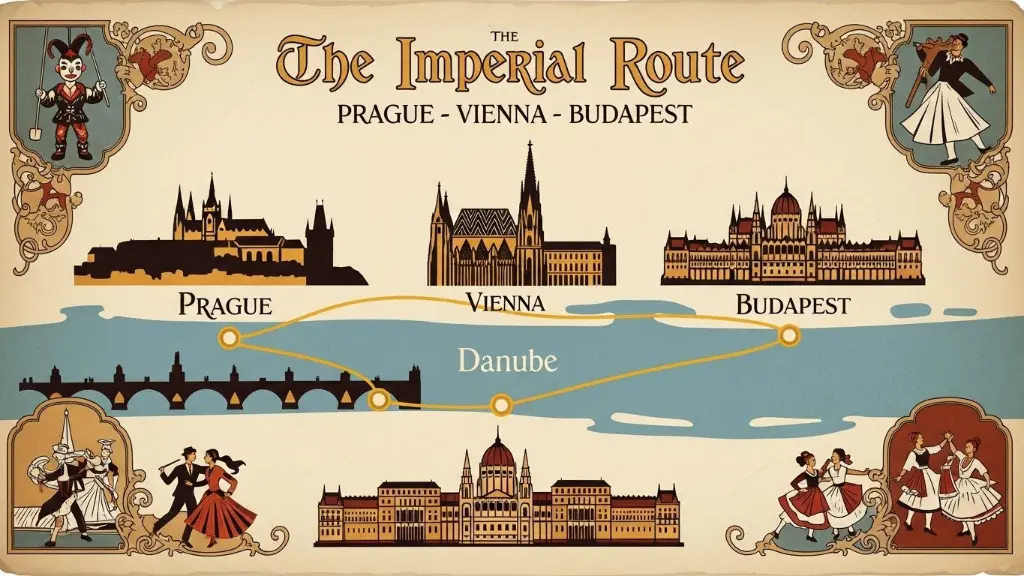
Three capitals. Three countries. One legendary journey through the heart of the former Habsburg Empire.
The Imperial Route connects Prague, Vienna, and Budapest — three of Europe’s most stunning cities. These were once the power centers of the Austro-Hungarian Empire, and today they remain jewels of Central European culture, architecture, and nightlife.
The best part? You can travel between all three by train in a single day. Or better — take your time and soak in centuries of imperial grandeur.
Here is your complete guide to conquering the Imperial Route by rail.
The Route: An Overview
| Segment | Distance | Duration | Trains per Day |
|---|---|---|---|
| Prague → Vienna | 334 km | 4 – 4.5 hours | 6 – 8 direct trains |
| Vienna → Budapest | 250 km | 2.5 – 3 hours | 10 – 12 direct trains |
| Total: Prague → Budapest | 584 km | 6.5 – 7.5 hours | Via Vienna |
You can travel the route in either direction. Most travelers start in Prague and end in Budapest — or vice versa.
The Journey: What You Will See
This is not a designated “scenic train” like the Swiss panoramic routes. But that does not mean the views are boring. Far from it.
Prague → Vienna
Prague → Brno
- What You See: The train leaves Prague’s historic main station (Praha hlavní nádraží) and heads southeast through the Bohemian countryside. Rolling farmland, small villages, and forested hills.
- Highlight: Passing through the Bohemian-Moravian Highlands — gentle, green, and peaceful.
Brno → Břeclav
- What You See: The Moravian wine region. Vineyards appear on the hillsides. The landscape flattens as you approach the Austrian border.
- Pro Tip: Moravia produces excellent wines — try some if you stop in Brno.
Břeclav → Vienna
- What You See: You cross into Austria and enter the flat plains of Lower Austria. The scenery is not dramatic, but the anticipation builds as you approach Vienna.
- Highlight: Arriving at Wien Hauptbahnhof (Vienna Central Station) — a sleek, modern station in the heart of one of Europe’s grandest cities.
Vienna → Budapest
Vienna → Hegyeshalom (Border)
- What You See: The train heads east across the flat Austrian plains. Not the most exciting scenery, but quick and smooth.
- Border Crossing: You enter Hungary at Hegyeshalom. No passport control (Schengen Area), but you will notice the signs change to Hungarian.
Hegyeshalom → Győr
- What You See: The Hungarian countryside — vast agricultural plains, small towns, church steeples.
- Highlight: Győr is a beautiful Baroque city. Worth a stop if you have time.
Győr → Budapest
- What You See: The Danube River appears on your right as you approach Budapest. The landscape becomes more interesting.
- Highlight: Arriving at Budapest-Keleti station — a stunning 19th-century railway palace. One of Europe’s most beautiful train stations.
What Makes It Special?
| Feature | Details |
|---|---|
| Three Imperial Capitals | Prague, Vienna, and Budapest were all power centers of European empires |
| Habsburg History | This route follows the old connections of the Austro-Hungarian Empire |
| Architectural Wonders | Gothic spires, Baroque palaces, Art Nouveau treasures in each city |
| Easy Connections | Direct trains, no complicated transfers |
| Affordable | Central European prices — much cheaper than Western Europe |
| Cultural Variety | Czech, Austrian, and Hungarian — three distinct cultures in one trip |
The Trains: What to Expect
Prague → Vienna
- Operators: ČD (Czech Railways), ÖBB (Austrian Railways), or RegioJet (private)
- Train Types:
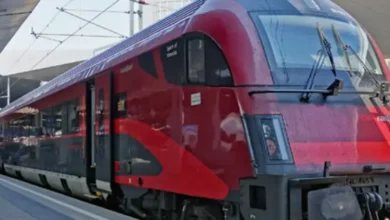
- Railjet: The premium option. Modern, fast, comfortable. First and second class. Bistro car available.
- EuroCity: Standard international trains. Comfortable but slightly older.
- RegioJet: Private operator. Often cheaper. Free drinks and entertainment included.
- Pro Tip: Railjet trains are the fastest and most comfortable. Book in advance for the best prices.
Vienna → Budapest
- Operators: ÖBB (Austrian Railways) and MÁV (Hungarian Railways)
- Train Types:
- Railjet: Fast and modern. The best option.
- EuroCity: Good alternative if Railjet is sold out.
- Pro Tip: Trains to Budapest fill up quickly, especially on weekends. Book ahead.
The Price (Very Affordable)
Train tickets in Central Europe are significantly cheaper than in Switzerland or Western Europe.
Prague → Vienna
| Class | Advance Price | On-the-Day Price |
|---|---|---|
| Second Class | €15 – €30 | €40 – €60 |
| First Class | €25 – €50 | €70 – €100 |
Vienna → Budapest
| Class | Advance Price | On-the-Day Price |
|---|---|---|
| Second Class | €15 – €25 | €35 – €50 |
| First Class | €25 – €45 | €60 – €85 |
Full Route: Prague → Vienna → Budapest
| Class | Advance Price | On-the-Day Price |
|---|---|---|
| Second Class | €30 – €55 | €75 – €110 |
| First Class | €50 – €95 | €130 – €185 |
Pro Tip: Book 2-4 weeks in advance on the ÖBB website or Czech Railways for the best prices. RegioJet often has the cheapest fares for the Prague-Vienna segment.
Rail Pass Discounts
| Pass | What You Get |
|---|---|
| Eurail / Interrail Global Pass | All three segments included. Seat reservation recommended but usually not mandatory. |
| Eurail One Country Passes | You would need three separate passes — not cost-effective for this route. |
| ÖBB Sparschiene | Discounted point-to-point tickets. Book early for the best deals. |
Is a Rail Pass Worth It?
For the Imperial Route alone, probably not. Direct tickets are cheap enough that a rail pass does not save money unless you are doing many more train journeys in Europe.
However, if the Imperial Route is part of a longer European trip, a Eurail/Interrail Global Pass can be excellent value.
Is It Worth It?
ABSOLUTELY YES, if:
- You love history and architecture. These three cities are living museums of European imperial power.
- You want to experience three cultures in one trip. Czech, Austrian, Hungarian — all different, all fascinating.
- You prefer trains over planes. The city-center to city-center connections beat flying by miles.
- You are on a budget. Central Europe offers incredible value compared to Western Europe.
- You enjoy train travel. Comfortable seats, dining cars, and watching the countryside roll by.
MAYBE NOT, if:
- You expect dramatic mountain scenery. This is not Switzerland. The landscapes are mostly flat and agricultural.
- You are in a rush. Flights between these cities take only an hour — though airports waste that time advantage.
- You hate long train rides. Prague to Budapest is 6-7 hours total (with Vienna transfer).
The Best Seat Strategy
| Segment | Best Side | Why |
|---|---|---|
| Prague → Vienna | Either | Scenery is pleasant but not dramatically different on either side |
| Vienna → Budapest | RIGHT | Better views of the Danube approaching Budapest |
Pro Tip: In Railjet first class, seats face forward in a 2+1 configuration with extra legroom. Worth the upgrade for long journeys.
How Many Days Do You Need?
| Itinerary | Days | Experience |
|---|---|---|
| Speed Run | 3 days | One night each city. Exhausting but doable. |
| Comfortable | 5-6 days | Two nights each city. Time to explore properly. |
| Ideal | 7-9 days | 2-3 nights each city plus possible day trips. |
My Recommendation: At least 2 nights in each city. These are not small towns — there is too much to see for just one night.
What to Do in Each City
Prague (Czech Republic)
- Charles Bridge: The iconic Gothic bridge lined with Baroque statues. Best at sunrise before the crowds.
- Prague Castle: The largest ancient castle complex in the world.
- Old Town Square: Astronomical clock, colorful Baroque buildings, medieval charm.
- Beer Culture: Czech beer is world-famous. Visit a traditional pub (hospoda) and try Pilsner Urquell or Staropramen.
- Hidden Gem: Vyšehrad — a peaceful fortress with incredible views, far from the tourist hordes.
Vienna (Austria)
- Schönbrunn Palace: The Habsburg summer residence. Versailles-level grandeur.
- St. Stephen’s Cathedral: Gothic masterpiece in the heart of the city.
- Belvedere Palace: Baroque palace with Gustav Klimt’s famous “The Kiss.”
- Coffee Culture: Vienna invented the coffee house. Spend an hour at Café Central or Café Sacher.
- Hidden Gem: The Naschmarkt — a sprawling food market with incredible international cuisine.
Budapest (Hungary)
- Buda Castle: The royal palace perched above the Danube. Take the funicular up.
- Hungarian Parliament: One of the most beautiful government buildings in the world. Best viewed from across the river.
- Thermal Baths: Széchenyi or Gellért — soak in hot springs like the locals have for centuries.
- Ruin Bars: The Jewish Quarter is famous for its quirky, artistic ruin bars. Szimpla Kert is the original.
- Hidden Gem: The Fisherman’s Bastion at sunset — fairy-tale towers with views over the entire city.
Combine It With…
The Imperial Route is a natural starting point for a larger European adventure.
Extended Central Europe Loop
- Prague → Vienna → Budapest (Imperial Route)
- Budapest → Bratislava (1.5 hours by train or hydrofoil on the Danube)
- Bratislava → Prague (4 hours by train)
A perfect circle through four capitals.
Add Krakow
- Prague → Vienna → Budapest
- Budapest → Krakow, Poland (5-6 hours by train)
- Visit Auschwitz and the Wieliczka Salt Mine
A powerful journey through Central European history.
Danube Connection
- Prague → Vienna (train)
- Vienna → Budapest (hydrofoil on the Danube — about 5 hours, very scenic)
Replace one train segment with a river cruise for a different perspective.
Continue South to the Balkans
- Complete the Imperial Route to Budapest
- Budapest → Belgrade, Serbia (6-8 hours)
- Belgrade → Sofia, Bulgaria or → Zagreb, Croatia
The Imperial Route becomes the gateway to the Balkans.
Practical Tips
Border Crossings
- All three countries are in the Schengen Area. No passport control on trains.
- You should still carry your passport or EU ID card at all times.
Currency
| Country | Currency | Cards Accepted? |
|---|---|---|
| Czech Republic | Czech Koruna (CZK) | Yes, widely |
| Austria | Euro (EUR) | Yes, widely |
| Hungary | Hungarian Forint (HUF) | Yes, widely |
Pro Tip: Exchange or withdraw local currency at each stop. Avoid currency exchange booths in tourist areas — terrible rates.
Language
- Prague: Czech. English widely spoken in tourist areas.
- Vienna: German. Excellent English everywhere.
- Budapest: Hungarian. English common in the center, less so outside.
Plug Type
All three countries use Type C / Type F plugs (standard European two-pin). Bring a universal adapter if you are from the US/UK.
Best Time to Visit
| Season | Experience |
|---|---|
| Spring (April-May) | Pleasant weather, blooming parks, fewer crowds |
| Summer (June-August) | Warm, busy, outdoor festivals — book accommodation early |
| Autumn (September-October) | Beautiful colors, wine harvest season, comfortable temperatures |
| Winter (November-March) | Christmas markets (December), cold but magical, fewer tourists |
Where to Book
| Website | Best For |
|---|---|
| ÖBB (Austrian Railways) | Best for Vienna connections. Often the cheapest Railjet tickets. |
| Czech Railways (ČD) | Prague departures. Good advance prices. |
| RegioJet | Private operator. Sometimes the cheapest Prague-Vienna option. |
| MÁV (Hungarian Railways) | Budapest tickets. Website can be tricky in English. |
| Trainline | Easy comparison of all operators. Small booking fee. |
Pro Tip: ÖBB usually has the best website experience and accepts international credit cards without issues.
Alternative: Fly Between Cities?
Budget airlines like Ryanair and Wizz Air operate between these cities. But consider this:
| Factor | Train | Plane |
|---|---|---|
| City Center to Center | Yes | No (airports are far out) |
| Check-in/Security Time | None | 1-2 hours minimum |
| Luggage Fees | None | Often extra |
| Comfort | Spacious seats, bistro car | Cramped seats, no food |
| Environmental Impact | Lower | Higher |
| Scenery | Countryside views | Clouds |
Verdict: Unless you are extremely short on time, the train wins. City center to city center, more comfortable, often the same total travel time once you factor in airport hassle.
Summary
The Imperial Route is not about dramatic Alpine scenery or engineering marvels. It is about something deeper — a journey through the heart of European history.
Three capitals. Three cultures. Palaces and castles. Coffee houses and beer halls. Danube views and cobblestone streets.
Prague’s Gothic spires. Vienna’s imperial grandeur. Budapest’s Danube-spanning beauty.
This is the route that emperors traveled. And now it is yours — for less than €100 and a few relaxing hours on a comfortable train.
Ready to travel like royalty? Book your tickets on ÖBB, Czech Railways, or RegioJet. Advance booking gets you the best prices — sometimes as low as €15 per segment.