China-Europe Freight Surge: Rail Bridges Continents as New Year Traffic Booms
January 17, 2026
0 98 9 minutes read
Multiple freight trains departed China in early January, strengthening overland supply chains between Asia and Europe
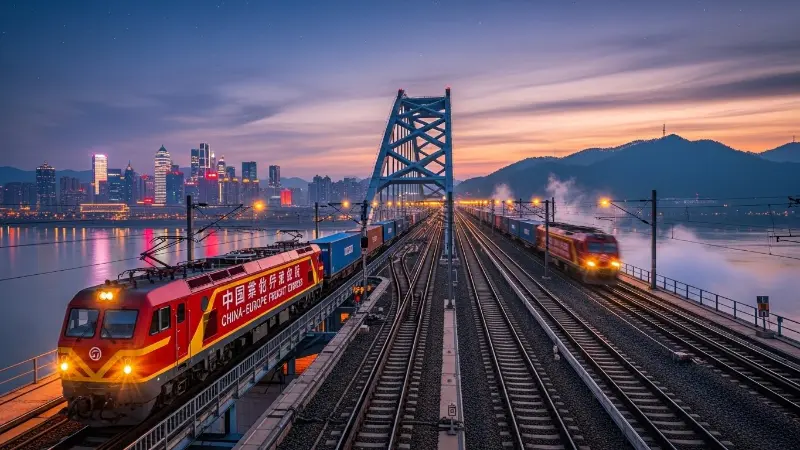
As the new year began, multiple freight trains departed from Chinese cities bound for European destinations, marking a strong start to 2025 for the China-Europe Railway Express network. Routes including Guangdong to Poland saw increased activity, reinforcing the overland freight corridor that has become a critical artery for global trade.
The surge comes at a significant moment for European logistics. With intra-European rail freight facing structural challenges, the transcontinental China-Europe service offers supply chain resilience, competitive transit times, and an alternative to both sea and air freight.
Containers transfer to truck/rail for final delivery
Route Development
New connections and capacity additions
Technology Transfer
Chinese logistics expertise applied to European operations
The China-Europe trains bring cargo that might otherwise arrive by sea at Rotterdam, Hamburg, or Piraeus. By entering Europe via the eastern land border, they redistribute logistics patterns and create new opportunities for Polish, German, and other terminals.
Infrastructure construction has environmental cost
Despite caveats, rail freight is significantly cleaner than air and generally comparable or better than sea freight for carbon emissions per ton-kilometer.
Challenges and Risks
Operational Challenges
Challenge
Impact
Border Delays
Gauge changes and customs slow transit
Capacity Constraints
Terminal and track capacity limits growth
Equipment Imbalance
More containers going west than east
Weather
Extreme cold affects operations in winter
Reliability Variance
Transit times can vary significantly
Geopolitical Risks
Risk
Concern
Russia Sanctions
Potential future restrictions
Transit Country Stability
Political changes could affect access
US-China Tensions
Trade war impacts cargo volumes
EU-China Relations
Strategic concerns about dependence
Commercial Risks
Risk
Factor
Competition from Sea Freight
Shipping rates fell post-pandemic
Subsidy Reduction
Chinese subsidies being phased out
Demand Fluctuations
Trade volumes sensitive to economic cycles
Price Competition
Multiple operators competing on routes
The Subsidy Question
Chinese government subsidies have supported the development of China-Europe rail freight:
How Subsidies Worked
Phase
Policy
Early Years (2011-2018)
Heavy subsidies — up to 50% of transport cost
Reduction Phase (2018-2020)
Gradual subsidy reduction mandated
Current Policy
Subsidies largely phased out; market pricing
Local Support
Some provincial/city subsidies continue
Impact of Subsidy Reduction
Concern
Reality
Will volumes collapse?
Volumes have remained strong post-subsidy reduction
Are services viable?
Market rates now competitive, services continue
Quality focus
Operators focus on reliability and service quality
Consolidation
Weaker operators exiting, stronger remaining
The China-Europe rail freight network has matured from a subsidized experiment to a commercially viable transport mode.
Major Operators
Chinese Operators
Operator
Base
Notes
CRCT (China Railway Container Transport)
Beijing
State-owned, largest operator
Sinotrans
Beijing
Major logistics company
COSCO
Shanghai
Shipping giant with rail arm
Provincial Operators
Various
Chengdu, Chongqing, Xi’an, etc.
European Operators
Operator
Base
Notes
DB Cargo
Germany
Deutsche Bahn’s freight division
PKP Cargo
Poland
Polish rail freight operator
Metrans
Czech Republic
Container operator
Hupac
Switzerland
Intermodal specialist
Various Forwarders
Multiple
DHL, DSV, Kuehne+Nagel offer services
Logistics Platforms
Platform
Role
Duisport
Duisburg terminal operator
UTLC ERA
Unified Transit Logistics Company (Russia-Belarus-Kazakhstan joint venture)
Trans Eurasia Logistics
CRCT-DB-Russian Railways venture
Future Outlook
Growth Projections
Metric
Projection
Train Trips
Continued 5-10% annual growth expected
Container Volume
2+ million TEUs annually by 2025
Route Expansion
New origin-destination pairs
Transit Time
Gradual improvement with infrastructure investment
Infrastructure Developments
Project
Impact
Khorgos Gateway Expansion
Increased capacity at key China-Kazakhstan crossing
Małaszewicze Upgrade
Polish border terminal expansion
Middle Corridor Investment
Alternative route development
Electrification
More efficient, greener operations
Digital Systems
Improved tracking, documentation, customs
Emerging Trends
Trend
Implication
Cold Chain Development
Temperature-controlled containers for food, pharma
E-commerce Growth
Fast restocking of European fulfillment centers
Automotive Expansion
Growing role in electric vehicle supply chains
Return Cargo Development
More European exports to balance flows
Sustainability Focus
Green corridor certification, carbon accounting
How It Connects to Passenger Rail
While the China-Europe Railway Express is strictly freight, it shares infrastructure and has implications for passenger rail:
No through China-Europe passenger train currently operates (though historically the Trans-Siberian connected Moscow to Beijing). However:
Possibility
Status
Direct Through Service
Not currently planned
Multi-Ticket Journey
Possible with multiple trains and border crossings
Tourist Trains
Occasional luxury train journeys offered
Future Potential
Infrastructure improvement could enable passenger services
For now, passengers flying between Europe and China might reflect that their cargo — the electronics, clothing, and goods they buy — increasingly travels beneath them on rails stretching across two continents.
What the January Surge Signals
Immediate Implications
Signal
Interpretation
Strong Start to 2025
Demand remains robust
Guangdong Activity
Manufacturing hub exports via rail
Poland as Gateway
EU eastern terminals remain critical
Post-Holiday Inventory
European retailers restocking after Christmas
Broader Significance
Factor
Meaning
Supply Chain Confidence
Businesses trust rail as reliable mode
Geopolitical Resilience
Despite tensions, trade continues
Commercial Maturity
Network operates without heavy subsidies
European Relevance
Rail freight gaining strategic importance
The January departures are not just trains — they are symbols of a trade relationship that transcends political tensions, connecting factory floors in Shenzhen to distribution centers in Warsaw, linking the world’s manufacturing heartland to its largest consumer market.
Conclusion
As freight trains rolled out of Chinese terminals in early January, they carried more than containers of electronics and consumer goods. They carried the continued momentum of one of the 21st century’s most remarkable logistics developments — the resurrection of the Silk Road in steel and diesel.
An alternative when sea freight is slow or disrupted
A competitive option for time-sensitive goods
A connection to the world’s manufacturing base
For Rail Freight in Europe:
Additional volume for underutilized networks
Investment in terminals and infrastructure
Proof that rail freight can compete
For Global Trade:
Diversification beyond sea and air
Overland connectivity across the Eurasian landmass
Resilience in an uncertain world
The challenges are real — geopolitical tensions, infrastructure constraints, trade imbalances, and environmental questions all require ongoing attention. But the trains keep running. The containers keep moving. The goods keep flowing.
From Guangdong’s factories to Poland’s distribution centers, from Xi’an’s ancient capital to Duisburg’s modern terminals, the Iron Silk Road carries the commerce of two continents.
The January surge confirms: in 2025, the trains are still running — and the world’s goods are on board.