Spain · Railway accident
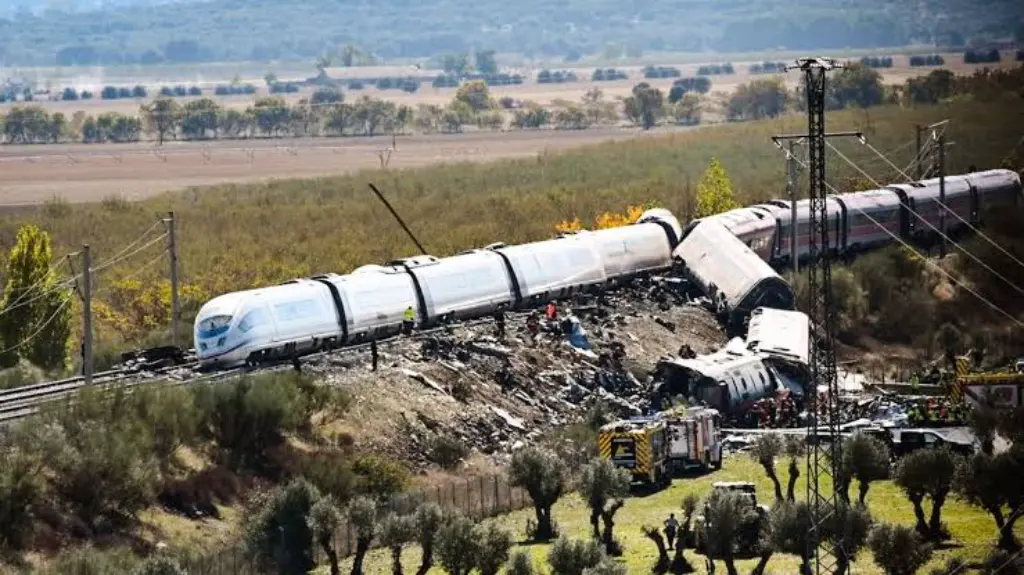
Train collision near Urda, Toledo: 68 dead after AVE hits stationary Iryo train
Two high-speed trains collided on the Madrid–Sevilla line on Wednesday morning. The AVE was reportedly cleared to run with a red signal and another train ahead, after a failure of the LZB signalling system.
At a glance
- 68 people confirmed dead — 24 in the Renfe AVE, 44 in the Iryo train (regional president Emiliano García-Page, 17:00).
- 68 people injured and classified — 15 in critical condition (“código rojo”), 53 requiring hospital care (“código amarillo”), plus minor injuries.
- Collision at around 08:50–08:53 at km 118 of the Madrid–Sevilla high-speed line, near Urda (Toledo).
- A Renfe AVE ran into the back of a stationary Iryo train after an LZB signalling failure.
- The AVE was reportedly authorised to resume running with a red signal and another train ahead; the transport minister called that decision “inexplicable” and said it was contrary to protocols.
- High-speed traffic between Madrid and Andalucía is suspended; Ouigo has cancelled Madrid–Andalucía services until at least 2 November.
- Three days of official mourning, 29–31 October.
What happened
Shortly before 09:00 on Wednesday 28 October, two high-speed trains travelling the Madrid–Sevilla corridor were involved in a rear-end collision near the village of Urda, in the province of Toledo, at kilometre point 118.
According to the reconstruction given by officials and reported by Spanish media:
- An LZB signalling failure affected the line.
- An Iryo train (147 passengers on board) came to a stop at the entrance to Urda station.
- A Renfe AVE (378 people on board) had left Madrid–Puerta de Atocha at 08:00, bound for Sevilla–Santa Justa with a scheduled arrival of 10:39.
- The AVE was authorised to resume running — according to the transport minister, despite a red signal and the presence of another train ahead.
- It struck the stationary Iryo train from behind at speed. Carriages derailed; a witness described a “tremendous crash” and said the train “flew into the air”.
The impact scattered wreckage along the embankment. Emergency services from Castilla-La Mancha, Madrid and neighbouring regions were mobilised, together with the Military Emergency Unit (UME), firefighters, Guardia Civil, Civil Protection and dozens of ambulances.
The victims
The regional president of Castilla-La Mancha, Emiliano García-Page, confirmed at around 17:00 that 68 people had died: 24 in the Renfe AVE and 44 in the Iryo train.
He warned that the figure could rise: a further death was reported during a coordination meeting, and rescue teams had not yet finished inspecting the wreckage.
| Category | Number | Meaning |
|---|---|---|
| Código rojo | 15 | Critical, life-threatening |
| Código amarillo | 53 | Requires hospital care |
| Minor injuries | not specified | Treated on site or discharged |
Hospitals in Madrid, Castilla-La Mancha, Castilla y León, Andalucía and the Valencian Community were placed on standby, and some patients were transferred to Madrid.
The rescue operation
- Judicial intervention now conditions part of the work: some operations must wait for authorisation from the court before debris can be moved.
- Firefighters, with cranes and UME support, are checking under carriages and between metal debris for further victims.
- Specialist search dogs have been deployed to look for survivors and locate people still unaccounted for.
- A municipal sports hall in Urda has been opened for those affected, and the Santo Cristo school pavilion has been converted into a family assistance centre.
- Psychological and social support teams — regional services, Red Cross and Guardia Civil — are working with families.
- Assistance points have also been set up at Madrid–Atocha, Sevilla–Santa Justa and Córdoba stations.
- The regional emergency plan (Platecam) remains at Situational Level 2 for the province of Toledo.
The investigation: LZB, a red signal and a decision
The central question is not why a train stopped. It is why another train was allowed to keep moving towards it.
What is LZB? The Linienzugbeeinflussung system is a cab-signalling and automatic train-protection technology used on Spain’s high-speed lines. It supervises train movement and applies the brakes if limits are exceeded. When it fails, the line falls back on procedural operation — which is exactly where human decisions become decisive.
According to the transport minister, Óscar Puente, the AVE received authorisation to resume normal running despite a red signal and another train standing ahead — an authorisation he described as “inexplicable” and against established protocols. His phrase: the decision was taken “with a red light and the train stopped.”
The control-centre operator who regulated traffic on the Madrid–Sevilla line at the time has been questioned by the Guardia Civil and is expected to appear before the rail accident investigation commission.
What is not known yet: whether the authorisation was a single individual error, a failure of procedure, a failure of supervision, or a combination; whether the LZB fault was correctly logged and escalated; and whether the “marcha a vista” protocol (running by sight, maximum 40 km/h) was applied or bypassed. The trains’ black boxes have not yet been analysed — rail experts have urged caution, noting that until the recorders are read, any attribution of cause is speculation.
Travel impact
- Madrid–Andalucía high-speed line: closed in both directions at the Urda section.
- Renfe (AVE/Avlo) and Iryo services between Madrid and Seville, Málaga, Córdoba and Granada are cancelled or diverted; passengers are being offered rebooking or refunds.
- Ouigo has suspended its Madrid–Andalucía services until at least 2 November.
- Málaga–Sevilla high-speed services are reported to be operating normally, despite the break in the connection with Madrid.
- Passengers with tickets for the coming days should check Renfe, Iryo and Ouigo websites and apps before travelling, and allow extra time for alternative arrangements.
The second disaster in ten months
This is the second fatal high-speed collision in Spain in 2026.
On 18 January 2026, an Alvia (Renfe) and a Frecciarossa (Iryo) collided near Adamuz, in the province of Córdoba, on the same Madrid–Sevilla corridor. 46 people died and 123 were injured. Investigations into that accident have examined, among other things, a possible defect in the track (a weld), while Adif has maintained that the detected irregularities were within safety limits.
The coincidence of corridor, operators and infrastructure has made the political question unavoidable: whether Spain’s high-speed network — the largest in Europe, with over 4,000 km — is being maintained and supervised to the standard its speed requires.
Reaction
- Three days of official mourning declared by the government (29–31 October).
- Election campaign events suspended; Copa del Rey football matches postponed.
- The Congress of Deputies cancelled a scheduled institutional act.
- The regional government of Castilla-La Mancha has thanked the municipalities of Urda and Los Yébenes, whose residents helped with the first rescue efforts.
- Blood donation appeals were issued in Toledo and Madrid.
The prime minister, Pedro Sánchez, said it was “not acceptable for Spain to suffer two high-speed accidents in a year”, promised that responsibilities would be established “with determination”, and said that “if there has been negligence, it will be known”.
Timeline of the day
| Time | Event |
|---|---|
| 08:00 | AVE departs Madrid–Atocha for Sevilla |
| ~08:38 | Iryo driver reportedly contacts the control centre |
| ~08:50–08:53 | AVE collides with the stationary Iryo train at km 118, near Urda |
| Morning | Emergency services, UME and helicopters deployed; line closed |
| Midday | Death toll rises from 30 to 40+; officials warn it will increase |
| ~15:00 | Government confirms three days of mourning; PM visits the site |
| ~17:00 | Regional president confirms 68 dead (24 AVE, 44 Iryo); 15 critical, 53 hospitalised |
| Evening | Control-centre operator questioned; rescue continues under judicial supervision |
Sources
- RTVE, live coverage (updated 17:59, 28 Oct 2026) — rtve.es
- La Cerca, Ascienden a 68 los fallecidos… (28 Oct 2026, 17:59) — lacerca.com
- RTVE, La Guardia Civil interroga al operario del centro de control — rtve.es
- RTVE, Qué se sabe del accidente — rtve.es
- La Sexta, Puente califica de “inexplicable” la decisión… — lasexta.com
- El País, accident coverage — elpais.com
- El Mundo (28 Oct 2026) — elmundo.es
- New York Times, live coverage — nytimes.com
- Rai News, live coverage — rainews.it
We do not name individuals who have not been officially identified, and we do not repeat unverified claims about the cause. Figures change; check the sources above for the latest.
- 28 Oct 2026, 18:30 CET
- First publication: 68 dead (24 AVE, 44 Iryo), 15 critical, 53 hospitalised; line closed; Ouigo suspended until 2 November.