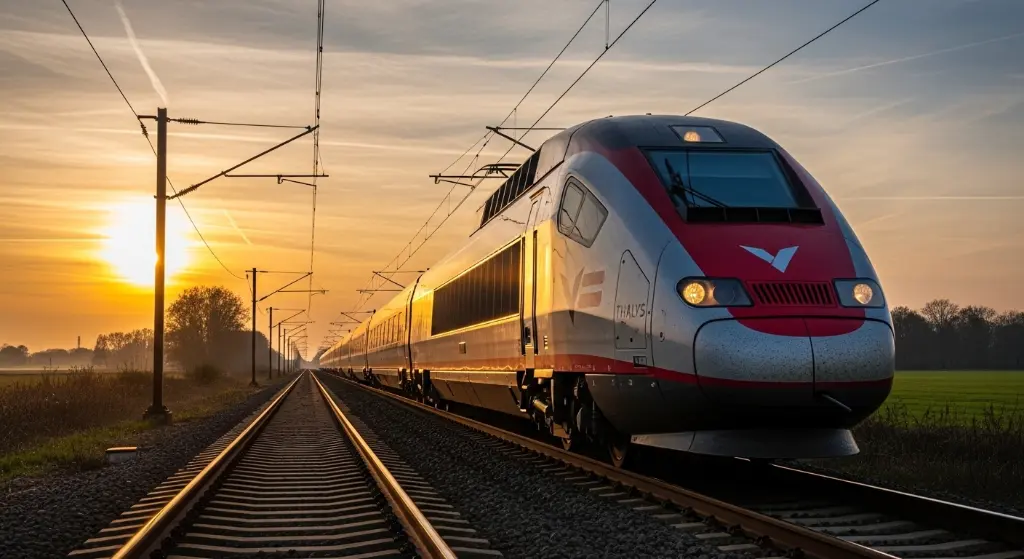
It is the country that punches above its weight, sitting at the very heart of the European high-speed network.
Belgium is small, dense, and incredibly well-connected. Its capital, Brussels, is the de facto capital of the European Union, and its rail network reflects this status. From the platforms of Brussels Midi, you can speed to Paris, London, Amsterdam, or Cologne in under two hours.
But beyond the high-speed glamor lies one of the densest domestic networks in the world. Trains connect the medieval canals of Bruges, the fashion streets of Antwerp, and the battlefields of Flanders with rhythmic frequency. With stations that look like cathedrals and a system that accepts almost any ticket you throw at it, Belgium is the easiest country in Europe to explore by train.
This is your complete guide to exploring Belgium by rail.
Belgium by Train: The Overview
| Fact | Details |
|---|---|
| Total Network | ~3,600 km of railway lines |
| Main Operator | SNCB (French) / NMBS (Dutch) — State-owned |
| Infrastructure | Infrabel (State-owned) |
| High-Speed Hub | Brussels Midi/Zuid |
| International | Eurostar (London, Paris, Amsterdam, Cologne) |
| Maximum Speed | 300 km/h (High-speed lines), 160 km/h (Domestic) |
| Languages | French, Dutch (Flemish), German |
| Eurail/Interrail | Fully valid on SNCB/NMBS trains |
| Currency | Euro (€) |
Why Train Travel Works in Belgium
- Density: You are never far from a station. The network is incredibly tight.
- The “IC” Rhythm: InterCity (IC) trains run frequently (usually hourly or half-hourly) between all major cities. No reservation needed.
- Short Distances: Brussels to Antwerp is 45 mins. Brussels to Bruges is 1 hour. Ghent to the coast is 40 mins.
- The Weekend Ticket: 50% off return tickets from Friday evening to Sunday. A massive bargain.
- Grand Stations: Antwerp Central is often voted the most beautiful railway station in the world. It is a stone-and-glass cathedral.
The History: The First on the Continent
Belgium was the first country on the European mainland to open a public railway. On May 5, 1835, a steam train ran between Brussels and Mechelen. The young Belgian state saw railways as a tool for independence and industrial might. By the 1900s, it had the densest rail network on Earth.
Today, that legacy remains. While some rural lines have closed, the core network is robust, electrified, and heavy with traffic. Belgium was also an early adopter of high-speed rail, building dedicated lines to welcome the TGV and later Eurostar.
The Operators: One Name, Two Languages
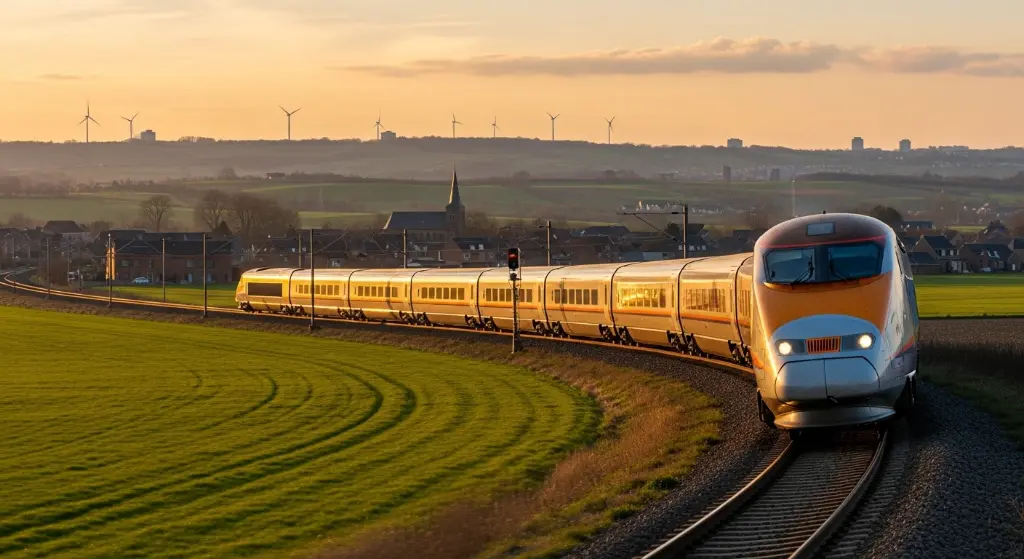
SNCB / NMBS
The national operator has two names but is one company.
- SNCB: Société Nationale des Chemins de fer Belges (French)
- NMBS: Nationale Maatschappij der Belgische Spoorwegen (Dutch)
You will see the “B” logo everywhere. They run all domestic passenger trains.
Eurostar (formerly Thalys)
The red high-speed trains. “Thalys” merged with Eurostar in 2023, so now all high-speed trains to London, Paris, Amsterdam, and Cologne operate under the Eurostar brand.
Train Types: Fast or Faster
Domestic
- IC (InterCity): The main trains connecting cities. Fast, comfortable, usually double-decker.
- S (S-Train / Voorstad): Suburban commuter trains around Brussels, Antwerp, Ghent, Liège, and Charleroi. Frequent stops.
- L (Local): Stopping trains in rural areas.
International
- Eurostar (Red): The former Thalys routes connecting Brussels to Paris, Amsterdam, and Germany.
- Eurostar (Blue): The cross-channel route to London.
- ICE International: German high-speed trains connecting Brussels to Frankfurt.
- Nightjet: Austrian sleeper trains from Brussels to Vienna/Berlin.
The Price: Discounts for Everyone
Belgian rail pricing is refreshingly simple. Domestic trains have fixed prices based on distance. There is no dynamic pricing for local trips—a ticket bought 2 minutes before departure costs the same as one bought 2 months ago.
Best Deals
- Weekend Ticket: 50% off any return journey between Friday 7pm and Sunday night.
- Standard Multi (Rail Pass): 10 journeys anywhere in Belgium for a fixed price (approx. €99, or €9.90 per trip). This is a physical or digital pass you fill in yourself. Great for long trips.
- Youth Multi (Go Pass 10): For those under 26. 10 journeys anywhere for approx. €59 (€5.90 per trip). An absolute steal.
- Senior Ticket: Fixed price return for travelers 65+ (approx. €8), valid after 9am on weekdays.
Rail Passes: Is Eurail/Interrail Worth It?
Eurail/Interrail is fully valid.
- Verdict: Good if you are just passing through Belgium or visiting multiple countries.
- For Belgium Only: Probably not worth it. The domestic tickets (especially Youth/Weekend/Multi) are so cheap that a rail pass day is usually more expensive than buying local tickets.
- Reservations: Not needed for domestic trains! Just hop on. (Mandatory for Eurostar).
Scenic Routes: Not Just Flat Fields
Belgium is often called flat, but the Ardennes in the south offer hills and forests.
1. The Ardennes Line (Liège – Luxembourg)
This route winds through the hilly valleys of the Ardennes. It’s green, rocky, and feels very different from the flat north.
2. Brussels to Luxembourg (via Namur)
Another route cutting through the forests of Wallonia. It passes the massive citadel of Namur.
Regional Guide: Major Hubs
Brussels (Bruxelles/Brussel)
The central knot. Trains traverse the North-South Connection, a busy underground tunnel linking the three main stations:
- Midi / Zuid: The International Hub. Eurostar, TGV, ICE all stop here. It’s gritty outside, but the transit links are unbeatable.
- Central / Centraal: The Tourist Hub. Right next to the Grand Place. Underground and busy.
- Nord / Noord: The business district station.
Antwerp (Antwerpen)
- Antwerpen-Centraal: A masterpiece. Often called the “Railway Cathedral.” It has four levels of trains, including tracks that pass through the basement.
Liège (Luik)
- Liège-Guillemins: A futuristic white curve designed by Santiago Calatrava. It looks like a spaceship landed in the city. Worth a visit just for the architecture.
International Connections: The Spider’s Web
- To London: Eurostar (2h). Remember to check in 45-60 mins early for border control.
- To Paris: Eurostar (1h 22min).
- To Amsterdam: Eurostar (1h 50min) or the slower “IC Brussels” (2h 50min – much cheaper, no reservation).
- To Cologne/Frankfurt: ICE or Eurostar (approx. 2-3h).
Practical Tips for Travelers
- Language: Station names change!
- French: Bruxelles, Anvers, Gand, Liège, Bruges
- Dutch: Brussel, Antwerpen, Gent, Luik, Brugge
- Know both names to avoid confusion on departure boards.
- Airport Train (Diabolo): Trains to Brussels Airport (Zaventem) require a “Diabolo Supplement” (€6.70) added to your ticket. If you have a rail pass, you must buy this supplement separately at a machine.
- 1st vs 2nd Class: 2nd class is fine. 1st class is quieter. Domestic trains do not have catering, so bring your own waffle.
- The App: Download the SNCB/NMBS app. It’s excellent for planning and buying tickets.
Common Mistakes
- Getting off at the wrong Brussels station: Midi, Central, and North are distinct. Central is best for sightseeing; Midi is for international connections.
- Writing on the Multi Pass too late: If you use a “Standard Multi” pass, you must write the date and route before you get on the train. Conductors are strict.
- Thinking “Brussels South” is Charleroi Airport: The budget airport “Brussels South Charleroi” is an hour away by bus/train combo. It is NOT Brussels Midi/Zuid station.
Summary
Belgium is the unsung hero of European rail. It connects the titans (London, Paris, Berlin) with ease, but its domestic network is a gem of accessibility. It invites you to hop from a Flemish art city in the morning to a Walloon forest in the afternoon, all for the price of a few chocolates.
Ready to ride? Start at Antwerp Central, marvel at the dome, and take the train to Bruges for a beer by the canal.
Useful Links:
- SNCB International: b-europe.com
- Domestic Tickets: belgiantrain.be