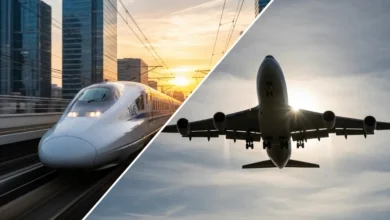
When planning travel across Europe, many people focus on price and speed. But one factor is becoming impossible to ignore: carbon emissions. How much difference does it really make to choose a train instead of a plane? The numbers may surprise you.
Average CO₂ Emissions: Train vs Plane
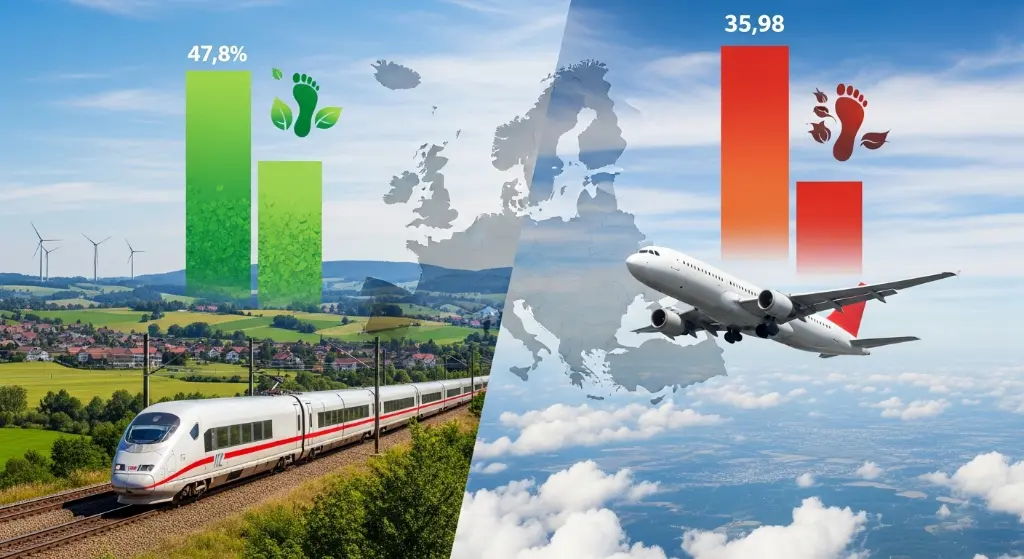
On average, short-haul flights in Europe emit between 150–250 grams of CO₂ per passenger per kilometer. Electric trains, by comparison, often emit as little as 10–30 grams per passenger per kilometer — depending on the country’s energy mix.
That means rail travel can produce up to 90% fewer emissions than flying on comparable routes.
Example: Paris to Milan
- Flight: ~115 kg CO₂ per passenger
- High-Speed Train: ~25 kg CO₂ per passenger
The difference becomes even more significant when multiplied by millions of passengers per year.
Why Trains Are More Efficient
Rail transport benefits from several structural advantages:
- Electric-powered systems
- High passenger capacity per journey
- Lower takeoff and landing energy spikes
- Increasing reliance on renewable electricity
In many European countries, rail networks are powered largely by renewables, making train travel even cleaner over time.
Night Trains: Double Sustainability Benefit
Overnight trains provide a unique sustainability advantage: they combine transportation and accommodation. By sleeping onboard, travelers eliminate the need for a hotel night and reduce additional energy consumption.
This is one reason why night trains are replacing short-haul flights on many popular European routes.
Short-Haul Flights: The Highest Impact Segment
Short-distance flights are disproportionately carbon-intensive because takeoff and landing consume the most fuel. For routes under 1,200 km, trains are almost always the more sustainable option.
That’s why many travelers now compare options in Night Trains vs Flying before booking.
City-Center Efficiency Reduces Secondary Emissions
Airports are often located far from city centers, requiring additional transport such as buses, taxis, or rental cars. Trains arrive directly in central stations, minimizing secondary emissions.
This city-center advantage is one of the reasons rail plays a central role in Sustainable Travel in Europe.
Does Flying Ever Make Sense?
Flights may still be more practical for island destinations or very long distances. However, for mainland Europe — especially between major capitals — rail often wins both environmentally and logistically.
The Bigger Picture
Individual travel choices matter, but systemic infrastructure investment is what truly shifts emissions at scale. Europe is investing heavily in rail modernization and night train expansion, reinforcing trains as the backbone of low-carbon mobility.
To understand how this shift is reshaping travel across the continent, explore our complete guide to Night Trains in Europe.