It is the country where trains don’t just run on time; they run every 10 minutes.
The Netherlands has one of the busiest, densest, and most efficient railway networks on the planet. To the Dutch, the train is not an adventure; it is a utility, like tap water or electricity. It is simply there, always running, connecting every corner of this compact nation.
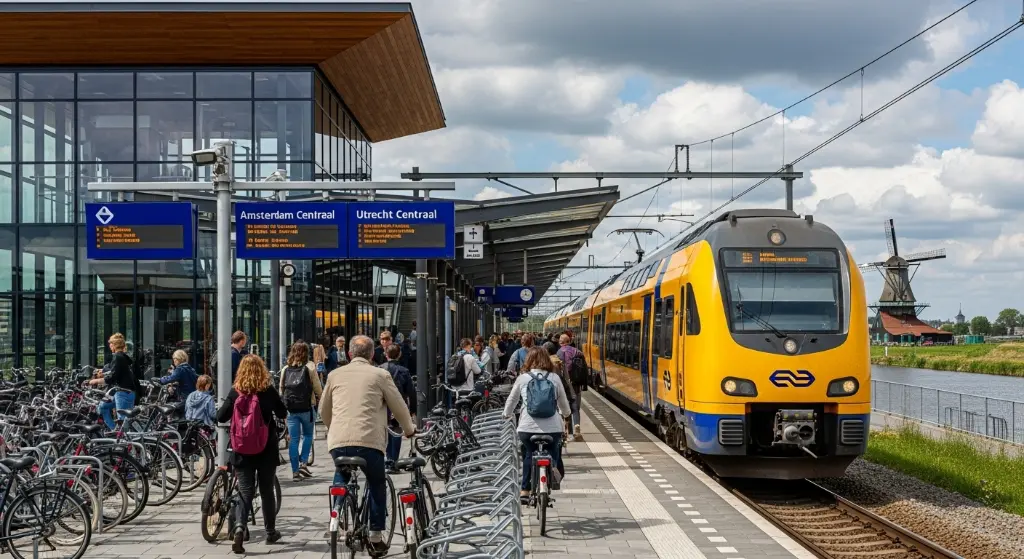
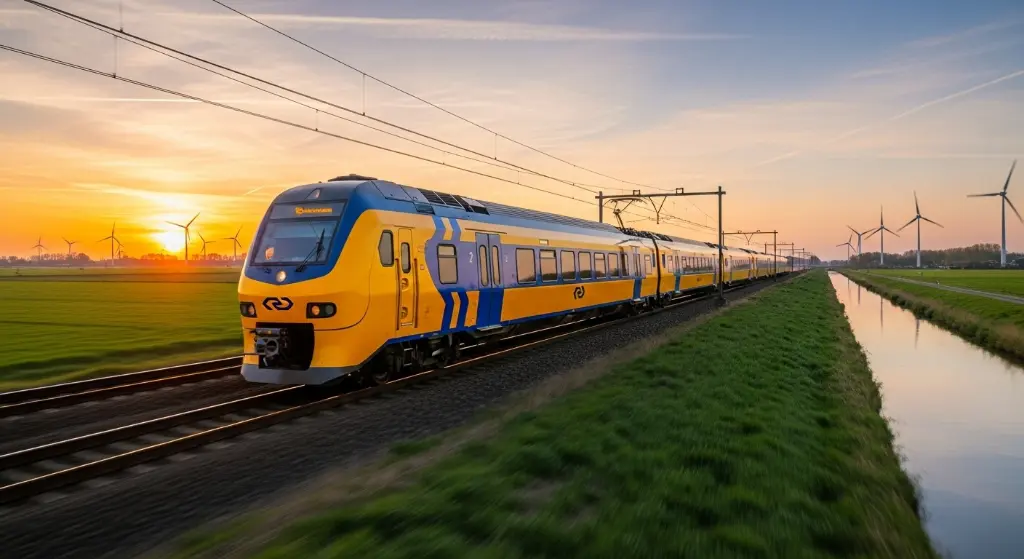
With its iconic yellow-and-blue double-decker trains, seamless integration with the world’s best cycling infrastructure, and a flat landscape that turns every window into a landscape painting of canals and windmills, the Netherlands is a joy to navigate by rail.
This is your complete guide to exploring the Netherlands by train.
Netherlands by Train: The Overview
| Fact | Details |
|---|---|
| Total Network | ~3,200 km of railway lines |
| Main Operator | NS (Nederlandse Spoorwegen) — State-owned |
| Regional Operators | Arriva, Keolis, Qbuzz (mostly in the North/East) |
| Infrastructure | ProRail (State-owned) |
| High-Speed | Intercity Direct, Eurostar, ICE International |
| Maximum Speed | 140 km/h (conventional), 300 km/h (High-Speed Line South) |
| Frequency | Every 10–15 mins on main routes |
| Eurail/Interrail | Fully valid on NS and regional lines |
| Currency | Euro (€) |
Why Train Travel Works in the Netherlands
- The “Randstad” Ring: The four biggest cities (Amsterdam, Rotterdam, The Hague, Utrecht) form a ring connected by ultra-frequent trains. You never need a timetable; just show up.
- The OV-chipkaart: One smart card covers ALL public transport in the entire country—trains, trams, buses, metros, and ferries.
- Bike & Ride: Every station has massive bike parking. You can rent an “OV-fiets” (public transport bike) at nearly any station to finish your journey.
- Proximity: Nothing is far. You can cross the country in 3 hours.
- English Everywhere: Conductors, ticket machines, and announcements (in major stations) are fluent in English.
The History: From Steam to Sprinters
The first Dutch railway opened in 1839 between Amsterdam and Haarlem. The locomotive was called De Arend (The Eagle). Because the ground in the Netherlands is soft and boggy (much of it is reclaimed land), building stable tracks was an engineering challenge.
In the 20th century, the network became fully electrified and focused on high-frequency passenger service rather than freight. The philosophy was simple: “The train should be like a tram.” Today, NS runs one of the most intensive timetables in the world.
The Operators: The Yellow Giant and the Blue Challengers
1. NS (Nederlandse Spoorwegen)
The national operator. Their yellow-and-blue trains run on the entire main network (Hoofdnet).
- Reputation: Efficient, clean, but prone to complaints from locals if a train is 2 minutes late.
2. Regional Operators (Arriva, Keolis/Blauwnet, Connexxion)
In the provinces (Friesland, Groningen, Limburg, Overijssel), regional lines are run by private companies.
- Key difference: The trains are different colors (blue, red, white), but the ticketing system is the same. You just check in with the same card.
Train Types: Sprinters and Intercities
Dutch trains are categorized by stopping pattern, not speed.
Intercity (IC)
Fast trains connecting major cities. They skip smaller stations.
- Amenities: Wi-Fi, quiet zones, double-decker carriages (VIRM).
- Intercity Direct: A faster version running on the high-speed line between Amsterdam, Schiphol, Rotterdam, and Breda. Note: Requires a small supplement fee.
Sprinter
Stopping trains. They stop at every station.
- Vibe: Modern, open-plan, no toilets on older models (but new ones have them). Great for short hops.
International High-Speed
- Eurostar: To London, Brussels, Paris.
- ICE International: To Germany (Cologne, Frankfurt).
- IC Berlin: To Berlin.
The Price: The OV-chipkaart System
The Netherlands has a unique ticketing system. Paper tickets are almost obsolete (and cost €1 extra).
1. OVpay (Contactless)
The easiest way for tourists. You can now check in and out directly with your contactless credit/debit card or phone.
- How: Tap your card at the yellow gate/pole when you enter. Tap the same card when you exit. The fare is calculated automatically.
2. The OV-chipkaart (Blue Card)
A rechargeable plastic card (€7.50). Useful if you are staying longer or have a subscription.
Pricing Structure
- Distance-based: No peak/off-peak pricing for single fares (unless you have a subscription).
- Example: Amsterdam to Utrecht (
€9), Amsterdam to Rotterdam (€17).
Discounts?
- Off-Peak Group Ticket: Great for groups of 2-7 people traveling in off-peak hours.
- Subscriptions: Locals use subscriptions (e.g., “Dal Voordeel” – 40% off during off-peak hours for €5/month). Tourists usually can’t get these easily without a Dutch bank account.
Rail Passes: Is Eurail/Interrail Worth It?
Eurail/Interrail is valid on all NS and regional trains.
- Verdict: Good for flexibility, but point-to-point tickets in the Netherlands are relatively cheap. A pass is only worth it if you plan to do a lot of travel in one day or are combining it with expensive countries like Germany or France.
- Reservations: Not needed for domestic trains! You just hop on. (Exception: Eurostar requires booking).
- Gates: Use the square barcode on your mobile pass to open the ticket gates (look for the gate with the “scan” glass, not just the card reader).
Scenic Routes: Flat but Beautiful
The Netherlands doesn’t have mountains, but it has charm.
1. The Flower Bulb Line (Haarlem – Leiden)
In spring (April/May), this short route passes directly through the blooming tulip fields. The colors are explosive.
2. The Veluwe Line (Zwolle – Maastricht)
Runs along the edge of the Hoge Veluwe National Park and down into the hilly (for Dutch standards) south of Limburg.
3. Almere to Lelystad (Oostvaardersplassen)
The train cuts straight through a nature reserve. You might spot wild horses, red deer, and heck cattle from the window.
Regional Guide: Major Hubs
Amsterdam Centraal
The grand neo-Renaissance palace. It sits on an island in the IJ river.
- Connections: Everywhere. Airport (15 mins), Paris, London, Berlin.
Utrecht Centraal
The geographic center and the busiest station in the country. Almost every train passes through here. It is attached to a massive mall (Hoog Catharijne).
Rotterdam Centraal
A stunning modern architectural icon with a soaring angular roof. Gateway to the south and the high-speed line.
International Connections: The Gateway
- To Belgium (Brussels/Antwerp): Eurostar (1h 50m) or the slower “Intercity Brussels” (2h 50m – cheaper, no reservation).
- To France (Paris): Eurostar (3h 20m).
- To UK (London): Eurostar direct (4h).
- To Germany: ICE to Cologne/Frankfurt or IC to Berlin.
Practical Tips for Travelers
- Check In AND Out: Crucial! If you forget to tap out at your destination, you will be charged a penalty (usually €20).
- 1st vs 2nd Class: 2nd class is perfectly fine. 1st class is quieter (good for working) and has red seats (2nd class is blue).
- Quiet Zones: In the “Stiltecoupe” (marked with Shh! symbols and silence icons on windows), silence is mandatory. The Dutch will glare at you if you talk.
- The NS App: Download it. It is excellent for planning and seeing real-time platform info.
- Toilets: Sprinters didn’t always have them, but modern ones do. ICs always have them. Station toilets usually cost €0.70 (card only).
Common Mistakes
- Buying a ticket to “Amsterdam” vs “Amsterdam Centraal”: There are many stations (Amstel, Zuid, Sloterdijk). Make sure you pick the right one.
- Boarding the Intercity Direct without a supplement: If you take the fast train between Schiphol/Amsterdam and Rotterdam, you need to tap your card at the red “Supplement” pole on the platform (approx. €2.90).
- Walking in the bike lane: When exiting a station, look left and right. Cyclists move fast and do not stop for tourists standing on the red asphalt.
Summary
The Netherlands offers a rail experience that is less about the romance of travel and more about the perfection of logistics. It is a system that respects your time. It allows you to wake up in Amsterdam, visit the museums of The Hague, have lunch in Rotterdam, and be back for dinner, all without checking a watch.
Ready to ride? Tap your card, find a blue seat (preferably upstairs for the view), and watch the windmills spin by.
Useful Links:
- NS (Official Planner): ns.nl/en
- 9292 (All Transport Planner): 9292.nl/en