The Complete Interrail Europe Guide 2026: Your Ultimate Rail Adventure
Interrail Europe is the ultimate way to explore the continent, offering unlimited train travel across 33 countries with a single pass. Whether you’re a first-time interrailers or a seasoned rail enthusiast, this comprehensive guide will help you plan the European adventure of a lifetime.
What Is Interrail?
Interrail is a rail pass that allows European residents to travel across Europe by train. With one pass, you can visit over 30,000 destinations in 33 countries, making it the most flexible and affordable way to explore Europe
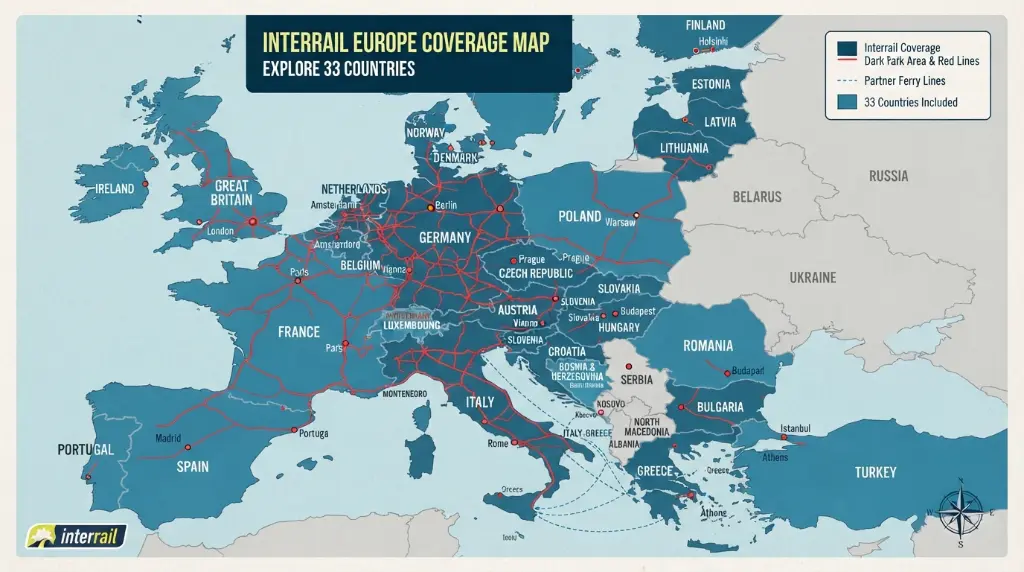
www.interrail.com
Who Can Use Interrail?
Interrail Pass:
- Available to European residents (including UK)
- Must have lived in Europe for at least 6 months
Eurail Pass:
- For non-European residents
- Same benefits, different name
- Must be purchased before arriving in Europe
Countries Covered
Full Interrail Coverage (33 countries):
Western Europe: 🇦🇹 Austria | 🇪 Belgium | 🇫🇷 France | 🇩🇪 Germany | 🇮 Liechtenstein | 🇱🇺 Luxembourg | 🇲🇨 Monaco | 🇳🇱 Netherlands | 🇭 Switzerland
Southern Europe: 🇷 Croatia | 🇷 Greece | 🇮🇹 Italy | 🇲🇹 Malta | 🇹 Portugal | 🇸🇲 San Marino | 🇪🇸 Spain | 🇻🇦 Vatican City
Northern Europe: 🇩🇰 Denmark | 🇪🇪 Estonia | 🇫🇮 Finland | 🇸 Iceland* | 🇱🇻 Latvia | 🇱🇹 Lithuania | 🇳🇴 Norway | 🇪 Sweden
Eastern Europe: 🇬 Bulgaria | 🇨🇿 Czech Republic | 🇭🇺 Hungary | 🇵🇱 Poland | 🇷🇴 Romania | 🇸 Serbia | 🇸🇰 Slovakia | 🇸🇮 Slovenia
Special Cases: 🇬🇧 United Kingdom | 🇹🇷 Turkey
*Iceland: Limited ferry connections only
Types of Interrail Passes
1. Global Pass
The Interrail Global Pass is the most popular option, allowing travel across all participating countries
www.interrail.com.
Flexi Pass Options:
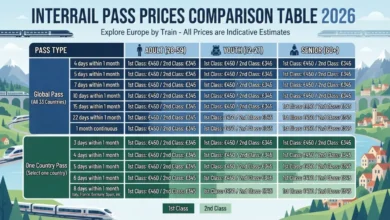
| Pass Type | Travel Days | Validity Period | Best For |
|---|---|---|---|
| 4 days | 4 days | 1 month | Weekend trips, 2-3 cities |
| 5 days | 5 days | 1 month | 1-week adventure |
| 7 days | 7 days | 1 month | 10-14 day trip |
| 10 days | 10 days | 2 months | 2-3 week journey |
| 15 days | 15 days | 2 months | Month-long adventure |
Continuous Pass Options:
| Duration | Best For |
|---|---|
| 15 days continuous | Intensive 2-week tour |
| 22 days continuous | 3-week exploration |
| 1 month continuous | Month-long backpacking |
| 2 months continuous | Extended summer trip |
| 3 months continuous | Gap year, sabbatical |
2. One Country Pass
Perfect for deep exploration of a single nation:
Popular Options:
- France: 3, 4, 5, or 8 travel days
- Italy: 3, 4, 5, or 8 travel days
- Spain: 3, 4, 5, or 8 travel days
- Germany: 3, 4, 5, or 8 travel days
- UK: 3, 4, 5, or 8 travel days
When to Choose One Country Pass: ✅ Focused itinerary ✅ Visiting 1-2 countries only ✅ Shorter trip (under 10 days) ✅ Want to explore regions thoroughly
Best Interrail Routes in Europe
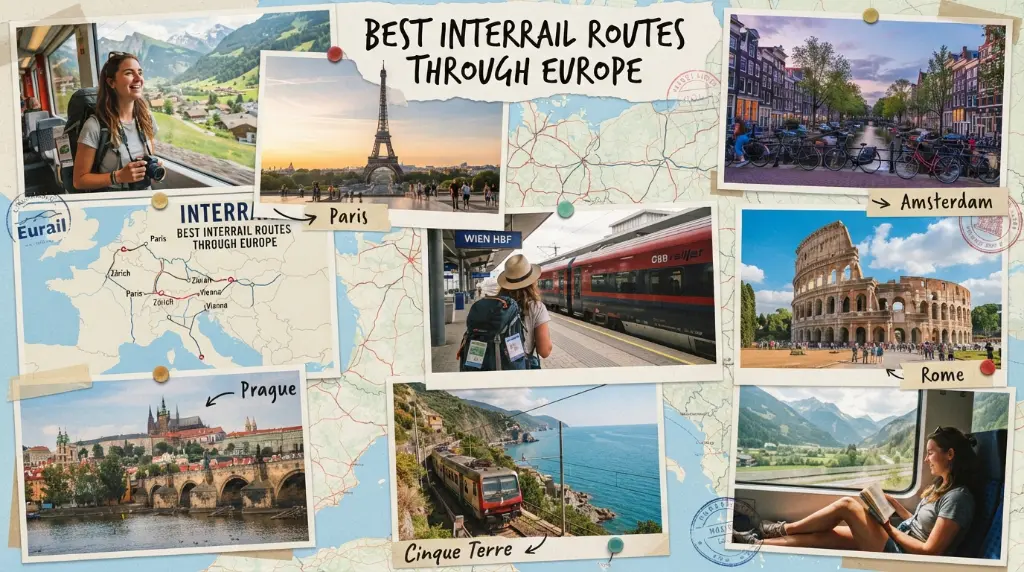
Classic Routes
1. The Grand European Tour (2-3 weeks)
Route: London → Paris → Amsterdam → Berlin → Prague → Vienna → Budapest → Rome Countries: 7 Duration: 15-21 days Highlights:
- Iconic capitals
- Diverse cultures
- Mix of Western & Eastern Europe
- Pass recommendation: 10 days within 2 months
2. Western Europe Highlights (1-2 weeks)
Route: Paris → Brussels → Amsterdam → Cologne → Frankfurt → Zurich → Milan Countries: 5 Duration: 10-14 days Highlights:
- Efficient high-speed trains
- Major cities
- Art, food, architecture
- Pass recommendation: 7 days within 1 month
3. Mediterranean Adventure (2 weeks)
Route: Barcelona → Nice → Genoa → Rome → Naples → Athens (ferry) Countries: 4 Duration: 12-14 days Highlights:
- Coastal scenery
- Ancient history
- Mediterranean cuisine
- Beach time
- Pass recommendation: 7-10 days within 1 month
4. Scandinavian Explorer (10 days)
Route: Copenhagen → Stockholm → Oslo → Bergen → Gothenburg Countries: 3 Duration: 8-10 days Highlights:
- Fjords and nature
- Design and culture
- Clean, efficient travel
- Pass recommendation: 5 days within 1 month
5. Alpine Crossing (1 week)
Route: Munich → Innsbruck → Zurich → Milan → Venice Countries: 4 Duration: 6-7 days Highlights:
- Mountain scenery
- Charming towns
- Outdoor activities
- Pass recommendation: 4-5 days within 1 month
Themed Routes
Romantic Cities Route
Stops: Paris → Bruges → Prague → Vienna → Budapest → Venice Perfect for: Couples, architecture lovers Duration: 2 weeks
Beach Hopping Route
Stops: Lisbon → Seville → Barcelona → Nice → Rome → Athens Perfect for: Summer travelers, sun seekers Duration: 2-3 weeks
Christmas Markets Route
Stops: Berlin → Prague → Vienna → Budapest → Krakow Perfect for: November-December travel Duration: 10 days
Outdoor Adventure Route
Stops: Interlaken → Chamonix → Innsbruck → Salzburg → Ljubljana Perfect for: Hikers, nature enthusiasts Duration: 10-14 days
How to Plan Your Interrail Journey
Step 1: Choose Your Destinations
Consider:
- Time available: 1 week = 2-3 cities; 1 month = 8-10 cities
- Budget: Western Europe more expensive than Eastern
- Interests: History, food, nature, nightlife
- Geography: Avoid backtracking
- Season: Summer = beaches; Winter = cities/Christmas markets
Planning Tools:
- Google Maps: Plot your route
- Rome2Rio: Check connections
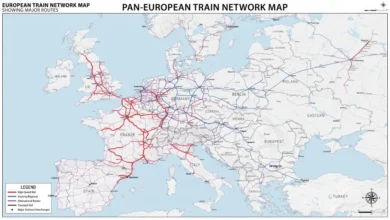
- Interrail Map: See covered countries www.eurail.com
Step 2: Select Your Pass
Decision Matrix:
Choose Global Pass if: ✓ Visiting 3+ countries ✓ Trip longer than 10 days ✓ Want maximum flexibility
Choose One Country Pass if: ✓ Focused on 1-2 countries ✓ Trip under 10 days ✓ Want deeper exploration
Flexi vs. Continuous:
Flexi is better when:
- Staying 2-3 days per city
- Taking breaks between travel
- Shorter overall trip
Continuous is better when:
- Traveling daily or every other day
- Trip longer than 3 weeks
- Visiting many cities quickly
Step 3: Build Your Itinerary
Sample 2-Week Itinerary:
Days 1-3: Paris, France
- Eiffel Tower, Louvre, Montmartre
- Day trip to Versailles
Days 4-5: Brussels, Belgium
- Grand Place, Atomium, Belgian chocolate
- Train: 1h 20m from Paris
Days 6-8: Amsterdam, Netherlands
- Canals, museums, cycling
- Train: 2h from Brussels
Days 9-11: Berlin, Germany
- Brandenburg Gate, museums, nightlife
- Train: 6h 30m from Amsterdam
Days 12-14: Prague, Czech Republic
- Old Town, castle, beer culture
- Train: 4h 30m from Berlin
Step 4: Book Reservations
Mandatory Reservations:
High-Speed Trains (Book 2-3 months ahead):
- Eurostar: London-Paris/Brussels
- TGV: French routes
- Frecciarossa: Italian routes
- AVE: Spanish routes
- Thalys: Paris-Brussels-Amsterdam
Night Trains (Book 1-2 months ahead):
- ÖBB Nightjet routes
- European Sleeper
- Caledonian Sleeper
How to Reserve:
- Interrail website: Easiest for pass holders
- National rail websites: SNCF, DB, Trenitalia
- Train stations: Can reserve in person
- Phone: Some operators allow phone booking
Reservation Costs:
- High-speed: €10-€38
- Night trains: €14-€100+
- Regional trains: Usually free
Step 5: Download Essential Apps
Must-Have Apps:
Rail Planner (Official Interrail App):
- Offline timetables
- Journey planner
- Mobile pass (if chosen)
- Real-time updates
Trainline:
- Multi-country booking
- Mobile tickets
- Delay notifications
DB Navigator:
- Excellent for Central Europe
- Platform information
- Real-time updates
Google Maps:
- Offline maps
- Walking directions
- Public transport
Additional Useful Apps:
- Booking.com: Accommodation
- Hostelworld: Budget stays
- XE Currency: Exchange rates
- Google Translate: Language help
Interrail Travel Tips
Before You Go
Packing Essentials:
Documents:
- Interrail pass (physical or mobile)
- Passport/ID
- Travel insurance
- Reservation confirmations
- Emergency contacts
Clothing:
- Comfortable walking shoes
- Layers for changing weather
- Rain jacket
- 1 semi-formal outfit
- Laundry bag
Electronics:
- Phone + charger
- Power bank
- European adapter (Type C/F)
- Headphones
- Camera
Other:
- Reusable water bottle
- Daypack
- Padlock (for hostel lockers)
- Earplugs + eye mask
- Basic first aid kit
At the Station
Arrival Time:
- Regional trains: 15 minutes early
- High-speed trains: 30 minutes early
- International trains: 45 minutes early
- Night trains: 45-60 minutes early
Finding Your Train:
- Check departure boards (platform announced 10-15 min before)
- Look for train number and destination
- Check carriage number (if reserved)
- Validate paper tickets if required
Platform Etiquette:
- Stand behind yellow line
- Let passengers off before boarding
- Have ticket/pass ready
- Ask staff if unsure
Onboard the Train
Seating:
- Reserved seat: Sit in your assigned spot
- Unreserved: First-come, first-served
- Quiet zones: Keep noise down
- Priority seats: For elderly, pregnant, disabled
Luggage:
- Store above seat or in designated areas
- Keep valuables with you
- Don’t block aisles
- Use luggage tags
Dining:
- Restaurant car: Full meals (€15-€40)
- Buffet car: Snacks and drinks
- Bring your own: Always acceptable
- Picnic: Popular on scenic routes
Etiquette:
- Keep conversations at reasonable volume
- Use headphones for music/movies
- Respect others’ space
- Clean up after yourself
- Be friendly – you’ll meet amazing people!
Money-Saving Tips
Accommodation:
- Hostels: €20-€40/night
- Book ahead: Especially summer
- Kitchen access: Cook your own meals
- Free nights: Couchsurfing, house sitting
Food:
- Supermarkets: Breakfast & lunch
- Local markets: Fresh, cheap, authentic
- Happy hours: Discounted drinks/food
- Picnics: Scenic and budget-friendly
Activities:
- Free walking tours: Tip-based
- Museum free days: Research ahead
- City cards: Bundle attractions
- Student discounts: Always ask
Best Time to Interrail Europe

Spring (April-June) ⭐⭐⭐⭐⭐
Pros: ✓ Mild weather (15-25°C) ✓ Fewer crowds ✓ Blooming flowers ✓ Lower prices ✓ Longer days
Cons: Unpredictable weather ✗ Some attractions limited hours
Best for: City hopping, countryside, hiking
Summer (July-August) ⭐⭐⭐
Pros: ✓ Warm weather (20-35°C) ✓ Long days (sunset 9-10pm) ✓ All routes operational ✓ Festivals and events ✓ Beach season
Cons: ✗ Very crowded ✗ Higher prices (30-50% more) ✗ Heat in southern Europe ✗ Need to book months ahead
Best for: Beaches, festivals, outdoor activities Tip: Book everything 3-4 months in advance
Autumn (September-October) ⭐⭐⭐⭐⭐
Pros: ✓ Beautiful foliage ✓ Mild weather (10-20°C) ✓ Fewer tourists ✓ Harvest season (wine, food) ✓ Good prices
Cons: ✗ Some seasonal routes end ✗ Shorter days Rain increases
Best for: Wine regions, photography, cities
Winter (November-March) ⭐⭐⭐
Pros: ✓ Christmas markets (Nov-Dec) ✓ Lowest prices ✓ No crowds ✓ Cozy atmosphere ✓ Ski season
Cons: ✗ Cold weather (-5 to 10°C) Short days (sunset 4-5pm) ✗ Some routes reduced ✗ Possible delays
Best for: Christmas markets, cities, skiing
Special Considerations
Traveling with Interrail as a Student
Benefits:
- Youth pass (12-27): 25% discount
- Student discounts: Museums, attractions
- ISIC card: Additional discounts
- Flexible schedule: Perfect for gap year
Popular Student Routes:
- Backpacker trail: London-Paris-Amsterdam-Berlin-Prague
- Mediterranean: Barcelona-Rome-Athens
- Budget-friendly: Eastern Europe focus
Interrailing as a Senior (60+)
Benefits:
- Senior discount: ~10% off passes
- More time: No rush
- Comfort: Choose 1st class
- Slower pace: Enjoy each destination
Tips:
- Book reservations ahead
- Choose direct trains when possible
- Consider luggage delivery services
- Travel insurance essential
Family Interrailing
Children:
- Ages 4-11: Travel FREE with adult pass
- Under 4: Free (no seat)
- Youth 12-27: Discounted passes
Family-Friendly Tips:
- Choose shorter journeys (under 4 hours)
- Book family compartments on night trains
- Pack entertainment
- Stay in family hostels/Airbnbs
- Mix cities with nature
Solo Female Travel
Safety Tips:
- Accommodation: Female-only dorms available
- Night trains: Book private compartments
- Stay connected: Share itinerary
- Trust instincts: Always
- Join groups: Hostels, tours, apps
Benefits:
- Complete freedom
- Meet other travelers easily
- Personal growth
- Build confidence
Common Interrail Mistakes to Avoid
1. Not Booking Reservations Early
Problem: High-speed trains sell out Solution: Book 2-3 months ahead for summer
2. Overpacking
Problem: Carrying heavy luggage up stairs Solution: Pack light, do laundry
3. Too Ambitious Itinerary
Problem: Burnout, no time to enjoy Solution: 2-3 days minimum per city
4. Not Activating Pass Correctly
Problem: Fines, issues with conductors Solution: Fill in travel diary before boarding
5. Ignoring Regional Trains
Problem: Missing reservation fees adds up Solution: Mix high-speed with regional
6. Not Getting Travel Insurance
Problem: Medical emergencies, theft Solution: Always get comprehensive insurance
7. Only Visiting Capitals
Problem: Missing hidden gems Solution: Include smaller towns
8. Not Budgeting for Extras
Problem: Running out of money Solution: Budget €50-€100/day beyond pass
Interrail vs. Other Options
Interrail vs. Point-to-Point Tickets
Interrail Better When: ✓ Visiting 5+ cities ✓ Want flexibility ✓ Spontaneous travel ✓ 10+ day trip
Point-to-Point Better When: ✓ Fixed itinerary ✓ 1-2 countries ✓ Under 7 days ✓ Can book 3+ months ahead
Interrail vs. Budget Airlines
Interrail Advantages: ✓ City center to city center ✓ No baggage fees ✓ Scenic journeys ✓ Eco-friendly (90% less CO2) ✓ No security lines
Budget Airlines Better When: ✓ Long distances (London-Athens) ✓ Very tight budget (if booked early) ✓ Time constraints
Interrail vs. Bus Travel
Interrail Advantages: ✓ Faster ✓ More comfortable ✓ Better scenery ✓ More reliable ✓ Night trains = hotel savings
Bus Better When: ✓ Ultra-budget travel ✓ Routes not served by train ✓ Very short distances
Frequently Asked Questions
Q: Do I need to make reservations with Interrail? A: Some trains require mandatory reservations (high-speed, night trains), while many regional trains don’t. Always check before boarding
www.interrail.com.
Q: Can I use Interrail in my home country? A: Yes, but with limitations. You get 1-2 travel days in your country of residence depending on pass type.
Q: What happens if I miss my train? A: With Flexi passes, use another travel day. With continuous passes, just take the next train (reservations may need repurchasing).
Q: Is Interrail worth it? A: Generally yes if visiting 5+ cities over 10+ days. Calculate individual ticket costs to compare
www.savethestudent.org.
Q: Can I work or study with Interrail? A: No, Interrail is for tourism only. You cannot use it for commuting or regular study travel.
Q: What if my train is delayed or canceled? A: You’re protected. Take the next available train. For major delays, you may be entitled to compensation.
Q: Can I upgrade to 1st class? A: Yes, purchase 1st class pass or upgrade on some trains (subject to availability and fee).
Q: Are bikes allowed on Interrail trains? A: Yes, but reservation required and fee applies (€10-€20). Folding bikes often free.
Ready to Start Your Interrail Europe Adventure?
Interrail Europe offers unmatched freedom, adventure, and the chance to discover the continent’s incredible diversity. With 33 countries, countless routes, and endless possibilities, your perfect rail journey awaits.
Your Next Steps:
- Choose your pass type
- Map your dream route
- Book key reservations
- Pack your bags
- Start your adventure!
Europe’s railways are calling – will you answer?