

What is an Interrail Pass? (And How It Works for Beginners)
If you’ve ever dreamed of hopping on a train in Paris, watching the Alps roll by, and waking up in Rome, an Interrail pass is your ticket to making that dream a reality.
For first-time travelers, the European rail network can seem intimidating. How do you buy tickets? Do you need reservations? What happens if you miss a train? This beginner-friendly guide breaks down exactly what an Interrail pass is and how it works, step-by-step, so you can travel with total confidence.
What Exactly is an Interrail Pass?
An Interrail pass is a single, all-in-one train ticket that grants you access to the rail networks of 33 European countries. Instead of buying individual point-to-point tickets for every journey, the pass allows you to hop on and off trains freely, giving you ultimate flexibility and freedom.
Interrail vs. Eurail: Which One Do You Need?
This is the #1 question for beginners. The passes are identical in price and benefits; the only difference is where you live:
- Interrail Pass: For legal residents of Europe (including the UK). You must have lived in a participating country for at least 6 months.
- Eurail Pass: For legal residents of countries outside of Europe (e.g., USA, Canada, Australia). You must buy it before arriving in Europe.
For the rest of this guide, we will use “Interrail,” but the rules apply identically to Eurail.
How Does Interrail Work? A 5-Step Guide for First-Timers
Using an Interrail pass is surprisingly simple once you understand the basics. Here is your step-by-step workflow:
Step 1: Choose the Right Pass
Don’t overcomplicate it. You generally have two main choices:
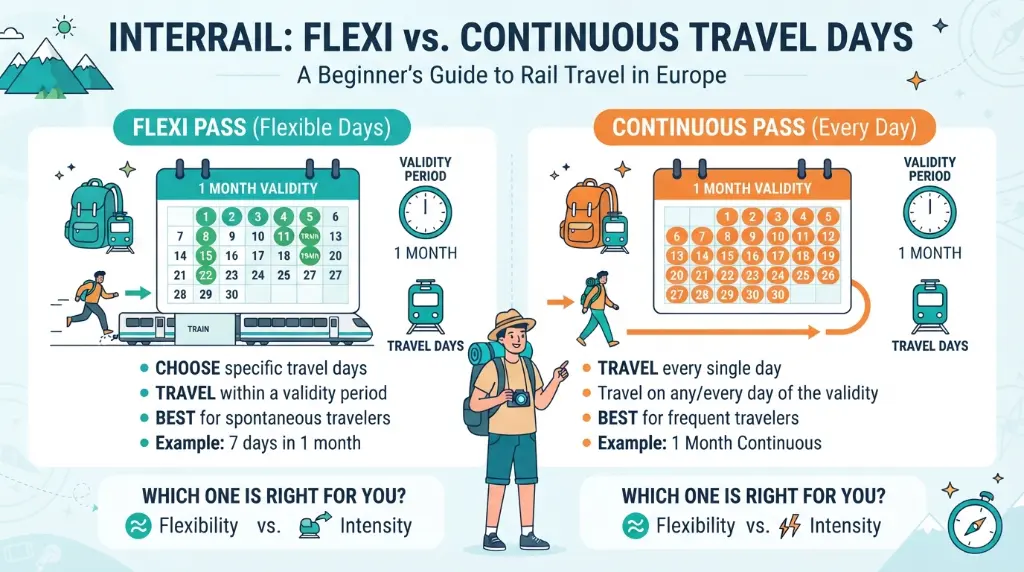
- Global Pass: Best if you are visiting 3 or more countries. You can choose a “Flexi” pass (e.g., 5 travel days within 1 month) or a “Continuous” pass (unlimited travel for 15 days, 1 month, etc.).
- One Country Pass: Best if you are spending your entire trip in just one nation (e.g., only Italy or only Spain). It’s cheaper and offers 3 to 8 travel days within a month.
💡 Pro Tip: Use the official Interrail/Eurail website’s “Pass Finder” tool to recommend the best option based on your exact dates and destinations.
Step 2: Buy and Activate Your Pass
You can choose a Mobile Pass (stored in the official Rail Planner app) or a Physical Pass (mailed to your home).
- Mobile is highly recommended for beginners. It’s impossible to lose, and you can activate it directly from your phone.
- You can buy your pass months in advance, but you only activate it on the first day you actually travel.
Step 3: Understand “Travel Days”
This is the most important concept to grasp. A Travel Day lasts from 00:00 (midnight) to 23:59 (11:59 PM).
- On a single travel day, you can take as many trains as you want.
- If you have a “5 days within 1 month” Flexi pass, you can choose any 5 days during that month to travel. On the other 25 days, your pass is “paused” and doesn’t count.
Step 4: Make Seat Reservations (When Required)
Crucial Rule: Your Interrail pass covers the base fare of the train, but it does not automatically guarantee you a seat.
- No reservation needed: Most regional trains, commuter trains, and many intercity trains in Germany, Austria, Switzerland, and the UK. You just hop on!
- Reservation mandatory: High-speed trains (French TGV, Italian Frecciarossa, Spanish AVE, Eurostar) and all night trains.
- Cost: Reservations typically cost between €3 and €40, depending on the train and country. You can book these via the Rail Planner app, national railway websites, or at the station.
Step 5: Add Your Journey and Board
- If using a Mobile Pass: Open the Rail Planner app, find your train, and tap “Add to My Trip.” Before boarding, tap “Start Travel Day” and generate your QR code.
- If using a Physical Pass: You must fill out the travel diary in pen before stepping onto the train. Write the date, departure station, arrival station, and train number.
- Boarding: Show your QR code (or physical pass + diary) and your passport/ID to the conductor.
The Golden Rule for Beginners: The “7 PM Rule”
If you plan to take a night train, you must know the 19:00 (7 PM) Rule.
If you board a direct night train that departs after 7:00 PM and arrives at its final destination after 4:00 AM the next day, you only need to write the arrival date in your travel diary.
- Example: You board a night train from Paris to Vienna at 8:00 PM on Monday and arrive at 8:00 AM on Tuesday. You only use one travel day (Tuesday), saving a valuable day on your Flexi pass!
Top 5 Tips for First-Time Interrailers
- Download the “Rail Planner” App: This is your bible. It works offline, shows real-time platform changes, indicates if a train requires a reservation, and stores your mobile pass. ا
- Embrace Regional Trains: If a high-speed train reservation is sold out or too expensive (e.g., €30), look for regional trains. They are slower but rarely require reservations, and the scenery is often much better.
- Carry Your Passport/ID Always: Your Interrail pass is not valid without an official ID. Conductors will ask to see both your pass and your passport together.
- Don’t Overpack: You will be carrying your own luggage on and off trains, up stairs, and through stations. Stick to a backpack or a lightweight carry-on suitcase.
- Activate Your Pass Before Boarding: A common beginner mistake is waiting until the conductor is standing in front of you to activate the app. Do it while you are on the platform to avoid stress (and potential fines).
What is NOT Included in an Interrail Pass?
To avoid budget surprises, remember that your pass does not cover:
- Seat/Couchette Reservations: (As mentioned above).
- Local City Transport: Trams, buses, and subways (though some cities offer minor discounts to pass holders).
- Food and Accommodation: You’ll need to budget separately for hostels, hotels, and meals.
- Supplements: A few ultra-scenic or private tourist trains (like the Glacier Express in Switzerland) require a mandatory supplement fee on top of the pass.
Frequently Asked Questions for Beginners
Q: What happens if I miss my train? A: Don’t panic! If you have a Flexi pass and haven’t activated the travel day yet, just activate it for the next train. If you already activated the day, you can usually hop on the next unreserved train heading in the same direction. If you had a mandatory reservation, you may need to buy a new reservation, but your pass itself remains valid.
Q: Can I share my Interrail pass with a friend or family member? A: No. Interrail passes are strictly personal, non-transferable, and linked to your name and passport.
Q: Do children need their own pass? A: Children aged 0–3 travel for free and don’t need a pass. Children aged 4–11 travel completely free when added to an adult’s pass (up to 2 children per adult). You just need to register them when you buy your pass.
Q: Can I get a refund if my plans change? A: Yes. If you have not yet activated your pass, you can get a full refund (minus a small 15% administrative fee) up to 11 months after purchase. Once activated, it is non-refundable.
Q: Is Interrail worth it for a short trip? A: If you are only visiting 1 or 2 cities over 3–4 days, buying individual point-to-point tickets in advance is usually cheaper. Interrail shines when you are visiting 3+ cities or traveling for 7+ days.
Ready to Start Your First Interrail Adventure?
An Interrail pass is more than just a ticket; it’s a passport to freedom, spontaneity, and some of the most beautiful landscapes in the world. By understanding how travel days work, booking reservations in advance, and using the Rail Planner app, your first European rail journey will be smooth, stress-free, and absolutely unforgettable.
Your Next Steps:
- Sketch out your dream itinerary.
- Use the Interrail Price Guide to calculate your budget.
- Purchase your pass and download the Rail Planner app.
- Pack your bags and get ready to explore Europe by rail!