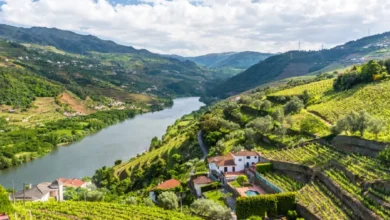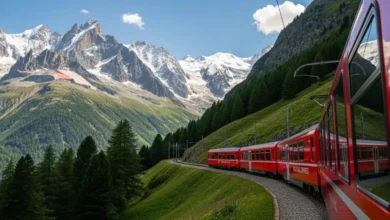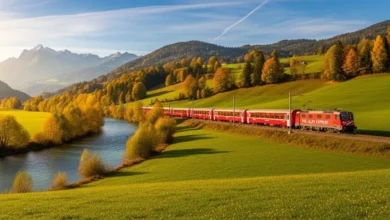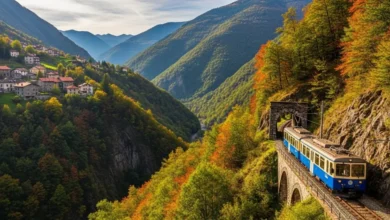
Switzerland is synonymous with breathtaking landscapes, and there is no better way to experience its dramatic alpine scenery than from the window of a train. From glacier-covered peaks to turquoise lakes, from charming villages to engineering marvels, Swiss scenic trains offer an unforgettable journey through some of the world’s most spectacular landscapes.
Whether you’re planning a luxury getaway or a budget-friendly adventure, this comprehensive 2026 guide will walk you through the most beautiful train rides in Switzerland, including practical tips on booking, pricing, and the best times to travel.
Why Travel by Train in Switzerland?
Switzerland’s railway network is legendary for its punctuality, cleanliness, and efficiency. But beyond practicality, Swiss trains offer something truly special: panoramic windows that turn every journey into a visual feast.
The Swiss Travel System is one of the densest in the world, with trains climbing steep mountain gradients, crossing viaducts suspended over deep gorges, and tunneling through the heart of the Alps. For travelers, this means you can witness UNESCO World Heritage landscapes without ever leaving the comfort of your seat.
Plus, train travel in Switzerland is eco-friendly, allowing you to explore with a minimal carbon footprint – a value that resonates with modern travelers.
1. The Glacier Express: The Slowest Express Train in the World
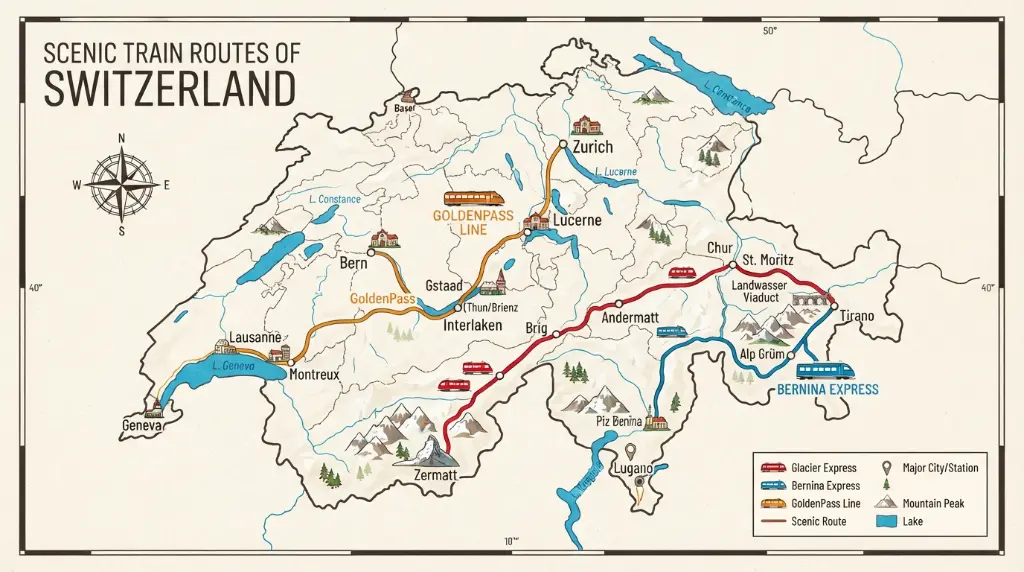
Route: Zermatt – St. Moritz (or Davos)
Duration: Approximately 8 hours
Distance: 291 kilometers (181 miles)
Overview
The Glacier Express is Switzerland’s most famous panoramic train, connecting two of the country’s premier ski resorts: Zermatt (home of the Matterhorn) and St. Moritz. Despite its name, this is not a high-speed train – it’s deliberately slow, averaging just 30 km/h, allowing passengers to fully absorb the stunning alpine vistas.
Route Highlights
- The Matterhorn: Depart from the shadow of Switzerland’s most iconic peak.
- Oberalp Pass: Cross the highest point of the journey at 2,033 meters (6,670 ft).
- Rhone Gorge: Often called the “Swiss Grand Canyon,” this dramatic gorge features turquoise waters carved through white rock.
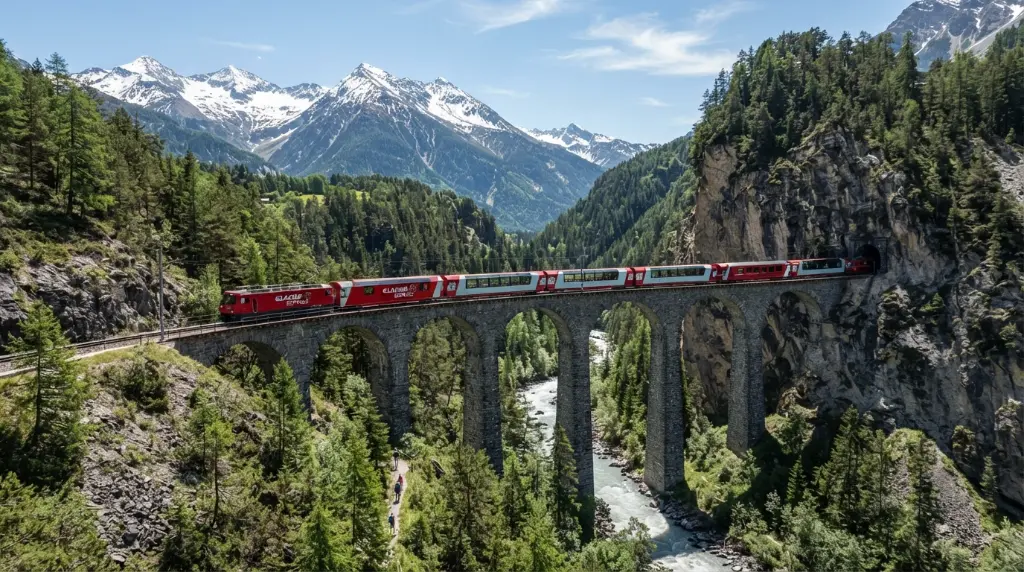
- Landwasser Viaduct: A spectacular six-arch limestone viaduct that leads directly into a tunnel – one of the most photographed railway structures in the world.
- Alpine Meadows: Pass through traditional Swiss villages with wooden chalets and grazing cows.
Train Features
- Panoramic Windows: Floor-to-ceiling windows offer unobstructed views.
- Gourmet Dining: A la carte menu served at your seat (reservation required).
- Audio Guide: Available in 8 languages via your smartphone.
Pricing (2026)
- Train Ticket: Covered by Swiss Travel Pass or Interrail/Eurail Pass (seat reservation mandatory).
- Seat Reservation: CHF 33-52 (depending on season).
- Full Fare (without pass): Approximately CHF 150-200 for second class.
Best Time to Travel
- Summer (June-September): Lush green landscapes, wildflowers, and clear mountain views.
- Winter (December-March): Snow-covered peaks and a magical winter wonderland atmosphere.
💡 Pro Tip: Book your Glacier Express reservation at least 2-3 months in advance, especially for summer travel. Window seats on the right side (facing forward from Zermatt) offer slightly better views of the Rhone Gorge.
2. The Bernina Express: A UNESCO World Heritage Journey
Route: Chur – Tirano (Italy)
Duration: 4 hours
Distance: 122 kilometers (76 miles)
Overview
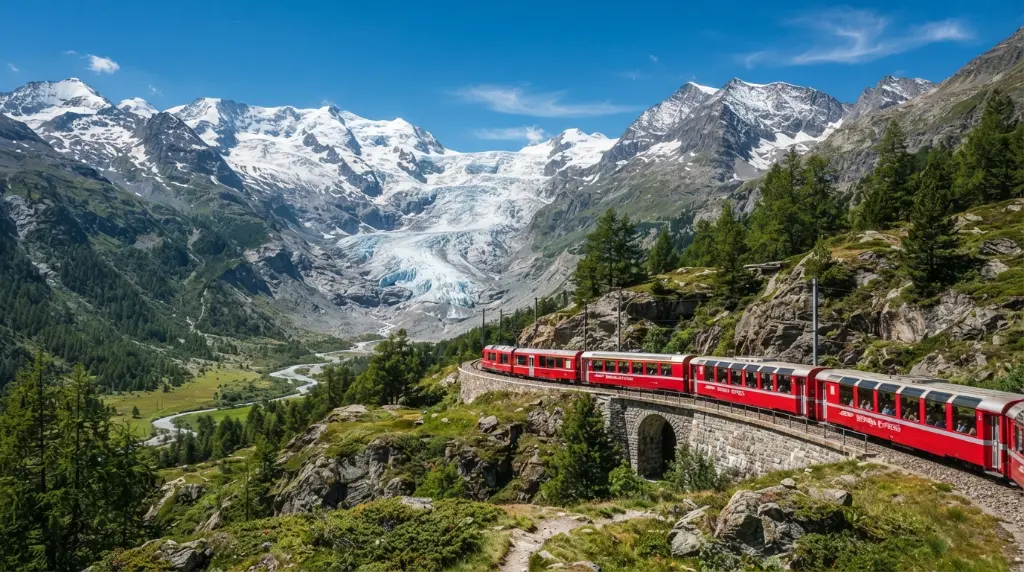
The Bernina Express is not just a train ride; it’s a journey through history and engineering excellence. This route is part of the Rhaetian Railway, a UNESCO World Heritage site, and it crosses the Bernina Pass without the use of rack-and-pinion gears – a remarkable feat of railway engineering.
Route Highlights
- Landwasser Viaduct: The train’s dramatic entrance onto this curved viaduct is a highlight.
- Bernina Pass: At 2,253 meters (7,392 ft), this is the highest railway crossing in the Alps.
- Morteratsch Glacier: View the longest glacier in the Eastern Alps.
- Lago Bianco & Lago Nero: Stunning alpine lakes with contrasting colors.
- Brusio Circular Viaduct: A spiral viaduct that allows the train to gain elevation in a tight space – a photographer’s dream.
- Tirano, Italy: The journey ends in Italy, allowing you to combine Swiss and Italian travel.
Train Features
- Panoramic Cars: Large windows that extend into the roof for 360-degree views.
- No Air Conditioning: Windows can be opened for fresh mountain air and photography.
- Audio Commentary: Available via app.
Pricing (2026)
- Train Ticket: Covered by Swiss Travel Pass (to the Swiss border) or Interrail/Eurail Pass.
- Seat Reservation: CHF 26 (mandatory for panoramic cars).
- Regular Regional Train: You can travel the same route on regular Rhaetian Railway trains without a reservation for free with a pass!
Best Time to Travel
- Summer: Best for hiking connections and clear views.
- Autumn: Stunning fall colors in the valleys.
- Winter: Spectacular snow scenery, though some sections may be affected by weather.
- Insider Secret: If you want the Bernina Express experience without the reservation fee, take the regular regional trains (R) that run on the same route. They use the same tracks, stop at the same stations, and offer nearly identical views – you just won’t have the panoramic windows or the “Express” branding.*
3. The GoldenPass Line: From Lakes to Mountains
Route: Lucerne – Interlaken – Zweisimmen – Montreux
Duration: 5-6 hours (can be broken into segments)
Distance: Approximately 240 kilometers (149 miles)
Overview
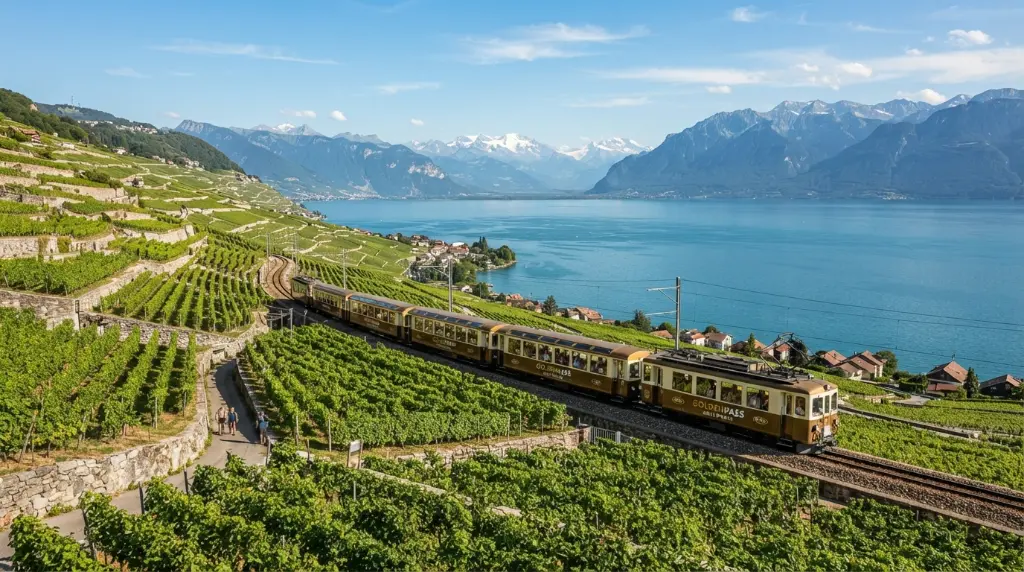
The GoldenPass Line is not a single train but a scenic route connecting central Switzerland to the French-speaking Lake Geneva region. This journey showcases the incredible diversity of Swiss landscapes: from the pristine lakes of Lucerne and Thun to the dramatic peaks of the Bernese Oberland and the vineyards of the Lavaux region.
Route Highlights
- Lake Lucerne: Depart from one of Switzerland’s most beautiful lakes.
- Brünig Pass: Cross this mountain pass with stunning views.
- Interlaken: Stop in this charming town nestled between two lakes.
- Spiez: A picturesque castle town on Lake Thun.
- Gstaad: Famous resort town known for its luxury and celebrity visitors.
- Lavaux Vineyards: A UNESCO World Heritage site with terraced vineyards overlooking Lake Geneva.
- Montreux: End your journey in this elegant lakeside town, home to the famous Montreux Jazz Festival.
Train Features
- GoldenPass Panoramic: Modern trains with large windows.
- GoldenPass Classic: Nostalgic Belle Époque trains on certain segments.
- VIP Seats: Some trains offer seats with elevated positioning for even better views.
Pricing (2026)
- Train Ticket: Fully covered by Swiss Travel Pass or Interrail/Eurail Pass.
- Seat Reservation: Optional, CHF 10-20 (recommended for VIP seats).
- Full Fare: Approximately CHF 100-120 for the entire route.
Best Time to Travel
- Late Spring (May-June): Wildflowers bloom, and the weather is mild.
- Autumn (September-October): The Lavaux vineyards turn golden, and the air is crisp.
💡 Pro Tip: You don’t have to do the entire GoldenPass Line in one day. Break it into segments: spend a night in Interlaken or Gstaad to fully enjoy these beautiful destinations.
4. The Gotthard Panorama Express: History and Engineering
Route: Lucerne – Lugano
Duration: 5.5 hours (train + boat combination)
Distance: Approximately 180 kilometers (112 miles)
Overview
The Gotthard Panorama Express combines a scenic boat cruise on Lake Lucerne with a historic train journey through the Gotthard region. This route celebrates the opening of the Gotthard Base Tunnel and showcases the original mountain route that has been in use since 1882.
Route Highlights
- Lake Lucerne Cruise: Start your journey with a relaxing boat ride.
- Gotthard Tunnel: Travel through the original 15-kilometer tunnel.
- Spiral Tunnels: Experience the engineering marvel of spiral tunnels that allow the train to gain elevation.
- Monte Ceneri Pass: Cross into the Italian-speaking region of Switzerland.
- Lugano: Arrive in this Mediterranean-style city with palm trees and Italian flair.
Train Features
- Panoramic Cars: Large windows for optimal viewing.
- Historic Significance: Travel on one of the world’s oldest mountain railway routes.
Pricing (2026)
- Train + Boat Ticket: Covered by Swiss Travel Pass (seat reservation recommended).
- Seat Reservation: CHF 18 (mandatory for panoramic cars).
- Full Fare: Approximately CHF 120 for the complete journey.
Best Time to Travel
- May to October: The boat portion operates seasonally, so plan accordingly.
5. The Jungfrau Railway: Top of Europe
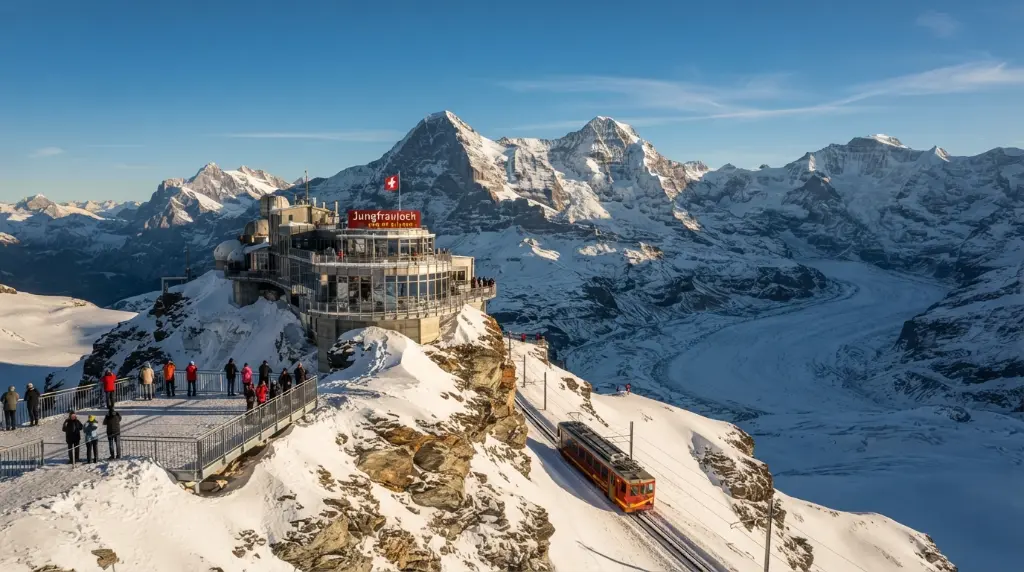
Route: Interlaken Ost – Kleine Scheidegg – Jungfraujoch
Duration: 2.5 hours (one way)
Elevation: Up to 3,454 meters (11,332 ft)
Overview
The Jungfrau Railway takes you to the Jungfraujoch – Top of Europe, the highest railway station in Europe. This is not just a scenic train ride; it’s an expedition to the heart of the Swiss Alps, where you can walk on glaciers year-round.
Route Highlights
- Lauterbrunnen Valley: Pass through this valley of 72 waterfalls.
- Grindelwald: Charming alpine village with views of the Eiger.
- Eiger North Face: See the legendary north face of the Eiger up close.
- Ice Palace: Explore ice sculptures carved into the glacier.
- Sphinx Observatory: Enjoy panoramic views from one of the highest observation decks in Europe.
- Aletsch Glacier: View the largest glacier in the Alps (UNESCO World Heritage).
Train Features
- Cogwheel Railway: Specially designed for steep mountain gradients.
- Modern Carriages: Comfortable seating with heating.
Pricing (2026)
- Full Fare: Approximately CHF 210-230 (round trip from Interlaken).
- With Swiss Travel Pass: 25% discount to Eigergletscher, then 50% discount from there to Jungfraujoch.
- With Interrail/Eurail: Same discount structure as Swiss Travel Pass.
💡 Budget Tip: The Jungfraujoch is expensive. If you’re on a budget, consider traveling only to Kleine Scheidegg or Eigergletscher, where you still get spectacular Eiger views at a fraction of the cost.
Best Time to Travel
- June to September: Best weather and clearest views.
- Winter: Magical snow scenery, but check weather conditions as the railway may close due to extreme weather.
6. The Chocolate Train: A Sweet Journey
Route: Montreux – Gruyères – Broc (Chocolatier)
Duration: Full day (approximately 9 hours)
Availability: Seasonal (May to October)
Overview
The Chocolate Train is a special tourist train that combines scenic travel with Swiss culinary delights. This seasonal train takes you from Montreux to the medieval village of Gruyères and the Cailler-Nestlé chocolate factory in Broc.
Experience Highlights
- Belle Époque Carriages: Travel in vintage-style panoramic cars.
- Gruyères Castle: Visit this perfectly preserved medieval castle.
- Cheese Tasting: Sample authentic Gruyère cheese.
- Cailler Chocolate Factory: Tour one of Switzerland’s oldest chocolate manufacturers and enjoy unlimited chocolate tasting.
Pricing (2026)
- Full Package: Approximately CHF 150-180 (includes train, castle entrance, cheese tasting, chocolate factory tour, and lunch).
- Reservation: Mandatory, book well in advance.
Best Time to Travel
- May to October: This is a seasonal train that operates only during warmer months.
Swiss Travel Pass vs. Point-to-Point Tickets
Swiss Travel Pass
If you plan to take multiple scenic trains, the Swiss Travel Pass is almost always worth it.
Benefits:
- Unlimited travel on trains, buses, and boats
- Free entry to over 500 museums
- Covers most scenic trains (reservation fees still apply)
- Discounts on mountain railways (Jungfrau, Gornergrat, etc.)
Pricing (2026):
- 3 days: CHF 232 (second class)
- 4 days: CHF 281
- 8 days: CHF 418
- 15 days: CHF 513
Interrail / Eurail Pass
For non-Swiss residents, the Interrail Global Pass (European residents) or Eurail Global Pass (non-European residents) offers excellent value.
Important: While the pass covers train travel, seat reservations are still mandatory and cost extra for most scenic trains (Glacier Express: CHF 33-52, Bernina Express: CHF 26, etc.).
Best Time to Travel on Swiss Scenic Trains
Summer (June – August)
Pros:
- Long daylight hours (sunset after 9 PM)
- All routes and mountain railways fully operational
- Lush green landscapes and wildflowers
- Best weather for photography
Cons:
- Peak tourist season (crowded trains)
- Higher prices for accommodation
- Need to book reservations months in advance
Autumn (September – November)
Pros:
- Fewer crowds
- Beautiful fall colors, especially in vineyards and valleys
- Mild weather
- Better availability for reservations
Cons:
- Some mountain routes may close in late October/November
- Shorter daylight hours
Winter (December – March)
Pros:
- Magical snow-covered landscapes
- Christmas markets in December
- Best for ski resort connections
- Unique winter photography opportunities
Cons:
- Weather disruptions possible
- Some routes operate on reduced schedules
- Cold temperatures at high altitudes
Spring (April – May)
Pros:
- Blooming flowers
- Fewer tourists
- Lower prices
Cons:
- Unpredictable weather
- Some high-altitude routes may still be closed
- “Mud season” in some areas
Practical Tips for Swiss Scenic Train Travel
1. Book Reservations Early
Scenic trains, especially the Glacier Express and Bernina Express, sell out months in advance. Book your seat reservations as soon as your travel dates are confirmed.
2. Choose the Right Side
- Glacier Express (Zermatt to St. Moritz): Right side for best Rhone Gorge views
- Bernina Express (Chur to Tirano): Right side for best glacier views
- GoldenPass (Lucerne to Montreux): Right side for lake views
3. Pack Smart
- Layers: Mountain weather changes quickly
- Sunscreen: UV radiation is stronger at high altitudes
- Camera: With extra batteries (cold drains batteries faster)
- Snacks and Water: While dining cars exist, they’re expensive
- Power Bank: For charging devices (outlets may be limited)
4. Photography Tips
- Sit on the correct side (see above)
- Clean your window before taking photos
- Use a polarizing filter to reduce reflections
- Shoot in RAW format for better post-processing
- Be patient: Wait for the train to slow down on curves for the best shots
5. Budget Wisely
Scenic train travel in Switzerland can be expensive. Here’s how to save:
- Get a Swiss Travel Pass or Interrail/Eurail Pass
- Travel in shoulder season (May, September, October)
- Take regular regional trains instead of “Express” branded trains (same route, same views, no reservation fee)
- Pack your own lunch and snacks
- Consider half-day journeys instead of full-day epics
Frequently Asked Questions (FAQ)
Q: Do I need a reservation for Swiss scenic trains?
A: Yes, for most panoramic trains like the Glacier Express, Bernina Express, and GoldenPass, reservations are mandatory. For regular regional trains on the same routes, no reservation is needed.
Q: Are Swiss scenic trains covered by Interrail/Eurail Pass?
A: Yes, the train travel is covered, but you must still pay for mandatory seat reservations (typically CHF 20-50).
Q: What is the most beautiful train ride in Switzerland?
A: This is subjective, but the Bernina Express and Glacier Express are consistently rated as the most spectacular due to their UNESCO World Heritage status and dramatic alpine scenery.
Q: Can I do multiple scenic trains in one day?
A: It’s possible but not recommended. These trains are meant to be savored. Instead, break your journey into segments and spend time exploring the destinations.
Q: Are Swiss trains wheelchair accessible?
A: Most modern trains are accessible, but some historic mountain railways are not. Check the official SBB website for specific accessibility information.
Q: What should I wear on a Swiss scenic train?
A: Dress in layers. Even in summer, temperatures at high altitudes can be cool. Comfortable shoes are recommended if you plan to get off at intermediate stations.
Q: Is there Wi-Fi on Swiss scenic trains?
A: Most panoramic trains do not have Wi-Fi. Regular Swiss trains usually have free Wi-Fi, but scenic trains prioritize views over connectivity. Download entertainment before boarding.
Q: Can I bring luggage on scenic trains?
A: Yes, but space is limited. Large suitcases can be stored at the ends of carriages. Consider traveling light or using the Swiss luggage forwarding service.
Q: Are children allowed on scenic trains?
A: Absolutely! Children under 16 travel free with a Swiss Family Card when accompanied by at least one parent. This is a fantastic deal for families.
Final Thoughts
Switzerland’s scenic trains are more than just transportation – they are an essential part of the Swiss travel experience. Whether you’re crossing glaciers on the Jungfrau Railway, winding through UNESCO World Heritage landscapes on the Bernina Express, or enjoying the slow-paced luxury of the Glacier Express, these journeys create memories that last a lifetime.
The key to enjoying Swiss scenic trains is planning ahead, choosing the right pass for your needs, and allowing yourself time to savor the views. Remember, the journey is the destination.
Have you traveled on any of Switzerland’s scenic trains? Share your favorite route, tips, or photos in the comments below!