You’ve planned the perfect European rail itinerary. You’ve secured your travel insurance. But there is one hidden trap that can silently drain 3% to 7% from your travel budget before you even board the train: foreign transaction fees and dynamic currency conversion (DCC).
Whether you are buying a last-minute regional ticket at a kiosk in Germany or booking a premium sleeper on the ÖBB Nightjet online, how you pay matters just as much as what you pay.
This 2026 guide reveals the best credit cards, digital wallets, and money-saving tricks to ensure every euro you spend goes toward your adventure, not toward bank fees.
The Hidden Cost of “Foreign Transaction Fees”
If you use a standard debit or credit card issued in the US, UK, or outside the Eurozone, your bank likely charges a Foreign Transaction Fee (FTF). This is typically 2% to 3% of every purchase made in a foreign currency.
Let’s do the math for a typical 2-week European train trip:
- High-speed train tickets (TGV, AVE, ICE): €400
- Night train sleeper supplements: €150
- Last-minute regional tickets & luggage storage: €100
- Total spent: €650
With a 3% FTF, you are throwing away €19.50 for absolutely no added value. Over a longer trip or a family vacation, this easily scales to €50–€100+ in wasted money.
The Best Credit Cards & Digital Wallets for European Train Travel (2026)
To travel smart, you need financial tools built for the road. Here are the top contenders for fee-free European travel:
1. Revolut (Premium or Standard)
Revolut has become the gold standard for European travelers.
- Why it works: Offers fee-free spending in 150+ currencies at the real interbank exchange rate (up to a monthly limit on the free plan, unlimited on Premium/Metal).
- Best for: Withdrawing cash from European train station ATMs and paying for tickets online without hidden markups.
- Bonus: Higher-tier plans include built-in travel insurance and airport lounge access.
2. Wise (Formerly TransferWise) Card
Wise is famous for its transparency.
- Why it works: It always uses the mid-market exchange rate with a tiny, upfront conversion fee (usually around 0.4%). There are zero hidden markups.
- Best for: Travelers who want to hold multiple currencies (EUR, GBP, CHF) in one app and spend seamlessly across different European countries.
3. Travel-Friendly Credit Cards (No FTF)
If you prefer traditional credit cards to build points or miles, ensure your card explicitly states “0% Foreign Transaction Fees”.
- US Travelers: Chase Sapphire Preferred, Capital One Venture.
- UK Travelers: Barclaycard Rewards, Starling Bank, Monzo.
- Why it works: You get the purchase protection and rewards points of a credit card, without the 3% penalty for spending abroad.
How to Avoid the “Dynamic Currency Conversion” (DCC) Trap
This is the most common mistake travelers make at European train stations.
When you insert your card into a ticket machine (e.g., at Paris Gare de Lyon or Berlin Hbf), the screen might ask: “Do you want to be charged in EUR or your home currency (e.g., USD/GBP/PLN)?”
ALWAYS CHOOSE THE LOCAL CURRENCY (EUR, CHF, GBP, etc.).
If you choose your home currency, the machine’s payment processor (not your bank) will do the conversion. This is called Dynamic Currency Conversion (DCC), and it includes a massive hidden markup of 5% to 7%. By choosing the local currency, you let your own fee-free bank handle the conversion at a fair rate.
Pro Tips for Buying Train Tickets in Europe
- Book Direct with Operators: Use the official apps (DB Navigator for Germany, SNCF Connect for France, Trenitalia for Italy). They often have the best prices and accept international cards without issue. Third-party sites sometimes add booking fees or have clunky payment gateways that trigger bank fraud alerts.
- Notify Your Bank: Before you leave, use your banking app to set a “Travel Notice.” This prevents your card from being frozen for “suspicious activity” when you suddenly buy a ticket in another country.
- Have a Backup Payment Method: Never rely on just one card. Keep a physical backup card in a separate place (like your luggage) in case your primary card is lost, stolen, or swallowed by an ATM.
- Use Contactless for Regional Trains: In cities like London (TfL), Amsterdam, and parts of Germany, you can now tap your contactless credit card or phone directly at the station gates to pay for regional travel, often at the best local fare.
Frequently Asked Questions (FAQ)
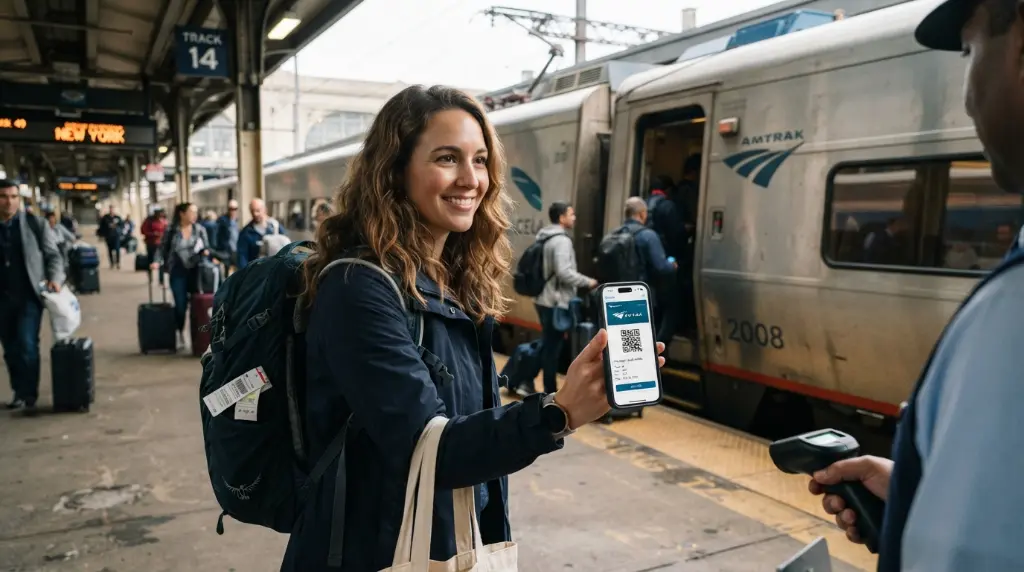
Q: Can I use Apple Pay or Google Pay to buy train tickets in Europe? A: Yes, absolutely. Most major European railway operators (SNCF, DB, ÖBB, Trenitalia) and their ticket machines fully support contactless payments via Apple Pay and Google Pay. It is often faster and more secure than inserting a physical card.
Q: Are there ATMs at European train stations, and are they safe to use? A: Yes, major stations have ATMs. However, avoid independent ATMs (like “Euronet”) which charge exorbitant withdrawal fees. Always use ATMs attached to actual, recognized banks (e.g., Deutsche Bank, BNP Paribas, Santander).
Q: What happens if my card gets declined while trying to book a Nightjet ticket online? A: This is usually a false fraud alert. Your bank sees a foreign transaction and blocks it. Call the number on the back of your card to authorize the charge, or try using a digital wallet like Revolut or Wise, which are less likely to be flagged.
Q: Do I need cash for European trains? A: For 95% of train travel in Western and Central Europe, no. Tickets, luggage storage, and even station cafes accept cards. However, it is wise to carry €50 in small bills for emergencies, small regional stations, or tipping.
Final Thoughts: Keep Your Budget on Track
Paying for European trains shouldn’t be a financial headache. By equipping yourself with a no-foreign-transaction-fee card, using digital wallets wisely, and always choosing the local currency at the terminal, you keep your travel budget exactly where it belongs: funding your next adventure.
Now that your finances are sorted, make sure your belongings are safe, too. Check out our guide on The Ultimate European Train Travel Checklist 2026: Insurance & Essential Gear to complete your pre-trip preparation.